ERP for chemical manufacturing in India
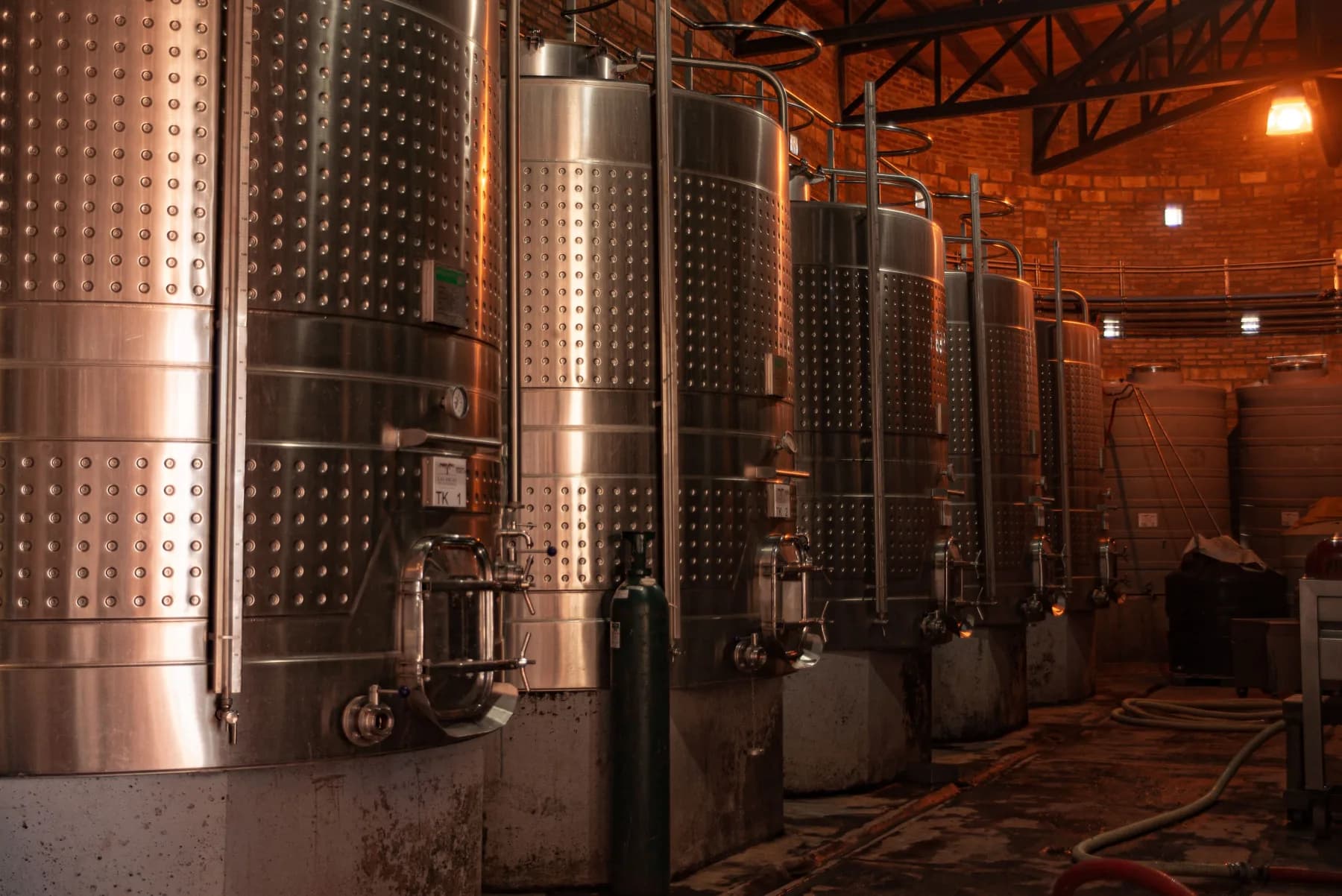
We used Crator to build a working chemical batch manufacturing reference on ERPNext. One synthetic, non-hazard-specific aqueous batch follows an approved formula revision and ingredient lots through manufacture, yield, quality release, delivery and margin. A second batch proves the substitution and quality-hold controls. The screens below come from the installed ERP, not a design mockup.
Why chemical manufacturing software has to preserve the batch record
The commercial order is only the start. A useful chemical manufacturing ERP must explain which approved revision was used, which ingredient lots entered the vessel, what quantity emerged, why any substitution was allowed, who made the quality decision and whether the finished batch was released or held.
The formula revision is the production basis
A batch must point to one approved version before planned quantities can be scaled.
Ingredient lots carry the material history
Planned and actual quantities only mean something when the supplier or internal lot remains linked.
A substitution is a separate decision
The system can record scope and approval without claiming chemical equivalence or safety.
Quality stays open until release
A failed result must keep the finished batch away from saleable stock and customer documents.
Formula control
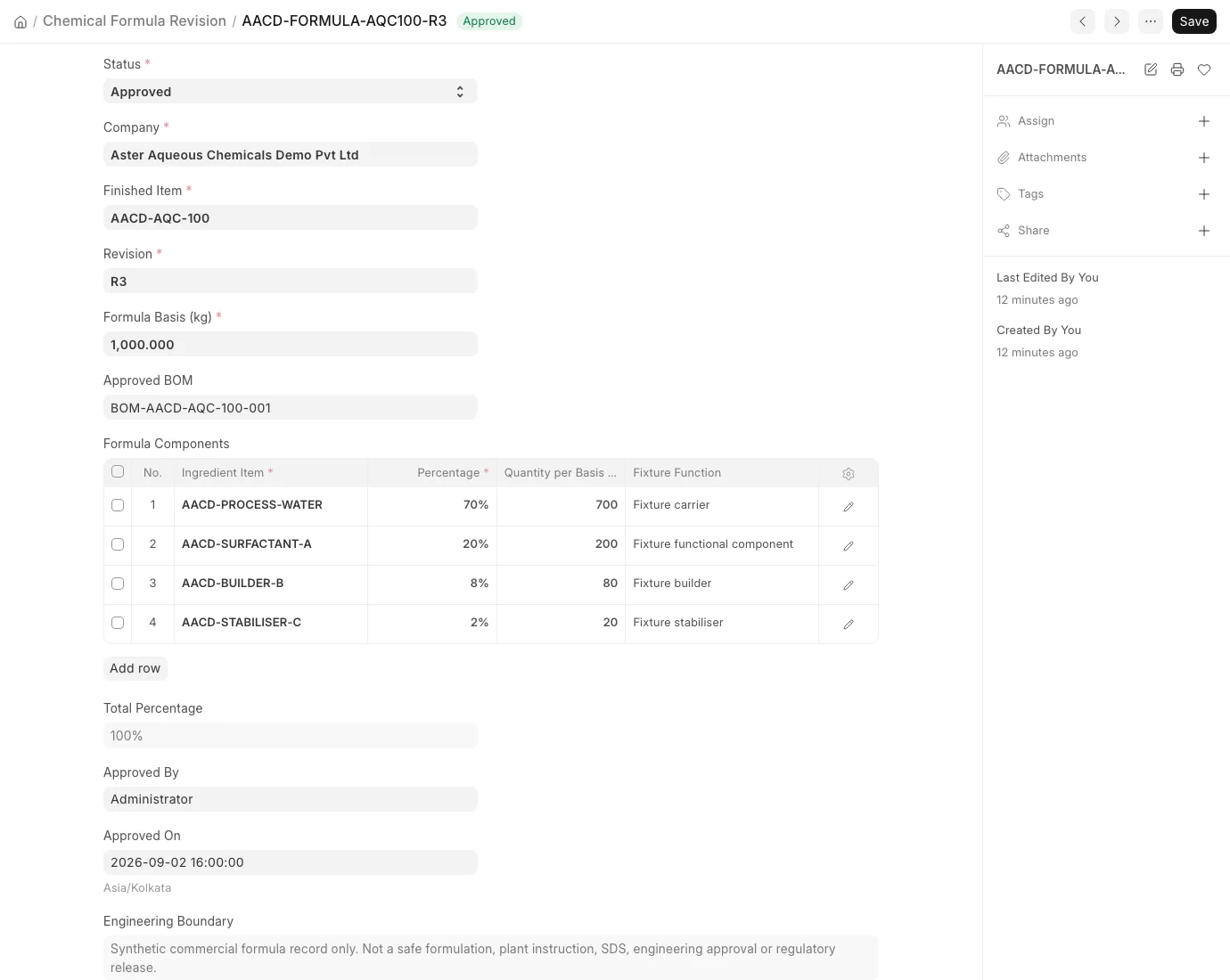
One approved revision scales into the planned batch
The reference formula uses an invented 1,000 kg basis for a non-hazard-specific aqueous process concentrate. Its four component rows total 100 percent and link to an ERPNext BOM. The production batch scales that basis to its target quantity and stores the actual lot and quantity consumed for each ingredient.
ERPNext documents the standard Bill of Materials as the manufacturing recipe record. Crator adds an explicit approved revision and testable lock for this industry reference. The numbers are software fixtures, not a usable formulation.
Lot trace and yield
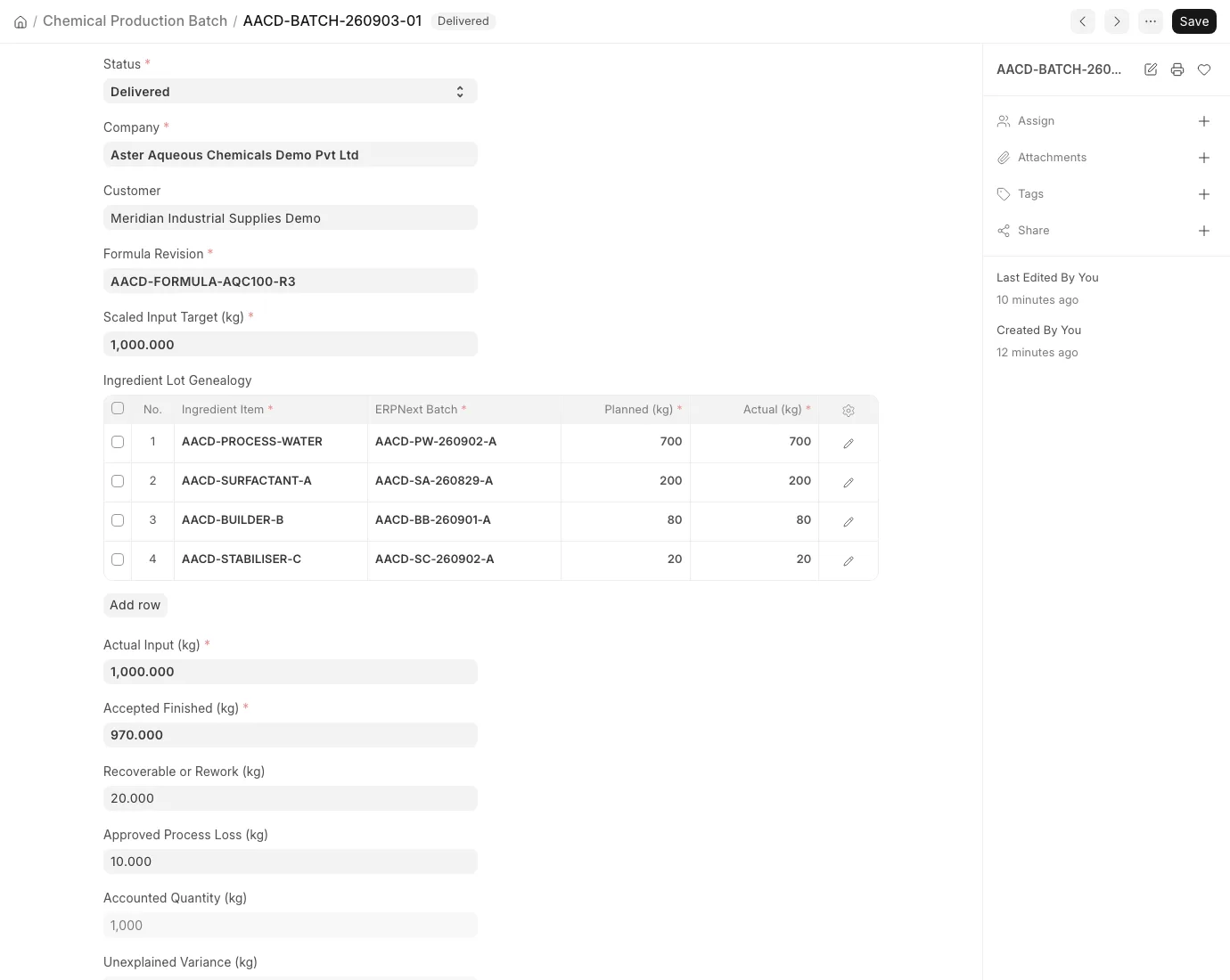
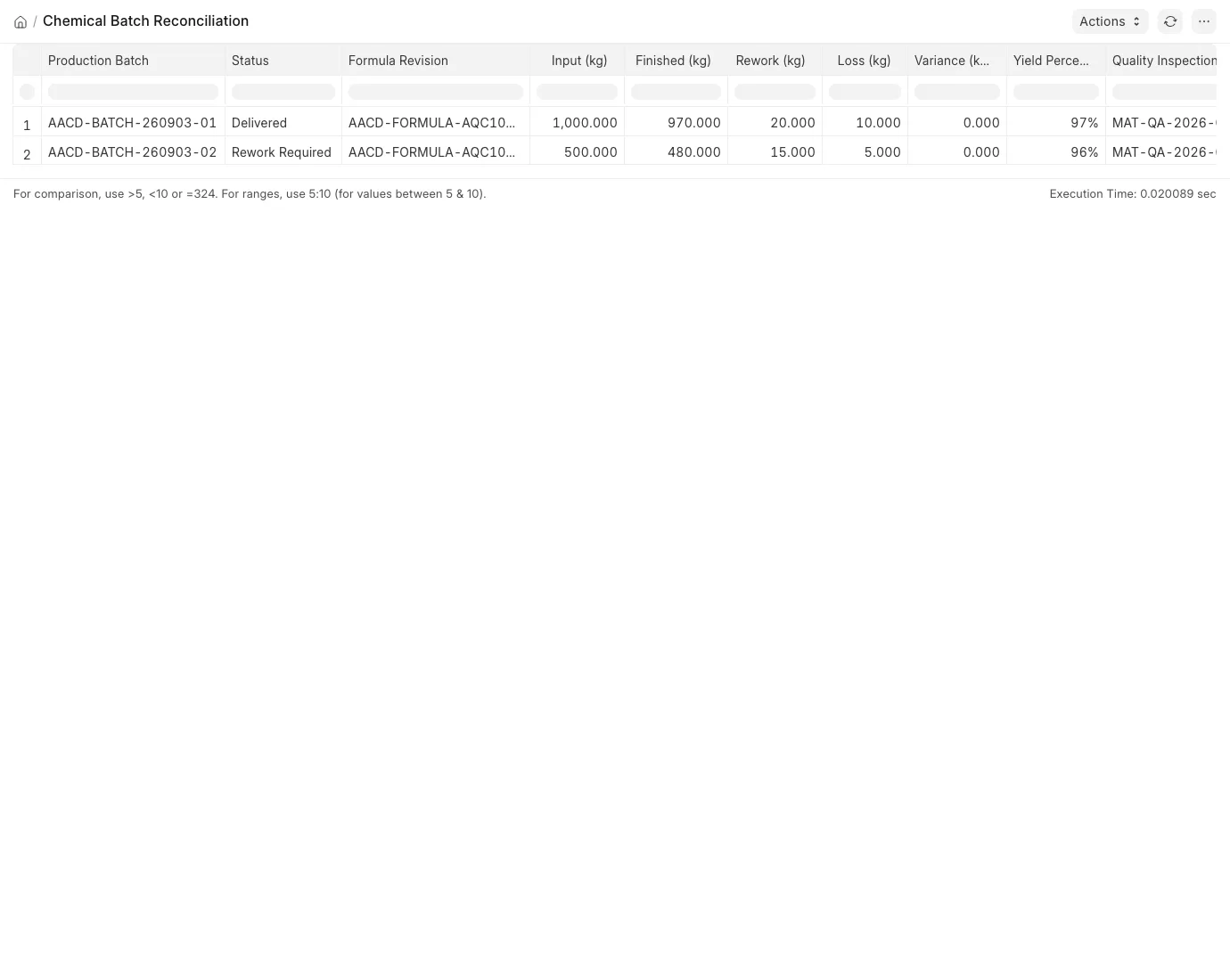
The completed batch reconciles 1,000 kg without hiding recovery or loss
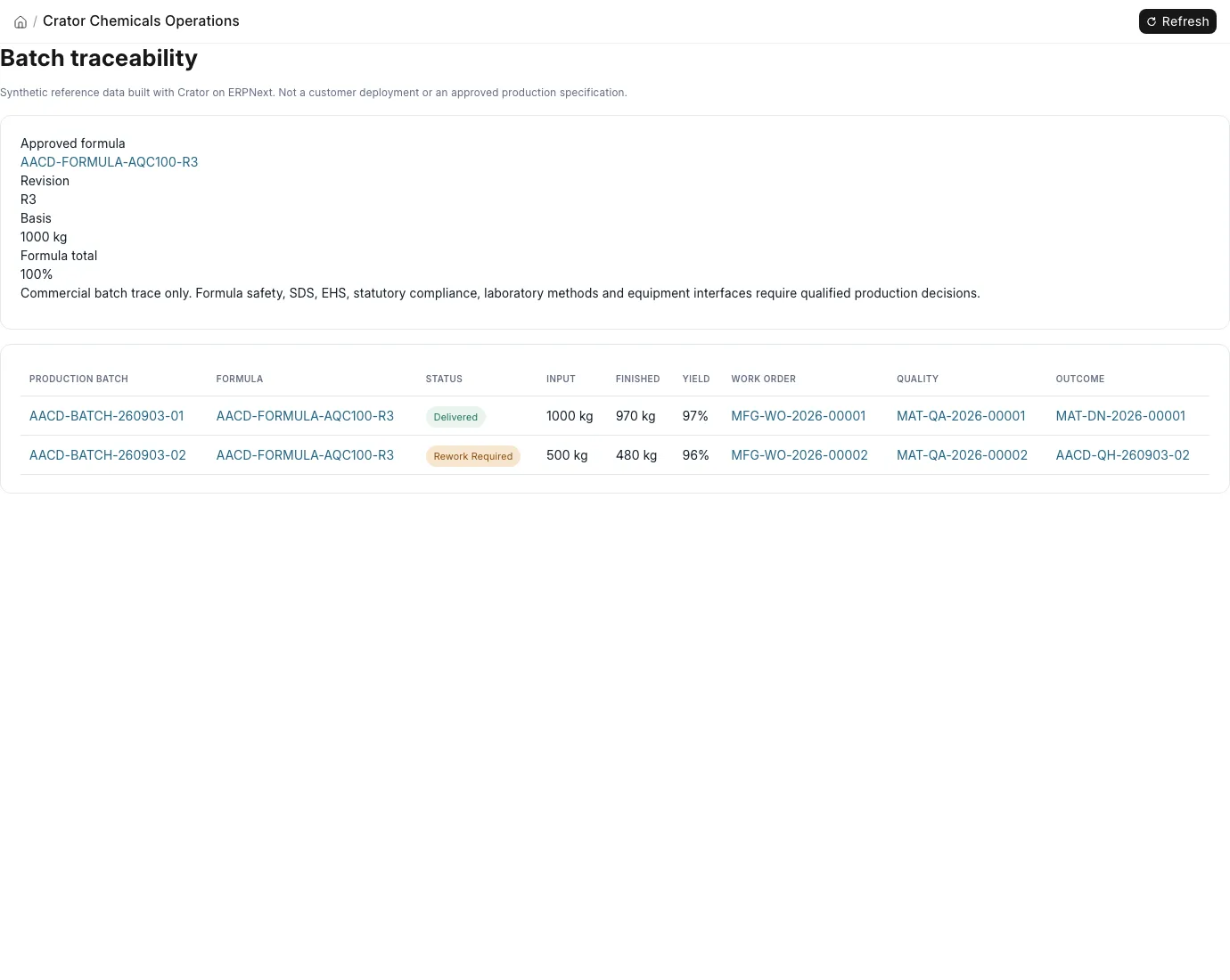
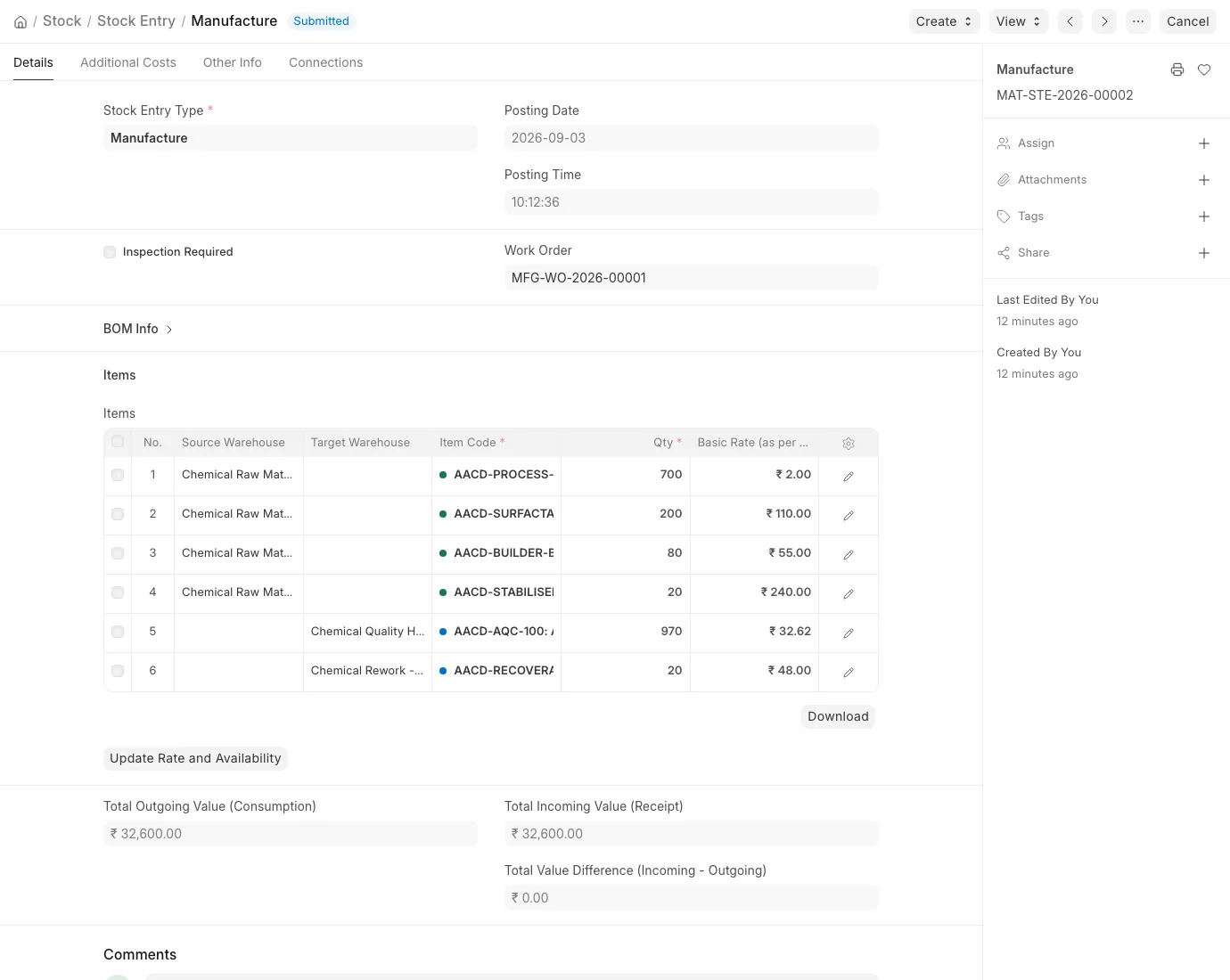
Four ingredient lots contribute 1,000 kg. The completed record accepts 970 kg as finished product, identifies 20 kg as recoverable material and records 10 kg as approved process loss. That leaves zero unexplained variance and a 97 percent finished yield.
The production record links to submitted ERPNext Work Order, Manufacture Stock Entry, Quality Inspection, finished-goods Batch, saleable transfer, Delivery Note and Sales Invoice documents. Those links are the proof trail behind the summary.
Controlled exception
An authorised substitute does not bypass finished-batch quality
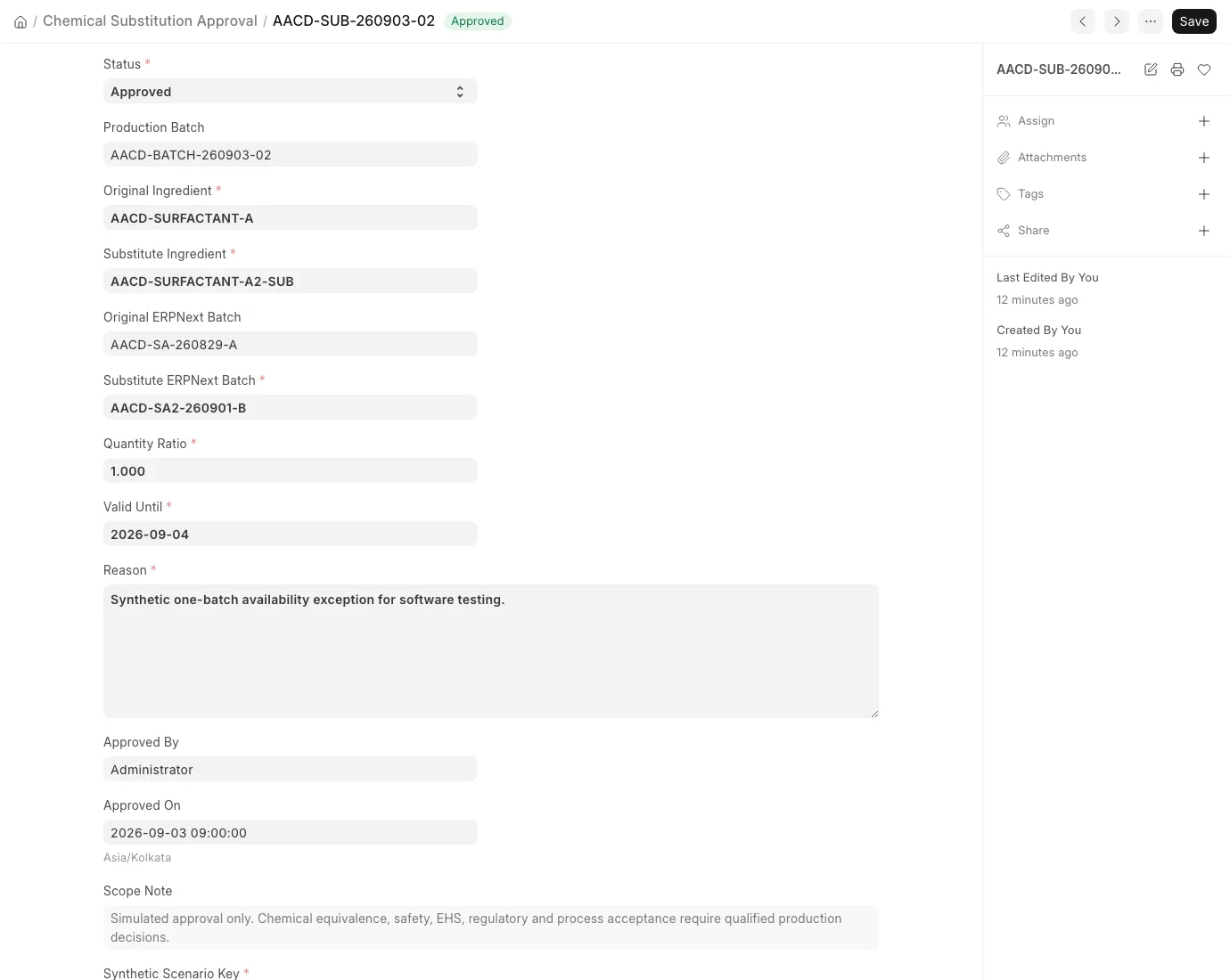
The second synthetic batch records a substitute surfactant lot through a separate approval. It names the original and substitute materials, both batch identities, quantity, validity, approver, reason and a scope note that says the record is simulated.
That approval is not a statement of chemical compatibility, worker safety or regulatory acceptance. It only proves that the ERP can keep the material exception explicit and attributable before qualified owners make the real production decision.
Quality hold and rework
A failed result stops saleable release
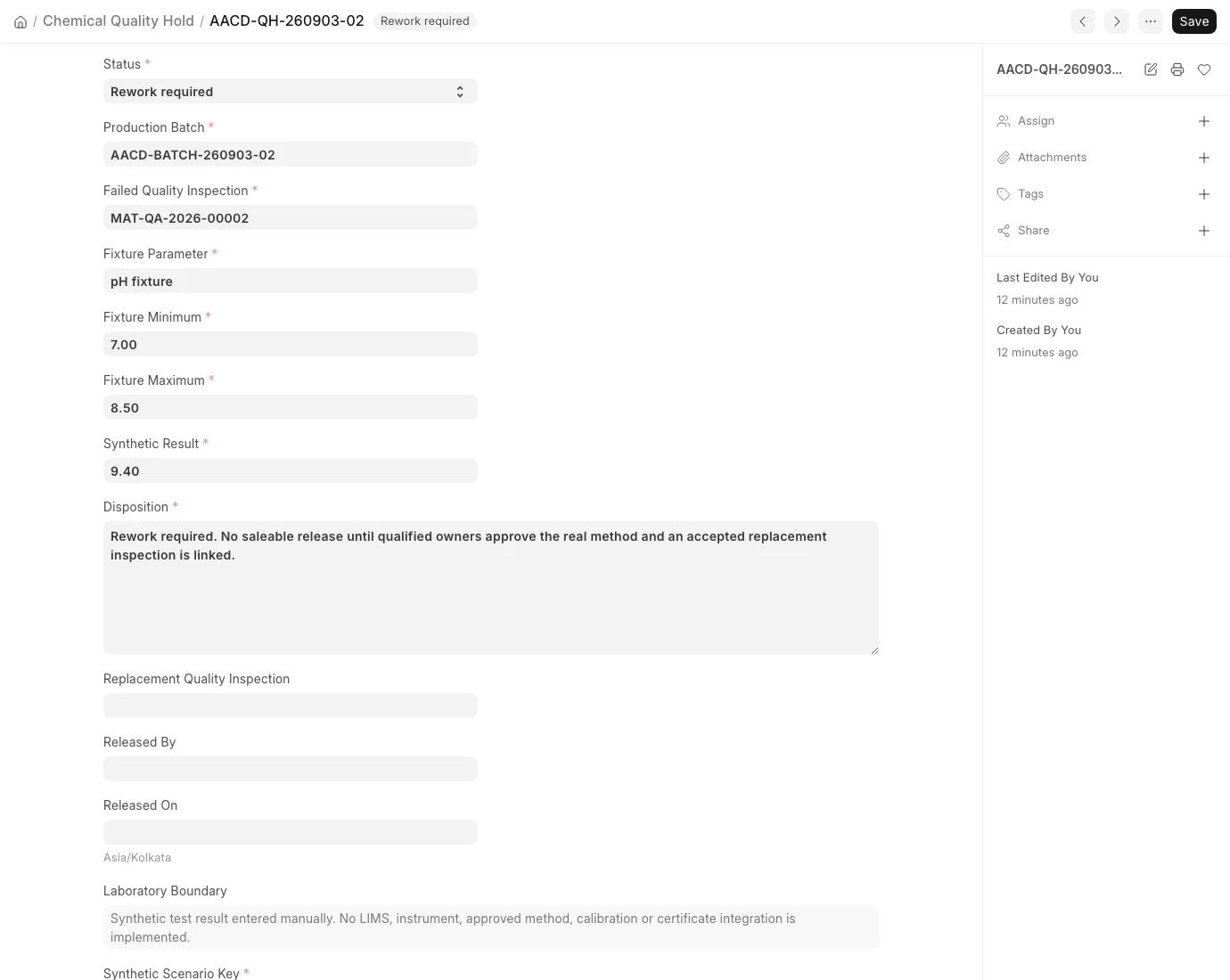
The second batch has a synthetic pH fixture result of 9.40 against an invented 7.00 to 8.50 range. Its rejected ERPNext Quality Inspection opens a Chemical Quality Hold with the disposition Rework required. Tests prevent the held batch from linking saleable stock, delivery or invoice records.
The system does not decide a rework method. Sampling, laboratory procedure, acceptance limits, reprocessing instructions and final disposition remain qualified production decisions.
Commercial close
Only the released batch reaches delivery, invoice and margin
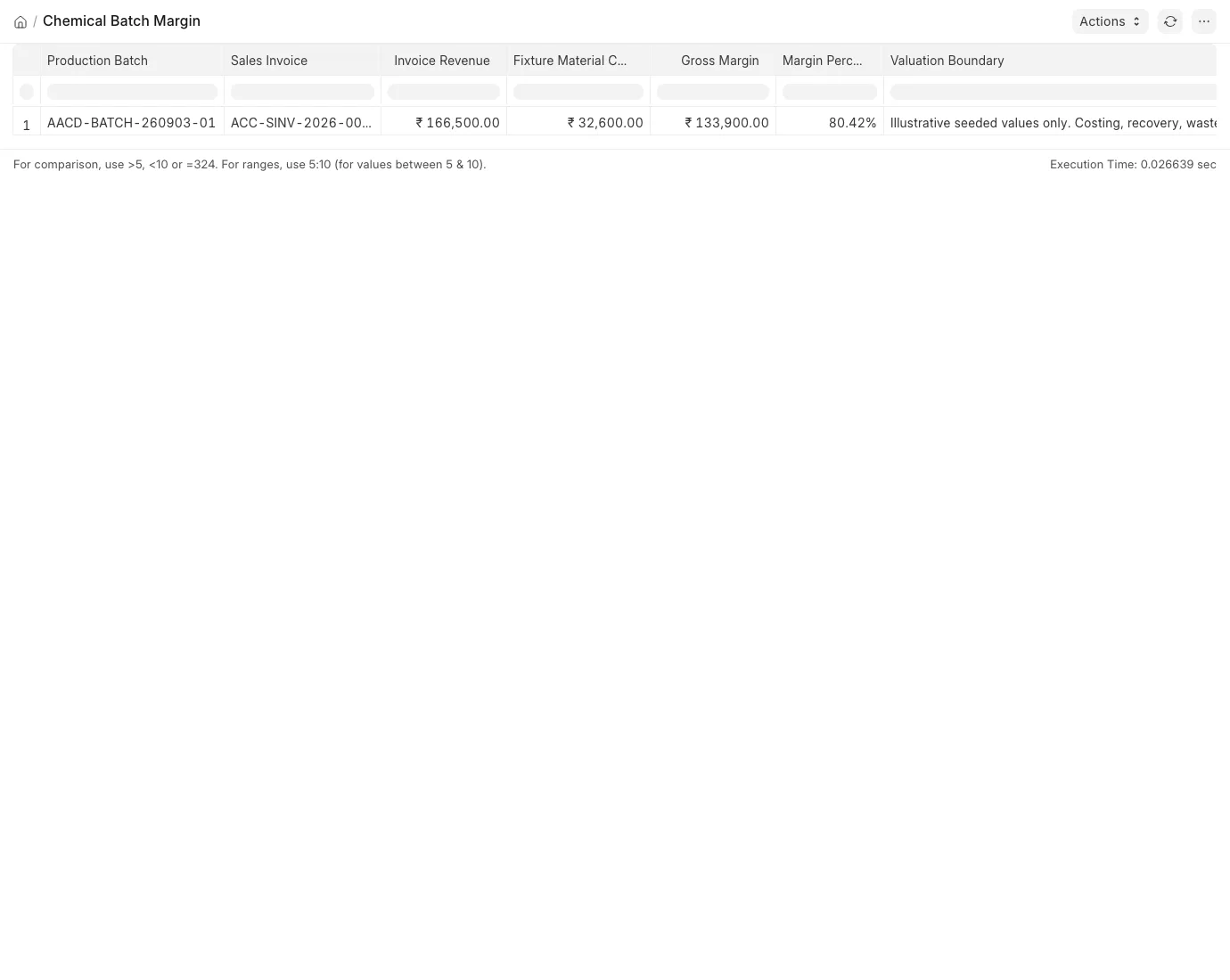
The accepted batch reaches a submitted Delivery Note and Sales Invoice. Its margin report combines invoice revenue with seeded ingredient valuation rates, while the held batch remains outside the commercial close.
The calculation is illustrative. A production method still needs approved inventory valuation, recovery and waste treatment, overhead allocation, duties, GST, rebates, freight, credit notes and accounting policy before anyone relies on its margin.
Implementation
What Crator added to ERPNext
ERPNext remains the inventory, manufacturing, quality, delivery and accounting foundation. Crator adds the formula approval, ingredient-lot trace, material-exception controls, batch reconciliation and bounded reporting as a separate Frappe app without editing ERPNext core.
One chemical batch manufacturing system
ERPNext foundation
- Items, warehouses and supplier batches
- BOMs, Work Orders and Stock Entries
- Quality Inspections and finished batches
- Delivery Notes and Sales Invoices
Crator chemical batch layer
- approved formula revision and scaling basis
- ingredient-lot plan and actual trace
- authorised substitution record
- yield, recovery, loss and variance reconciliation
- quality hold, rework gate and illustrative batch margin
Production boundary
What a real chemical manufacturer still has to decide
This reference proves configured records and controls, not production readiness. A rollout still needs qualified chemical engineering, approved formulations, SDS governance, EHS and hazardous-material procedures, current statutory review, permits, labels, storage and transport rules, laboratory methods, calibrated instruments, equipment and control-system interfaces, security, segregation of duties, accounting, migration, validation, user acceptance and cutover. The current Indian environmental rules and notices should be checked from the Ministry of Environment, Forest and Climate Change for the actual site and product scope.
Frequently asked questions
For a batch manufacturer, it should connect the commercial order to an approved formula revision, scaled ingredient requirement, supplier and internal lots, work order, actual consumption, finished batch, yield, quality decision, release, delivery, invoice and margin. The useful record is the trace between those documents, not a separate summary dashboard.
Yes, as an ERP foundation. ERPNext provides Items, Bills of Materials, Work Orders, Batches, Stock Entries, Quality Inspections, Delivery Notes and Sales Invoices. Crator adds the controlled formula revision, ingredient-lot trace, substitution approval, batch reconciliation and quality hold shown here without editing ERPNext core.
The reference freezes an approved revision with a 1,000 kg basis and scales its planned quantities into the production batch. Once that revision has been used, a test prevents its formula rows from changing. A live formula still needs qualified technical review, version policy, permissions and validation for the actual product and process.
Only through a separate approval record in this reference. It names the original ingredient, proposed substitute, both lots, quantity, validity, approver and scope note. The record does not establish chemical equivalence, compatibility or safety. Those remain qualified production decisions.
The failed synthetic pH result opens a quality hold, keeps the finished batch out of saleable stock and blocks delivery and invoicing links. Release requires an accepted replacement inspection and an authorised decision. Rework method, sampling, laboratory evidence and disposition must be approved for the actual operation.
No. This reference does not author or validate safety data sheets, classify hazards, decide storage compatibility, control exposure, submit statutory records or operate plant equipment. A production implementation must assign those responsibilities to qualified owners and validate the current rules, permits, labels, controls, records and integrations that apply to the site and product.
It is a working reference app built with Crator on ERPNext, not a fictional customer case study. The app can be handed over and adapted, but production still needs approved masters, roles, security, accounting, migration, laboratory and equipment decisions, validation, user acceptance and cutover for the actual business.