ERP for jewellery manufacturing in India
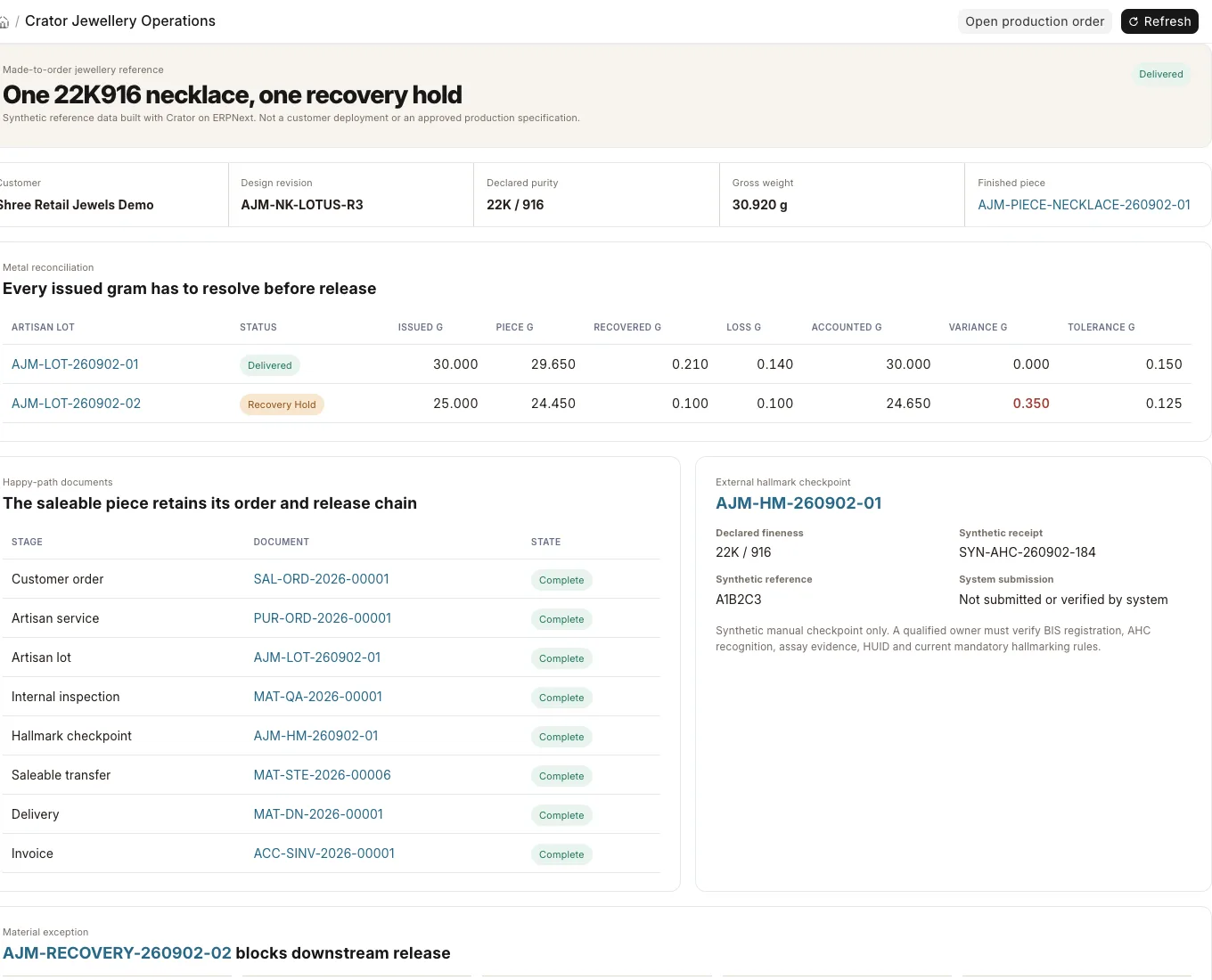
We used Crator to build a working jewellery manufacturing and wholesale reference on ERPNext. One synthetic 22K916 necklace order connects purity, gross and net weight, stones, findings, artisan issue, metal recovery, internal inspection, a manual hallmark checkpoint, delivery, invoice and margin. The screens below come from the installed ERP, not a design mockup.

Why jewellery software has to follow both the piece and every gram
A finished necklace is one piece in stock, but its manufacturing record is a weight equation. The useful trail explains what purity was declared, how much metal and stone left the vault, what returned in the piece, what came back as recovery, what was accepted as loss, and who released the piece after internal and external checks.
Purity is a declared control and a compliance claim
The order, artisan lot and checkpoint must agree without presenting an internal field as an assay.
The artisan lot is the investigation grain
Metal issue, finished weight, recovery, process loss and unexplained variance resolve at one named lot.
Gross and net weight answer different questions
Stones and findings affect the physical piece while metal recovery still depends on net metal.
Hallmark release is not the same as an ERP approval
The system can enforce a checkpoint, but an authorised person must verify real external evidence.
Artisan issue and return
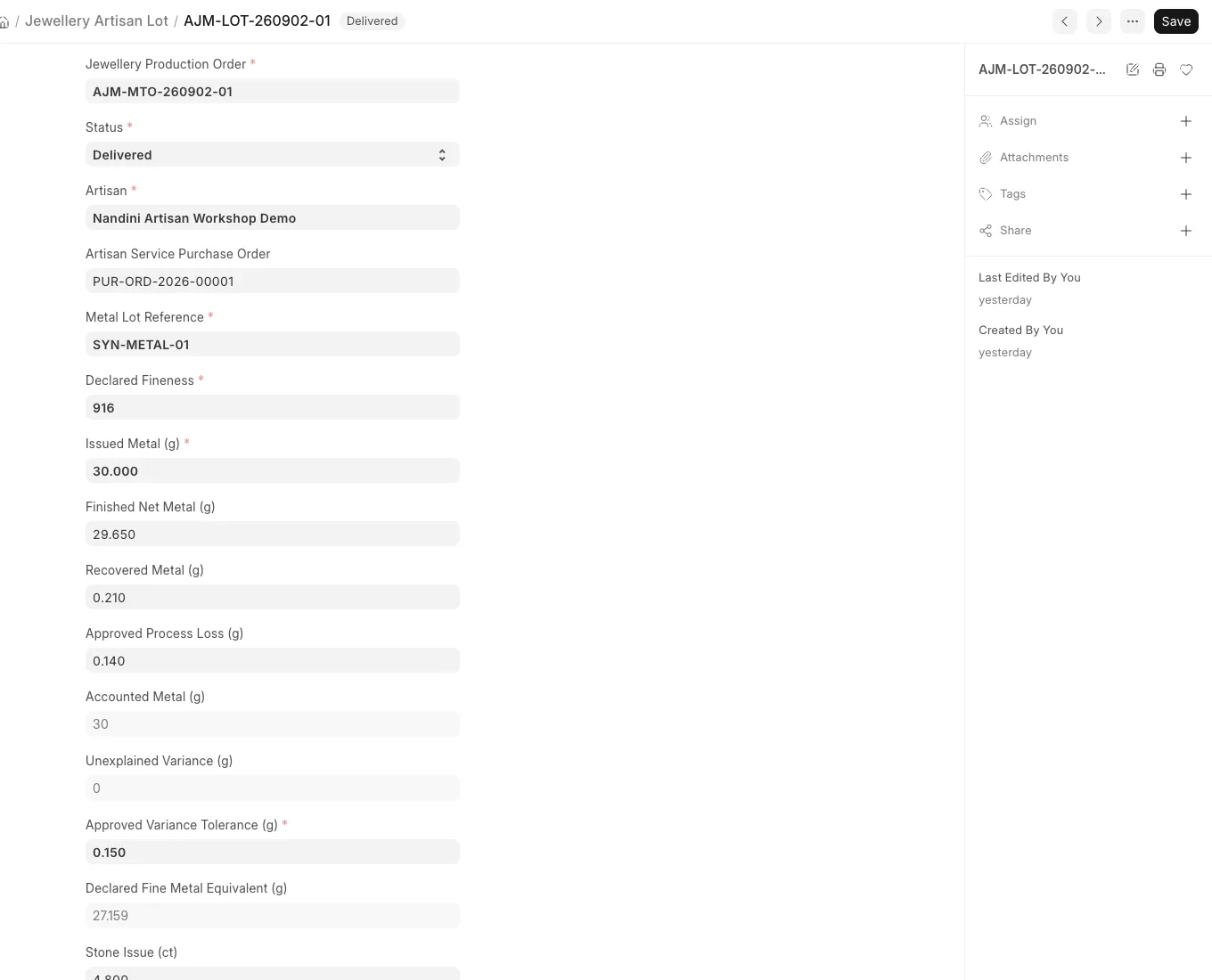
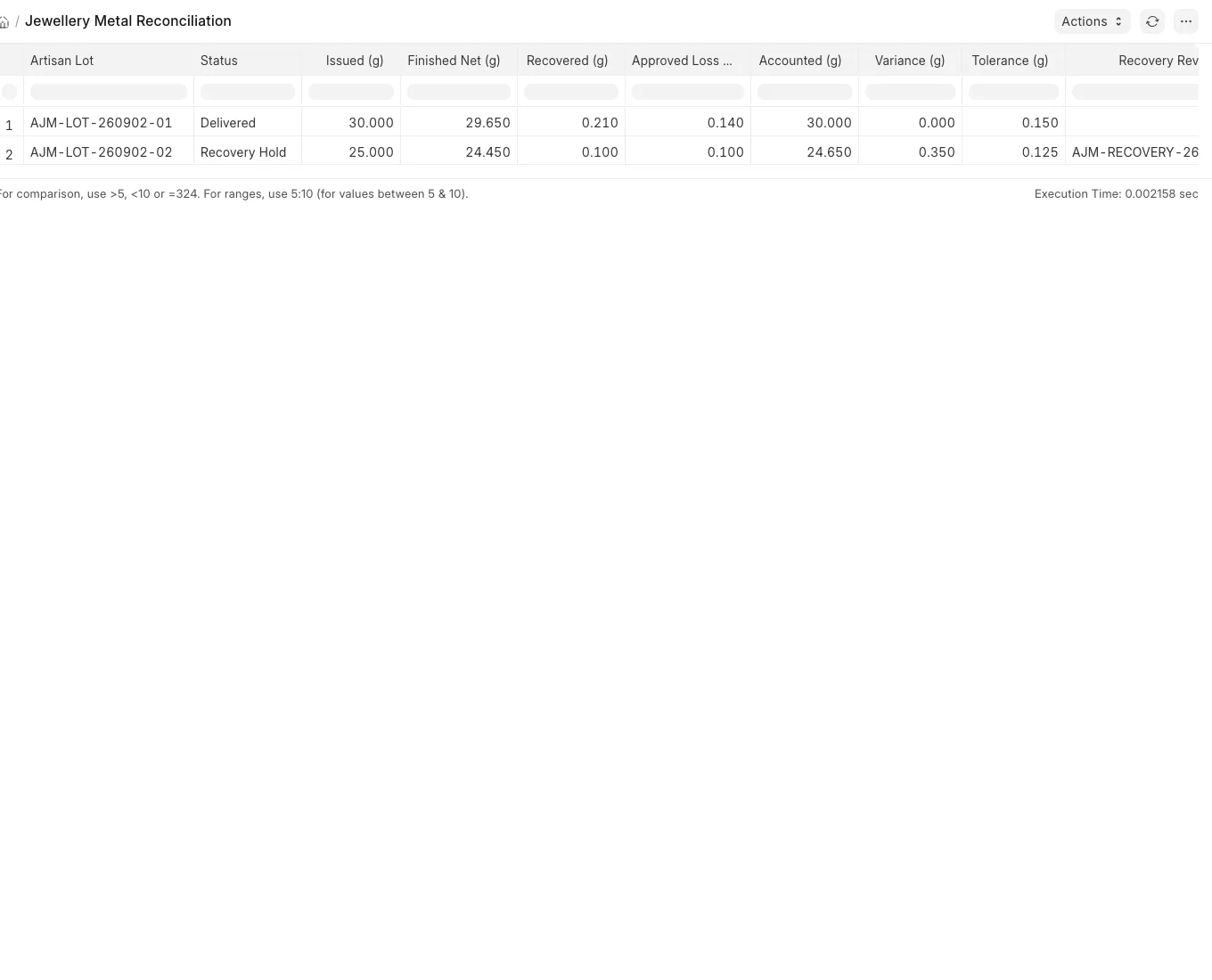
The reference resolves a 30.000 g metal issue exactly
The synthetic necklace receives 30.000 g of 22K alloy, 4.800 ct of stones and a 0.310 g finding. Submitted ERPNext Stock Entries move the material to the artisan warehouse, receive the finished piece, return 0.210 g of recovered metal and post 0.140 g of approved loss.
Finished net metal is 29.650 g. Net metal, recovery and approved loss add back to the issued 30.000 g, leaving no unexplained variance against the synthetic 0.150 g tolerance.

Internal quality and hallmark boundary
A finished piece needs two different kinds of evidence
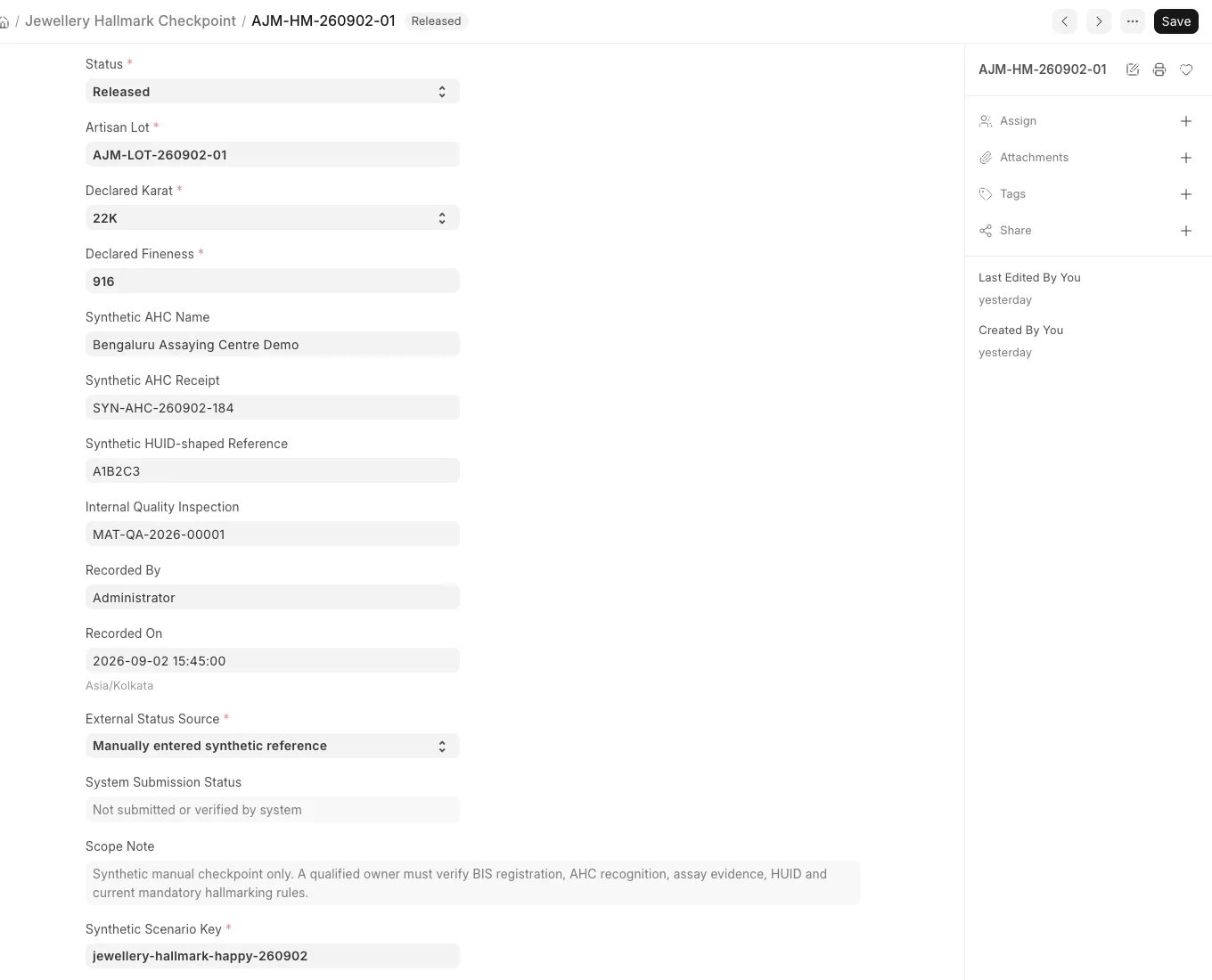
An ERPNext Quality Inspection records the synthetic internal weight, finish and stone-setting decision. The Crator hallmark checkpoint separately stores declared 22K916 fineness, a synthetic centre receipt and a six-character demonstration reference.
The checkpoint says Not submitted or verified by system. It does not claim to be an assay, a BIS portal response or a HUID verification. According to BIS, hallmarking and recognised Assaying and Hallmarking Centres sit within a regulated external process. A production implementation must follow the current order and procedures for the actual article and location.

Recovery exception
A 0.350 g unexplained variance stops the second lot
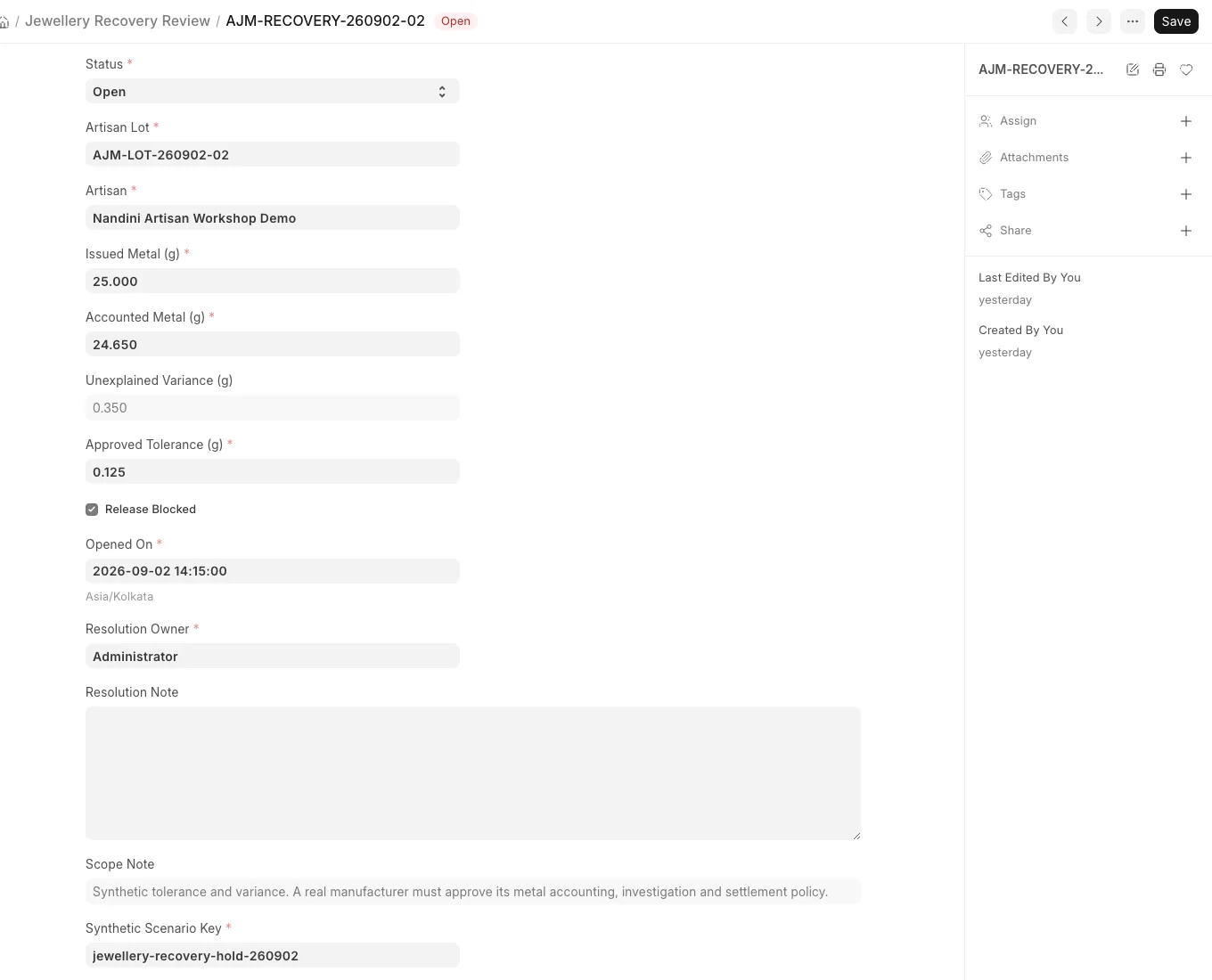
The synthetic bangle lot receives 25.000 g. Only 24.650 g is accounted across the stated finished metal, partial recovery and process loss. The 0.350 g difference exceeds its 0.125 g tolerance, so a Jewellery Recovery Review stays open.
The lot cannot link a hallmark release, saleable transfer, Delivery Note or Sales Invoice. This is a tested stop condition, not an allegation about a real artisan and not a universal jewellery-wastage allowance.
Delivery, invoice and margin
Only the released necklace reaches the customer ledger
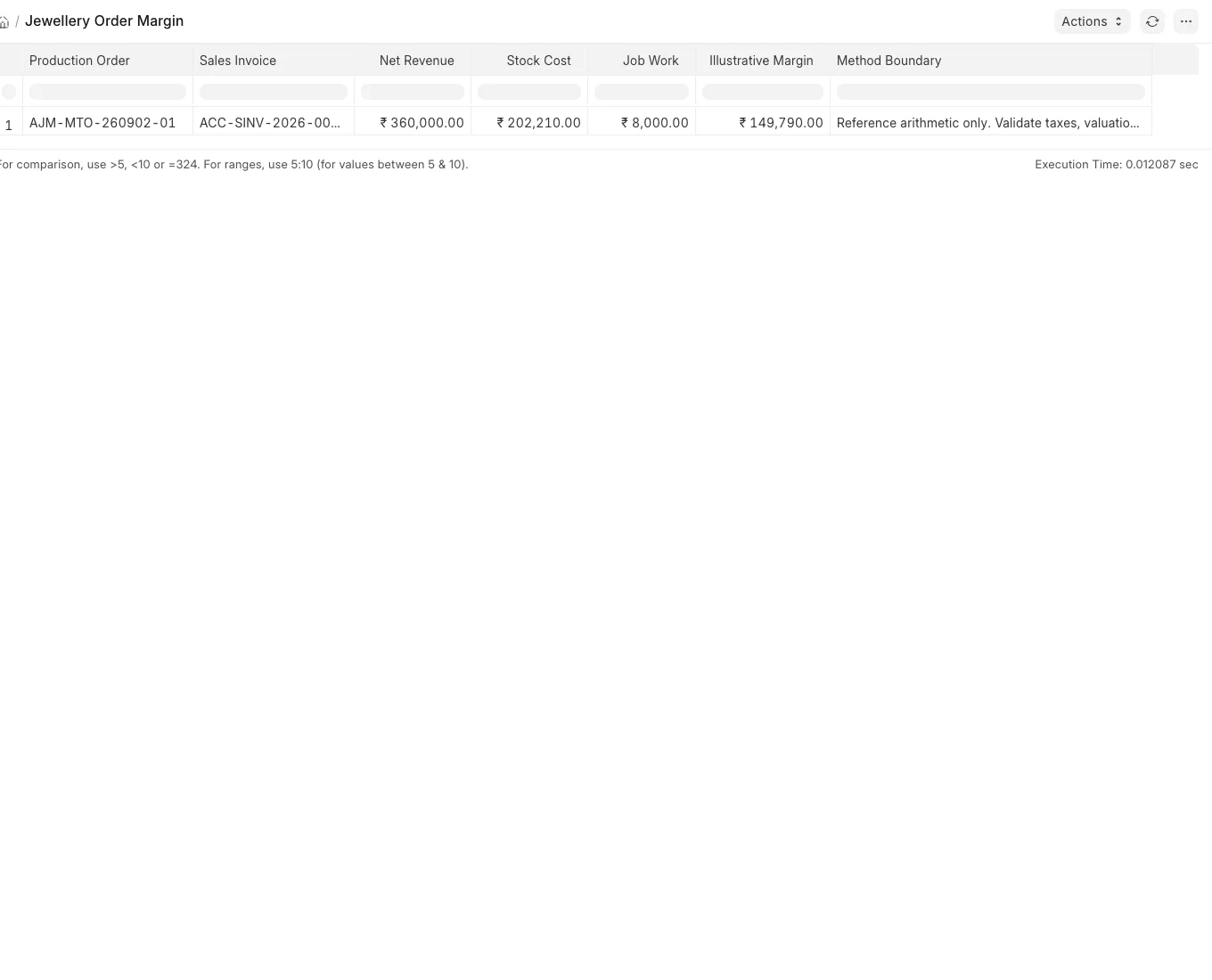
The necklace moves into the saleable warehouse, then closes through a submitted ERPNext Delivery Note and Sales Invoice. The margin report combines invoice revenue, the delivered piece’s ERPNext incoming rate and the recorded artisan charge.
That margin is illustrative. A live method must decide the approved gold-rate source and timing, stone and finding valuation, recovery credits, process loss, job-work capitalization, tax treatment and accounting policy before anyone relies on it financially.
Implementation
What Crator added to ERPNext
ERPNext remains the inventory, buying, selling, delivery and accounting foundation. Crator adds the jewellery-specific planning, gram-level trace, recovery exception and manual compliance checkpoint as a separate Frappe app without editing ERPNext core.
One jewellery manufacturing system
ERPNext foundation
- Items and secure warehouse locations
- Sales Orders and artisan Purchase Orders
- Stock Entries and Quality Inspections
- Delivery Notes and Sales Invoices
Crator jewellery layer
- production order with design and declared purity
- artisan lot and metal-weight equation
- recovery review that blocks release
- manual hallmark checkpoint with an external boundary
- piece delivery and illustrative margin trace
Production boundary
What a real jewellery business still has to decide
The reference proves the configured records and controls, not production readiness. A rollout still needs current BIS and GST review, live purity and design masters, accepted weighing and recovery policy, tax and valuation rules, gold-rate governance, recognised external evidence, calibrated devices, barcode or RFID decisions, vault and workshop security, segregation of duties, migration, stock count, user acceptance, cutover and support.
Frequently asked questions
For a manufacturer or wholesaler, it should connect the customer order to design revision, declared purity, metal and stone issue, artisan job work, gross and net weight, recovery, loss approval, internal quality, hallmark release, piece stock, delivery, invoice and margin. Retail POS and bullion trading are separate operating scopes.
Yes. ERPNext supplies Items, Warehouses, Sales Orders, Purchase Orders, Stock Entries, Quality Inspections, Delivery Notes and Sales Invoices. Crator adds the jewellery production order, artisan lot, weight reconciliation, recovery review and hallmark checkpoint shown here without changing ERPNext core.
The reference stores declared karat and fineness, then reconciles issued metal against finished net metal, recovered metal and approved process loss at artisan-lot level. Its fine-metal equivalent is a declared calculation, not an assay reading. Live purity, weighing, valuation and tolerance policies need qualified approval.
No. The reference records a manually entered synthetic Assaying and Hallmarking Centre receipt and a HUID-shaped demonstration value. It clearly says Not submitted or verified by system. A real rollout must validate current BIS registration, article eligibility, centre recognition, assay, hallmarking and HUID procedures with the responsible compliance owner.
No. The page proves an ERPNext Sales Invoice and an illustrative margin report. Current HSN classification, GST, job-work treatment, invoice requirements, e-invoice applicability, gold-rate source, stone valuation, recovery policy and capitalization must be configured and tested for the actual business.
It is a working reference app built with Crator on ERPNext, not a fictional customer case study. The app can be handed over and adapted, but production still needs the company’s masters, security model, weighing devices, label or RFID rules, accounting method, compliance decisions, migration and user acceptance testing.