ERPNext pricing changes the maths as your team grows
· Yajat Gulati · 7 min read
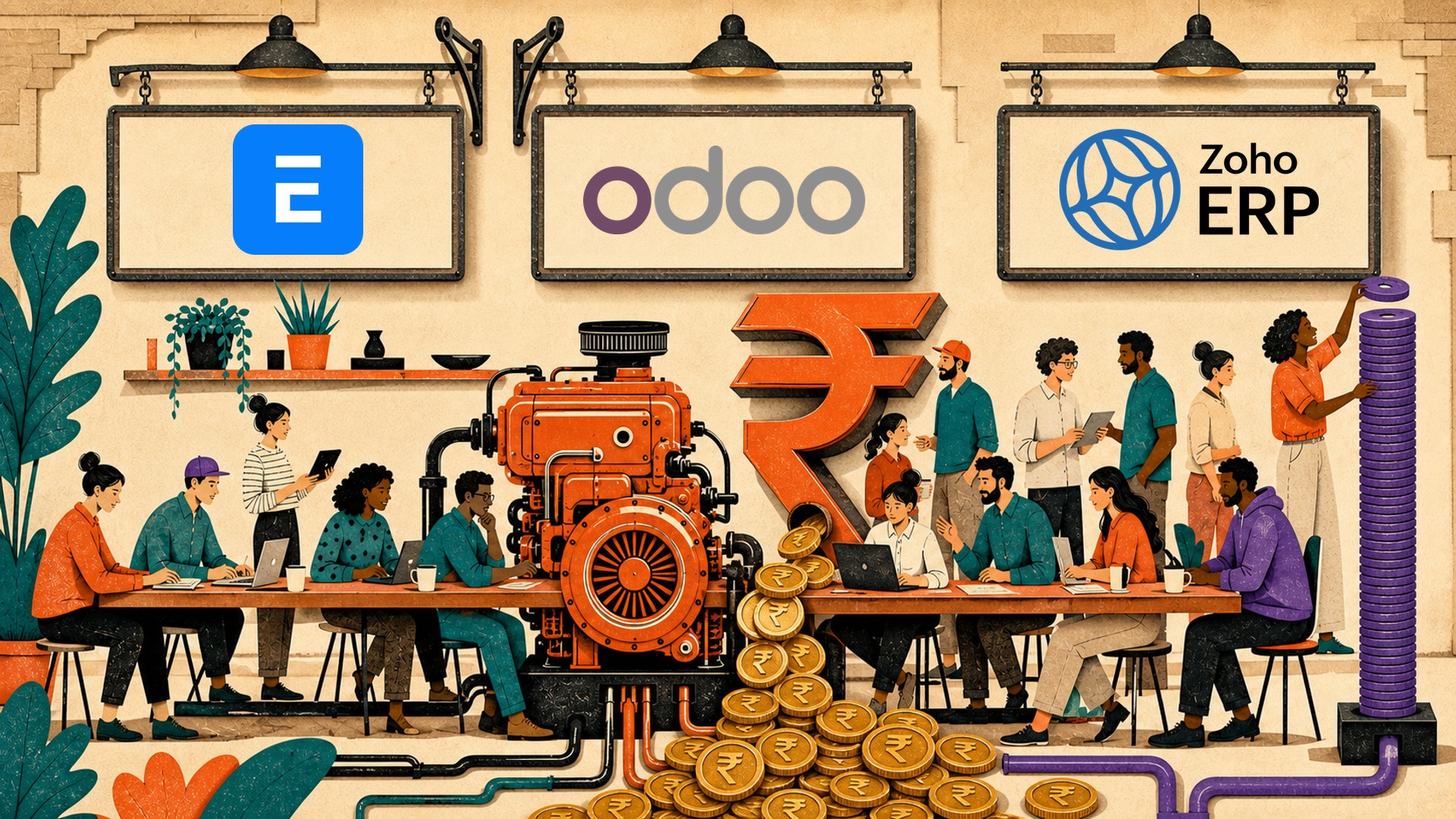
ERPNext pricing starts with a software licence cost of ₹0, whether the system has ten users or a thousand. Hosting, implementation, migration, support and customisation still need money and people. The useful advantage is that the software does not add another licence every time an employee needs access.
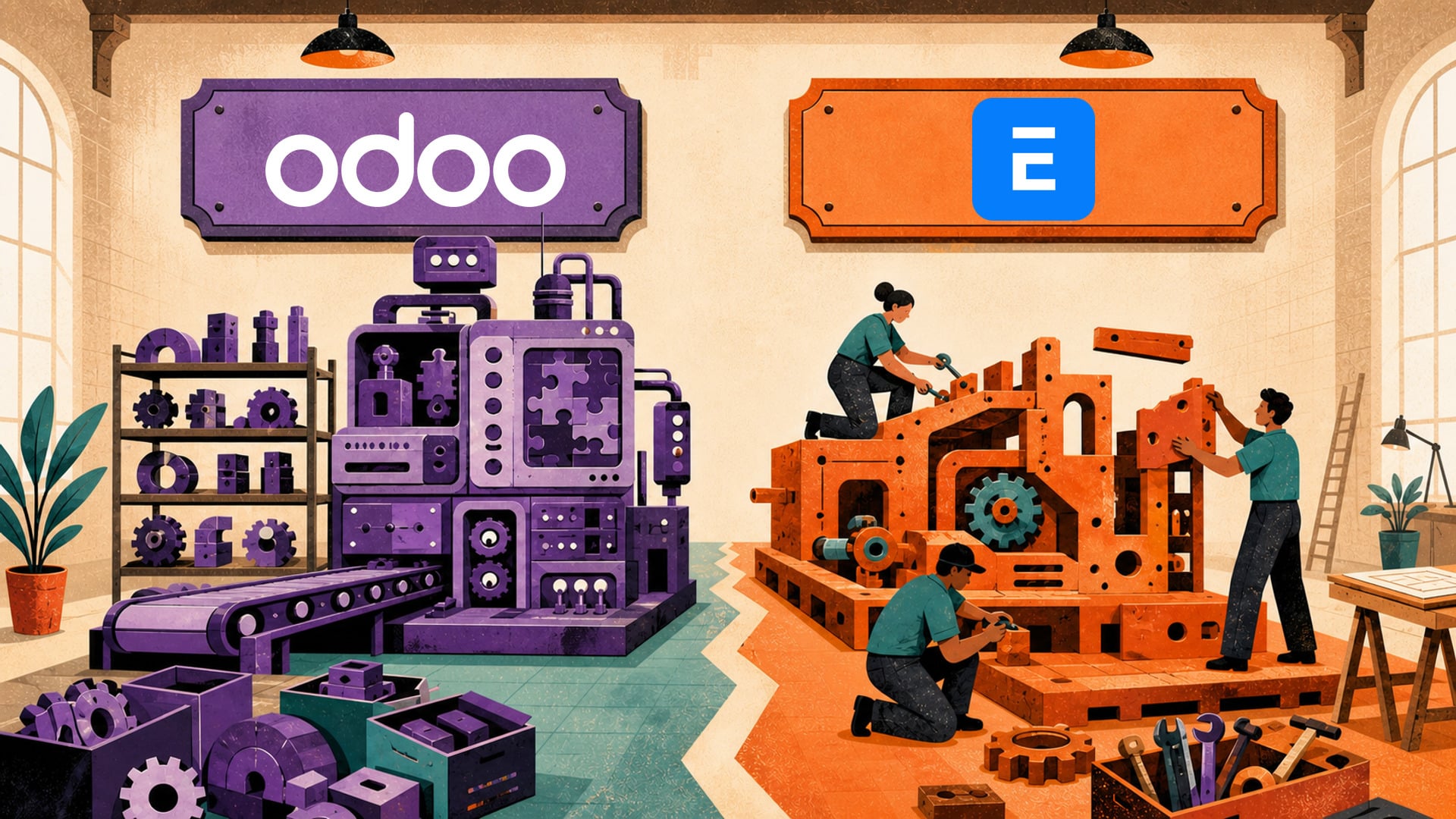
Odoo Enterprise and Zoho ERP use per-user subscriptions. ERPNext uses an open-source licence and can run on infrastructure chosen by the company. These models produce different cost curves as a team grows.
All prices below were checked on 26 August 2026. Vendor prices and exchange rates will change, so use the linked pages for a current quote.
Published pricing at a glance
| Product | Published software model | What grows with usage |
|---|---|---|
| ERPNext | Free and open source, with no per-user software licence | Hosting capacity, support and implementation work |
| Odoo Standard | US$24.90 per user/month for the first year when billed annually on the page checked | Licensed users |
| Odoo Custom | US$49 per user/month for the first year when billed annually on the page checked | Licensed users, plus separate Odoo.sh hosting where used |
| Zoho ERP Standard | ₹999 per user/month billed annually, plus ₹249 per employee/month | Full users, employees, locations and selected add-ons |
| Zoho ERP Premium | ₹2,499 per user/month billed annually, plus ₹249 per employee/month | Full users, employees, locations and selected add-ons |
Odoo's pricing page distinguishes its free one-app plan, Standard plan and Custom plan. The Custom tier includes Studio, multi-company, external APIs and the ability to use Odoo.sh or deploy on-premise.
Zoho ERP's India pricing has a minimum of five full users. It also separates full users from employees using payroll, expenses, retail billing or field operations. Standard and Premium have organisation-level transaction limits, and Zoho lists separate charges for additions such as locations and API capacity.
ERPNext's source is available under the GPL. A business can self-host it or pay for managed infrastructure. Frappe Cloud currently lists shared site plans from ₹410 per month and server plans from ₹3,600 per month.
Per-user subscriptions and server capacity grow differently
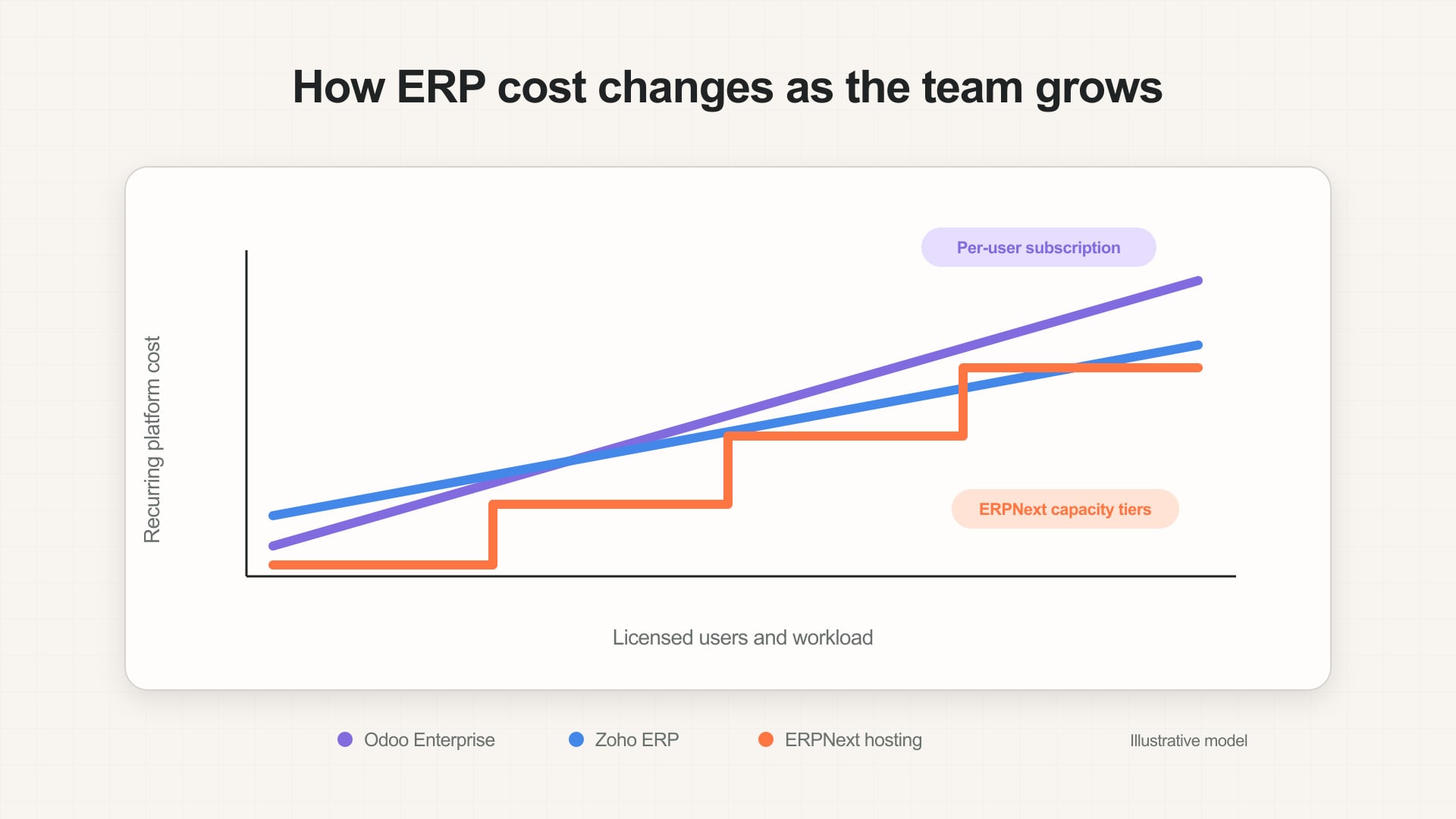
The graph is deliberately illustrative. It compares the shape of the pricing models, not a vendor quote.
A per-user subscription rises roughly in a straight line. Add another group of licensed employees and the recurring software bill rises with it. Discounts, employee licences and plan rules can bend the line, but headcount remains part of the calculation.
ERPNext's software licence stays at zero. Hosting behaves more like a staircase. A server can support more activity until the workload needs additional CPU, memory, storage or isolation. The bill rises when the infrastructure moves to the next capacity tier, not whenever another person receives a login.
Crator uses a similar tiered approach. The subscription combines the Crator platform with ERPNext hosting, while hosting adjusts across team-size tiers. You can see the current figures on the Crator pricing page.
What ERPNext pricing does and does not include
ERP proposals become misleading when they compare a SaaS subscription with an open-source download and stop there.
A serious ERP budget should include:
- Implementation. Process mapping, configuration, opening balances, permissions, training and go-live support.
- Data migration. Cleaning old customers, suppliers, items, accounts and transactions usually takes longer than exporting them.
- Local compliance. Tax, invoicing, payroll and reporting may require a regional application, configuration or external service.
- Custom workflows. Approvals, integrations, reports and industry-specific records need design, testing and maintenance.
- Hosting and operations. Backups, monitoring, upgrades, recovery and security still exist when the licence is free.
- Internal time. Finance, operations and leadership must make decisions and verify the result.
ERPNext moves the cost away from permission to use the software. It does not make the other six lines disappear.
The implementation model changes those costs too. Our guide to ERPNext implementation with a consultant, partner or in-house team explains where specialist help adds value and where internal ownership matters more.
Why we still prefer the ERPNext model
Paying per user can create odd incentives. A company buys an ERP to connect its operation, then limits access because every additional employee increases the subscription.
An infrastructure-based model lets the company ask a better question: who needs access for the process to work properly? Warehouse staff, supervisors, salespeople and occasional approvers can participate without each login carrying a separate ERPNext software fee.
The second advantage is ownership. A company can host ERPNext itself, move providers or inspect and change the application. That freedom is especially useful when the ERP becomes a long-lived operating system rather than a replaceable department tool.
Crator is designed to make that ownership practical. Your team describes a change, Crator builds it in a separate environment, and the team reviews it before publication. The company spends on the system it wants to run, rather than paying a new implementation cycle for every incremental improvement.
Where Odoo and Zoho ERP still make sense
Odoo and Zoho ERP can be good purchases when the standard product closely matches the business and the company values a managed commercial relationship.
If Odoo is already on your shortlist, our ERPNext vs Odoo comparison looks beyond price at customisation, ownership and the operating model behind each product.
Zoho ERP is particularly straightforward for an Indian team that wants one published subscription covering finance, supply chain, payroll and other operating modules. Odoo offers a mature suite, multiple deployment options and a large partner ecosystem.
The subscription is not automatically wasteful. A predictable per-user fee may be preferable to owning infrastructure and application decisions, especially for a company without the appetite to maintain a more open system.
Our preference changes when the number of users is large, the workflows are distinctive or the company already has an internal technology team. In that situation, ERPNext with Crator can turn software ownership into an operating advantage.
Compare total cost over three years
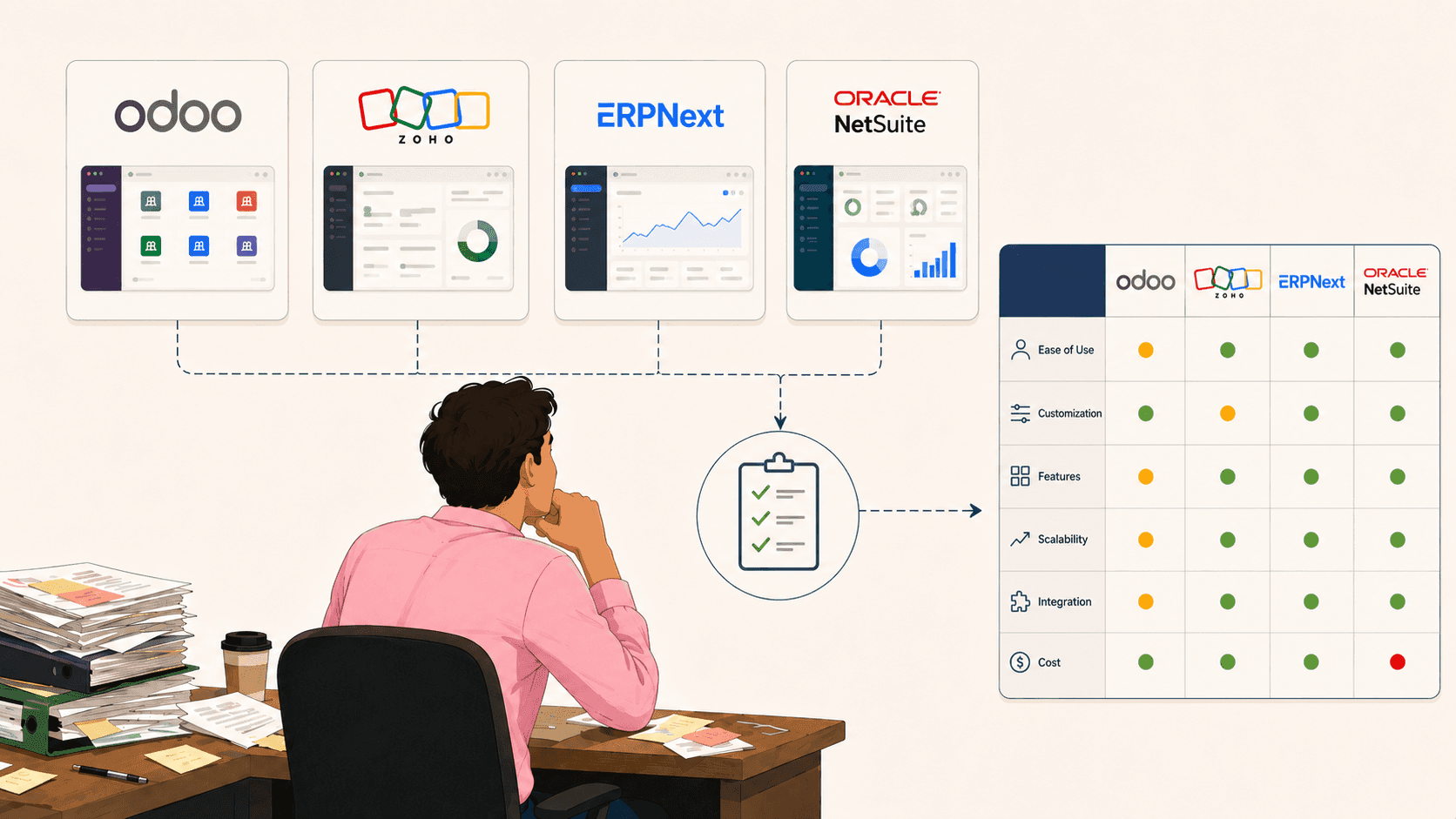
Do not compare the first invoice. Model at least three years with the expected user count, transaction growth and changes the business already knows it will need.
For Odoo and Zoho ERP, include the relevant user categories, plans, hosting and add-ons. For ERPNext, include infrastructure, Crator or another implementation route, regional compliance, support and the internal owner of the system.
The winning model is the one that gives the business the right system at a cost it can keep paying. ERPNext starts with a structural advantage because access to the software itself does not become more expensive with every new user.