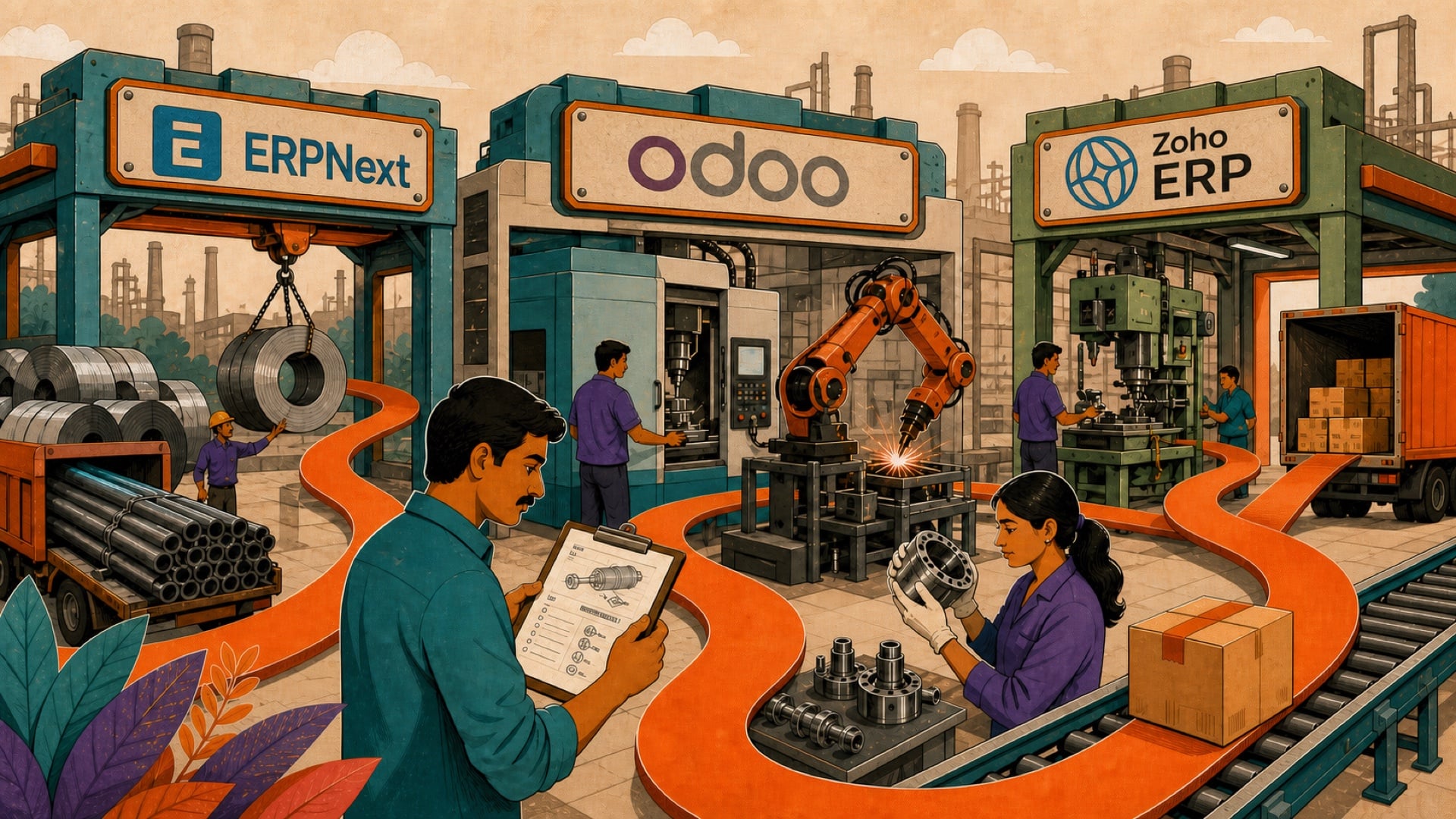
ERPNext vs Odoo: the choice is really about control
· Yajat Gulati · 7 min read
ERPNext and Odoo can both handle accounting, sales, purchasing, inventory and manufacturing. Both can be customised. Both can run companies much larger than the small-business label that often gets attached to open-source ERP.
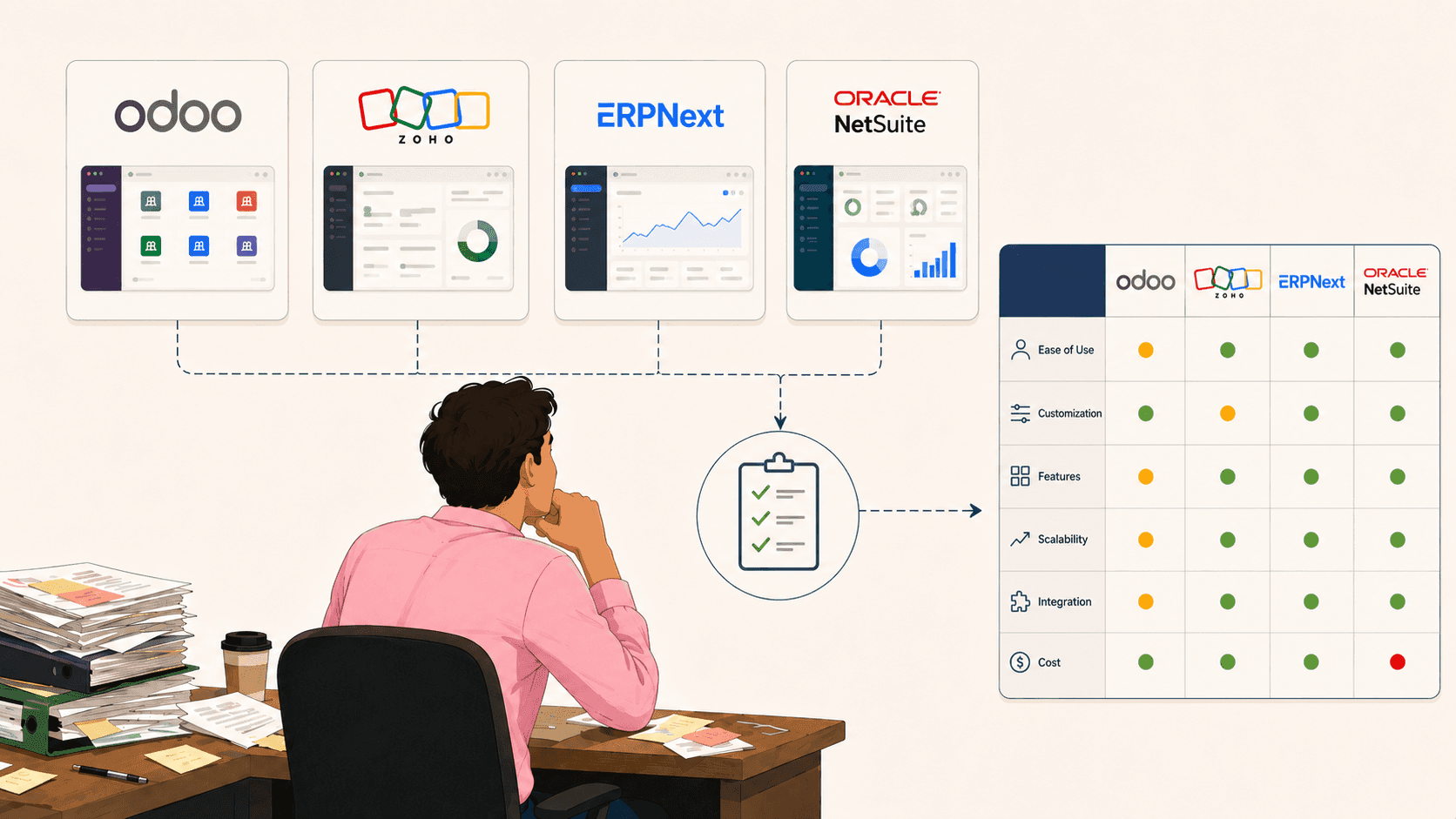
So an ERPNext vs Odoo decision should not begin with a grid of green ticks. It should begin with a more practical question: how much of your business should remain standard, and who should control the parts that need to change?
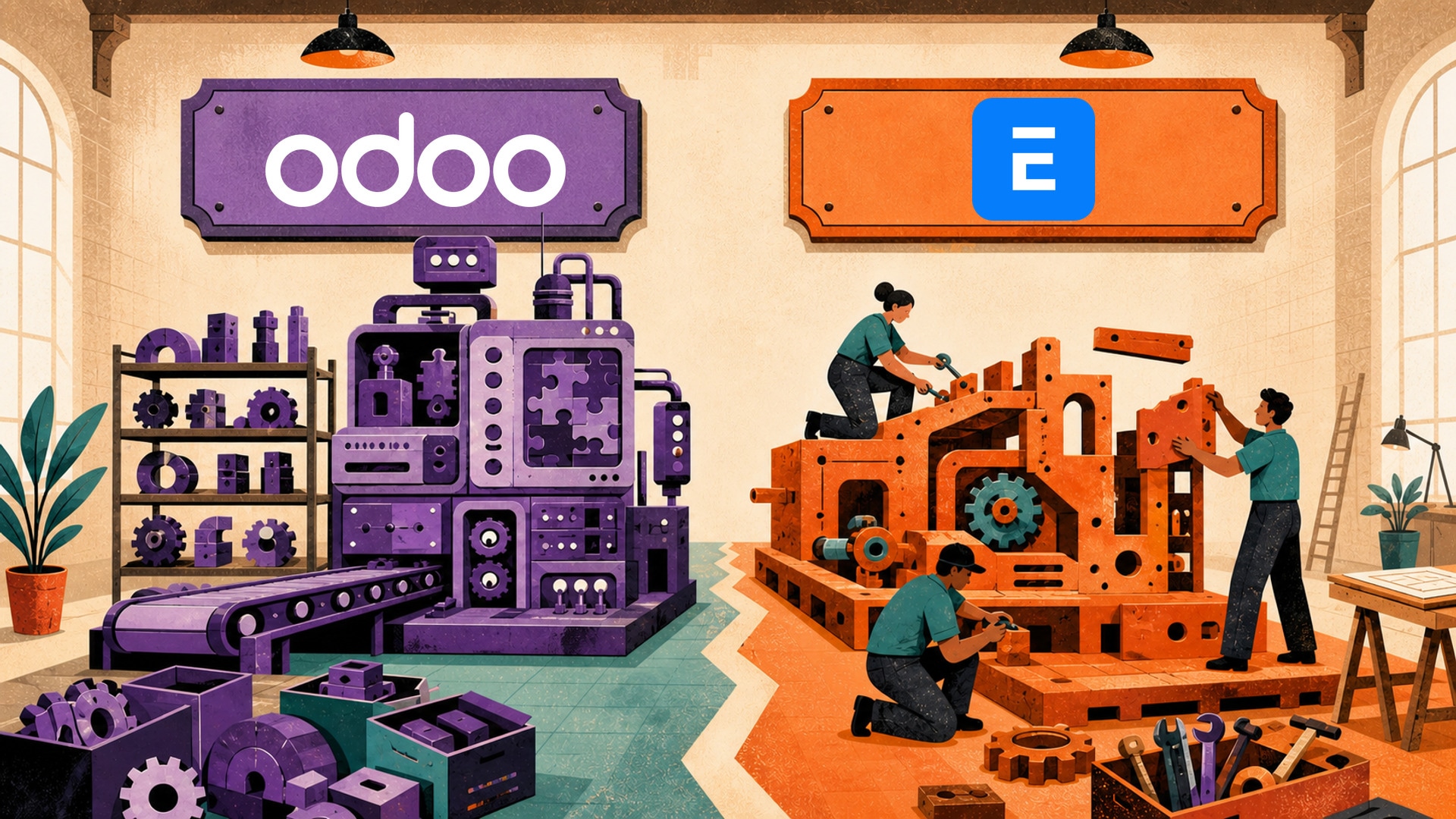
Our answer at Crator is fairly direct. Odoo is a sensible choice when its standard applications already match the way you want to operate. ERPNext becomes the stronger foundation when your workflows are part of your advantage and you want to keep improving them without turning every change into a new vendor project.
The short answer
Choose Odoo when you want a broad suite, a polished standard setup and a conventional vendor or partner-led implementation. Odoo Studio also gives teams a substantial no-code customisation layer.
Choose ERPNext with Crator when you want an open-source ERP, no per-user software licence and more control over how the system evolves. Crator lets your team describe a workflow, report, form or integration in plain language, review the result in a separate environment and publish it when it is ready.
There is one hard condition. ERPNext must support the statutory and industry compliance your business needs. If it does not, flexibility elsewhere cannot compensate for that gap.
Odoo supports substantial customisation
Describing Odoo as the standard option and ERPNext as the customisable one would be wrong.
Odoo Studio can change fields, views, models, reports, approval rules, automations, webhooks and security rules without conventional development. The Custom plan supports Studio, multi-company setups, external APIs and deployments on Odoo.sh or your own infrastructure.
Odoo also has a large application and partner ecosystem. A business that finds a close match between its operation and the standard product can move quickly, especially when the implementation partner already understands the industry.
The trade-off is the operating model around those changes. Odoo Enterprise is licensed per user. Studio moves an Odoo Standard database onto the Custom plan. Code-level changes still need to be designed, built, tested and maintained through upgrades.
Those may be acceptable costs. The useful question is whether the resulting dependency is a deliberate choice or something the company discovers after implementation.
For a closer look at how the cost models behave as a team grows, see our ERPNext pricing comparison with Odoo and Zoho ERP.
ERPNext gives you the whole foundation
ERPNext is published as open-source software. Its records, forms and business rules sit on Frappe Framework, where a DocType defines both the data model and much of the interface around it.
That architecture makes changes unusually coherent. A new document type can gain a list view, form, permissions, API access and reporting behaviour from the same model. Teams can add fields and workflows through configuration, then move into custom applications when a requirement needs deeper logic.
Open source also changes the ownership question. You can host ERPNext yourself, use Frappe Cloud or move between service providers. Your ability to run the software does not end because a subscription for each employee ends.
None of this makes implementation free. Someone still has to configure accounts, clean data, map processes, train users and maintain integrations. ERPNext removes the per-user software licence. It does not remove the work required to build a dependable operating system for a company.
Crator changes who can make the next improvement
Traditional ERP customisation usually begins with a requirement document. A consultant translates it for a developer, the developer builds it, somebody tests it, and the business eventually sees the result.
Crator compresses that loop. The person who understands the operation describes the change in plain language. Crator builds it on a separate copy of ERPNext. The team reviews the workflow with realistic records, discards it if it is wrong, or publishes it to the live system.
That model is useful for a ten-person company without an ERP developer. It may be even more useful for a large company with an internal technology or operations team. The internal team keeps the context, the priorities and the ability to respond. Crator handles more of the ERPNext work behind each request.
External expertise still has a place. A good implementation partner can bring accounting, compliance, migration and change-management experience that software cannot manufacture. We would use that expertise where it carries real value, rather than making the partner the permanent route for every new field, report and approval rule.
Our guide to ERPNext implementation with a consultant, partner or in-house team explains how we would divide that responsibility.
Standardise the common parts and protect your advantage
Businesses should not customise an ERP for the pleasure of having a unique ERP.
The general ledger should behave like a general ledger. Stock transactions need consistent controls. Tax records should follow the law. Rebuilding those foundations around personal preferences creates risk without creating advantage.
The valuable changes sit closer to the way the company wins:
- how a manufacturer releases an urgent order without losing material traceability;
- how a distributor allocates scarce stock across channels;
- how a service business approves work that sits outside a standard contract;
- how a retailer prices, replenishes and reconciles across locations;
- how management sees the few operational signals that predict a problem early.
These workflows are often missing from a demo because they belong to the business, not the software category. Flattening them into a generic process can make implementation easier while making the company less distinctive.
Our preference is to keep the boring parts boring and encode the parts that create alpha.
ERPNext vs Odoo by decision
| If your priority is... | Our recommendation |
|---|---|
| A broad standard suite with a conventional implementation path | Start with Odoo |
| No-code changes inside a managed commercial product | Evaluate Odoo Studio |
| No per-user ERP software licence | Start with ERPNext |
| Full access to the application source and deployment | Start with ERPNext |
| An internal team that can keep changing the ERP | ERPNext with Crator |
| Country or industry compliance that ERPNext does not cover | Choose the product that covers it |
| Minimal implementation effort | Test both against one real workflow before deciding |
The final row deserves more attention than it usually gets. A polished demo can hide the work between sample data and a live operation. Run one representative process from beginning to end, including exceptions, permissions, accounting entries and reporting. The gaps become visible quickly.
Our verdict
Odoo is a credible ERP, and for some businesses it will be the right answer. We would choose it when the company wants a largely standard system, prefers its product experience and is comfortable with Odoo's commercial and implementation model.
When ERPNext covers the required compliance, we prefer ERPNext with Crator. It gives the company an open-source foundation, removes per-user software licensing and lets the people closest to the operation keep improving the system.
The product you select matters. The organisation that retains the ability to change it matters for much longer.