The best ERP for manufacturing should fit the factory, not flatten it
· Shrivardhan Goenka · 8 min read · Updated
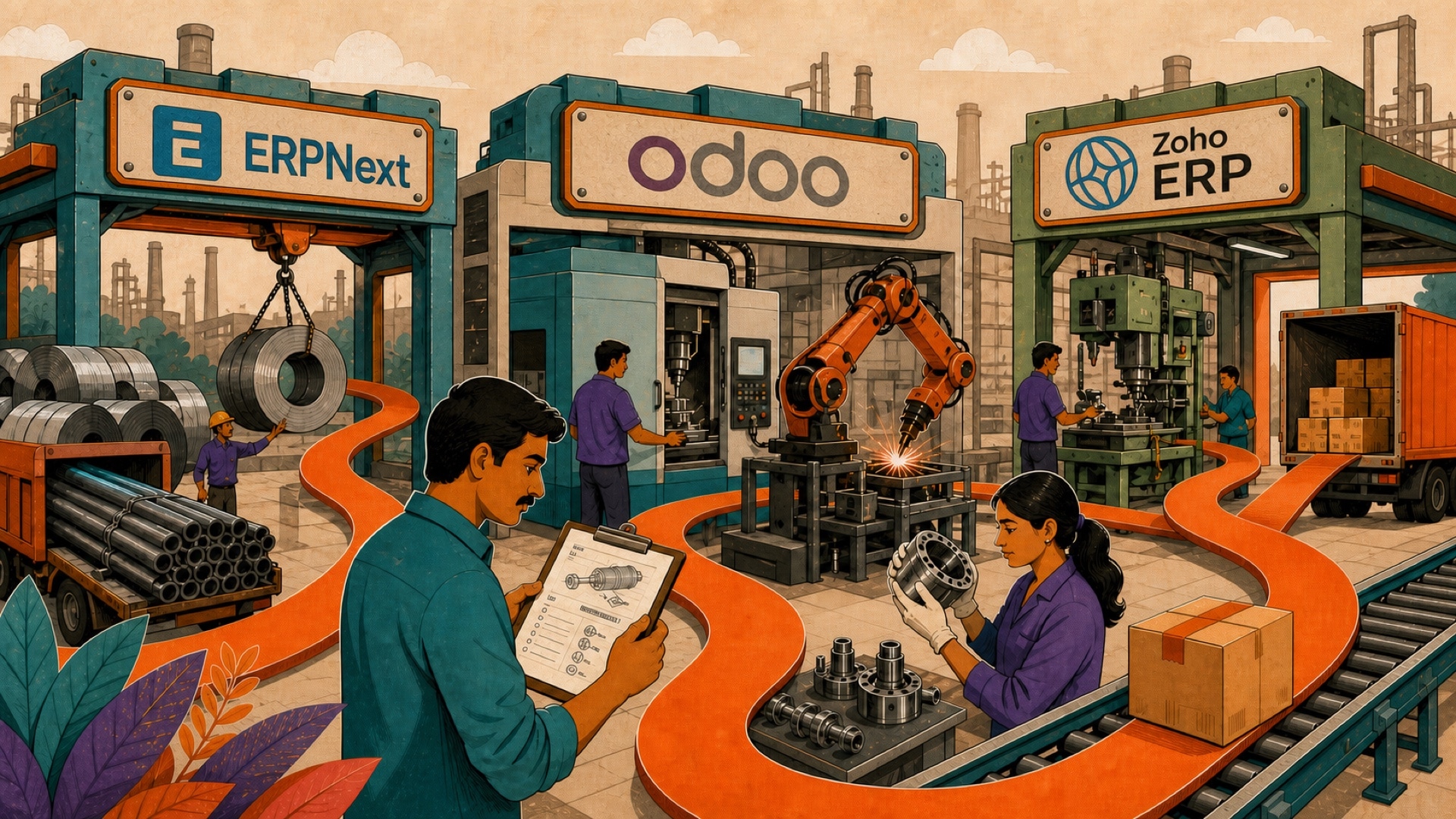
The best ERP for manufacturing is rarely the product with the longest feature list. It is the one that can represent how material, people, machines, quality and money move through your factory.
ERPNext, Odoo and Zoho ERP all cover recognisable manufacturing records. They support bills of materials, production orders, work centres, shop-floor activity and inventory. Any of them can look convincing in a prepared demo.
The difference appears when the demo meets the factory. Alternate materials need approval. A subcontractor consumes company-owned stock. Quality results quarantine one batch but release another. A rush order changes the production queue. Scrap affects valuation. One customer requires a different process from everyone else.
Our preference is ERPNext with Crator when those details form part of how the manufacturer competes. Odoo or Zoho ERP may be the better answer when the standard flow already fits and the company wants a conventional managed product.
What ERP for manufacturing needs to connect
A manufacturing system should connect more than production orders. At minimum, evaluate:
- multi-level bills of materials and alternate BOMs;
- operations, routings, work centres and job cards;
- production planning and material availability;
- work in progress and finished-goods valuation;
- batch, serial number and expiry traceability;
- subcontracting and supplier-owned or company-owned material;
- incoming, in-process and outgoing quality checks;
- scrap, rework and yield variance;
- maintenance and downtime;
- sales demand, purchasing and accounting;
- permissions and approvals on exceptional transactions.
The most revealing evaluation uses one real product with an awkward exception. A standard finished good proves that the module exists. An urgent order with a substituted component proves whether the system can support the operation.
ERPNext starts with a serious manufacturing foundation
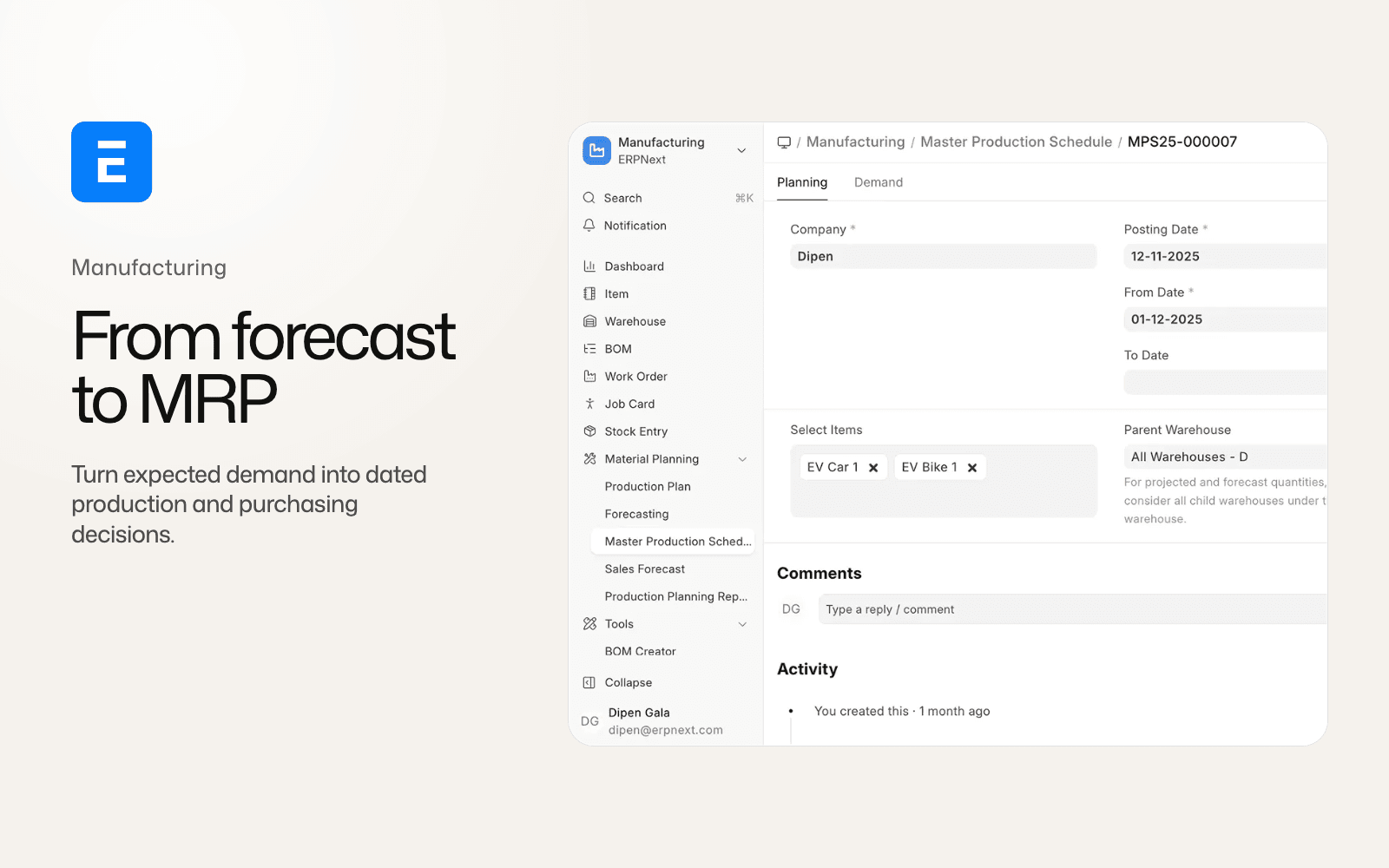
ERPNext's manufacturing module includes multi-level BOMs, production planning, work orders, capacity planning, subcontracting, stock integration, quality and manufacturing reports.
The BOM connects raw materials, sub-assemblies and operations. Work Orders generate material transfers and Job Cards. Production Plans pull demand from Sales Orders or Material Requests and calculate what must be produced or purchased. Costs flow from material and operations into finished goods.
ERPNext also keeps manufacturing close to the rest of the company. A sales commitment can feed planning. A material transfer updates stock. A completed order changes valuation. Finance does not have to reconstruct the production result in another application at month end.
That standard foundation is why we are comfortable recommending ERPNext to manufacturers. The open-source application and Frappe Framework then give the business room to represent the parts that are specific to its factory.
Odoo has a mature manufacturing suite
Odoo is a credible manufacturing ERP. Its official documentation covers manufacturing orders, work centres, dependencies, shop-floor work and quality control points. Quality checks can run against manufacturing or inventory operations, and work centres track capacity, cost and efficiency.
Odoo Studio can also change models, views, approvals and automation without conventional coding. Companies that need deeper work can use the Custom plan and the Odoo development ecosystem.
We would shortlist Odoo when its applications already match the production model, the company prefers its interface and partner ecosystem, and per-user Enterprise licensing is acceptable.
Our broader ERPNext vs Odoo comparison looks at the ownership, customisation and implementation choices behind that shortlist.
The evaluation should include upgrade and custom-module ownership. A manufacturing implementation usually lives for years, and a clever modification made before go-live can become a permanent maintenance responsibility.
Zoho ERP is now a real manufacturing option in India
Zoho introduced its dedicated ERP product in India in 2026. Its manufacturing module includes operations, work centres, manufacturing orders, job cards and shop-floor tracking. Job Cards allocate operations to work centres and record estimated and actual time. Manufacturing journals record material consumption, work in progress and finished goods.
Zoho ERP also provides custom modules, fields, workflows, functions and Blueprints. It should not be dismissed as an accounting suite with a few inventory screens attached.
Its appeal is clearest for an Indian business that wants finance, supply chain, payroll and manufacturing within a vendor-managed Zoho environment. The published plans charge per user and employee, with transaction and location rules that should be tested against expected scale.
The ERPNext pricing comparison with Odoo and Zoho ERP shows how those subscription models differ from ERPNext's infrastructure-based cost curve.
Zoho ERP is newer than the other two manufacturing products. A buyer should test the depth of the exact production workflows it needs rather than extrapolating from the breadth of the wider Zoho suite.
Customise the exception, not the accounting foundation
Manufacturers often hear that they should adapt their process to the ERP. There is some wisdom in that advice. Rebuilding basic stock controls or accounting logic around personal preferences creates expensive complexity.
The advice breaks down when a process is part of the company's edge.
A manufacturer may approve component substitutions using availability, customer specification and margin. Another may price every order from a site-specific BOM. A third may release finished goods only after laboratory results and customer documentation agree. These are not colourful versions of the same standard workflow. They are how the business protects quality, delivery and profit.
We would keep statutory accounting, ledgers and basic inventory controls close to ERPNext. Then we would use Crator to build the approvals, records, reports and integrations that preserve the manufacturer's advantage.
What Crator changes for a manufacturing team
Manufacturing requirements are usually discovered on the floor, not in a conference room before implementation.
With Crator, an operations or internal ERP team can describe a change in plain language. Crator builds it on a separate ERPNext environment. The team tests it against the process, reviews the resulting records and publishes it when it is ready.
That shortens the distance between the person who sees the problem and the person who can change the system. A production manager does not need to accept a bad process for six months because the customisation backlog belongs to an external vendor.
The same model supports larger companies. An internal ERP team can maintain governance and architecture while Crator handles more of the forms, workflows, reports and integrations behind each request.
We applied that method to a ready mix concrete ERP reference build. The disclosed synthetic transaction runs a 40 cubic metre order through five ERPNext manufacturing batches, five deliveries and one invoice. A separate returned-load scenario checks material review, quantity reconciliation and quality escalation. It is a working example of the pilot we would run before adapting the system to a real plant.
Our manufacturing ERP shortlist
| Business situation | Product we would evaluate first |
|---|---|
| Standard manufacturing with a preference for Odoo's suite and ecosystem | Odoo |
| India-based operation wanting a managed Zoho product across finance, people and operations | Zoho ERP |
| Distinctive production workflows with a need for ownership and open-source flexibility | ERPNext with Crator |
| Country or industry compliance not available for ERPNext | The compliant alternative |
| A large manufacturer with an internal technology team | ERPNext with Crator deserves a serious pilot |
Before selecting any of them, run a pilot with one real product, one quality failure, one material shortage and one accounting close. That will reveal more than another hundred-row feature matrix.
Compliance remains the first gate. Our guide to when not to choose ERPNext covers the cases where flexibility should not outweigh a missing statutory or operational requirement.
ERPNext is our preferred foundation when compliance is covered because the manufacturer can own the system and keep changing it. Crator makes that flexibility usable by the people responsible for the operation.