ERP for ready mix concrete plants in India
We used Crator to build a working ready mix concrete ERP reference on ERPNext for an Indian plant workflow. It follows one order through mix approval, production, dispatch, delivery, quality control and invoicing. The screens below come from the ERP, not a design mockup.
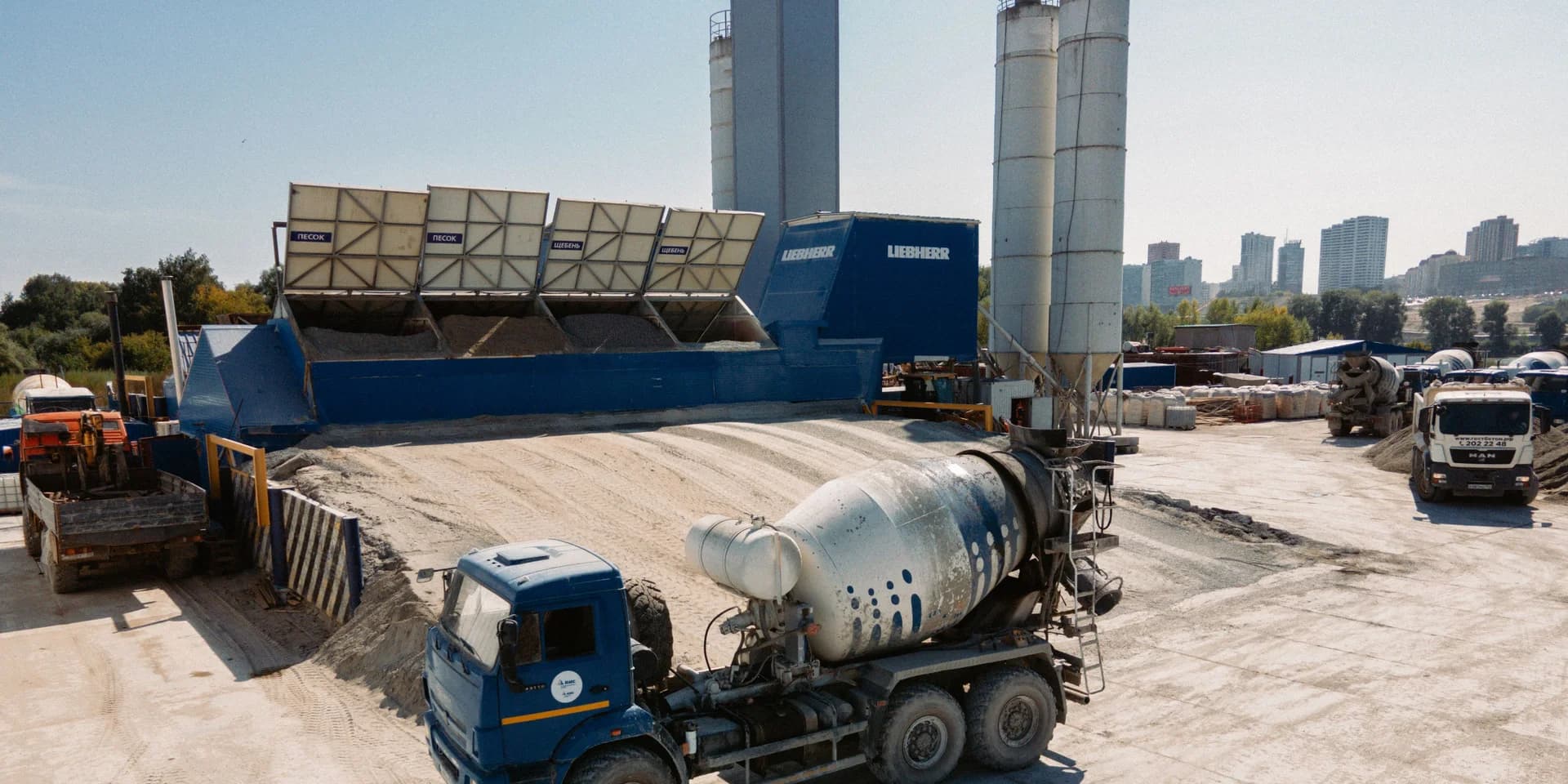
Why RMC software has to follow every pour
An RMC ERP has to connect every time-sensitive load to the order, approved mix, mixer, job-site events and later test results. Ready mix concrete leaves the plant before its quality record is complete, so the recipe, batch, delivery and test record cannot live in separate systems.
The plant schedules a pour, not finished stock
An order needs a concrete grade, quantity, site, pour window and delivery sequence. The plant also has to check batching capacity and mixer availability before it commits to that window.
The approved mix has to meet the actual batch
The mix design controls material planning and cost. Controller readings show what the plant consumed for each load, so cement, aggregate, water and admixture variance can be reviewed against the approved revision.
The mixer load is the traceability record
One load connects its finished batch to a vehicle, driver, dispatch time, site arrival, delivery challan and accepted quantity. Diversions, rejections and plant returns also belong at this level.
Quality stays open after the truck leaves
Slump checks and later strength results need to resolve back to the same mix, batch, pour location and customer. A failed result needs an escalation trail that survives beyond the day of dispatch.
For this reference workflow, Crator added those RMC records as a separate Frappe app. ERPNext remains the source of truth for sales, manufacturing, stock, fleet, delivery, accounting and quality actions.
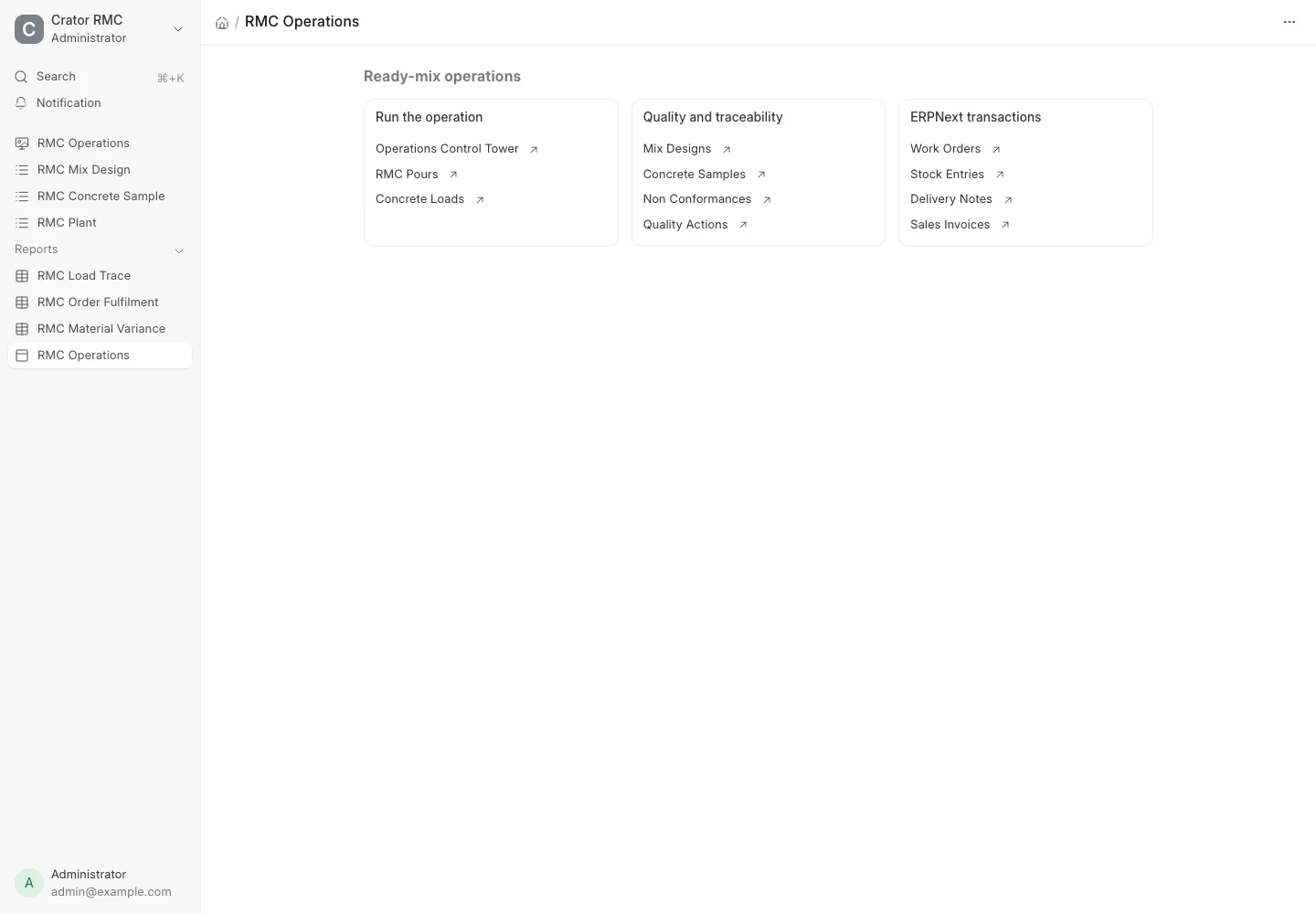
Order to dispatch
From one order to five mixer loads
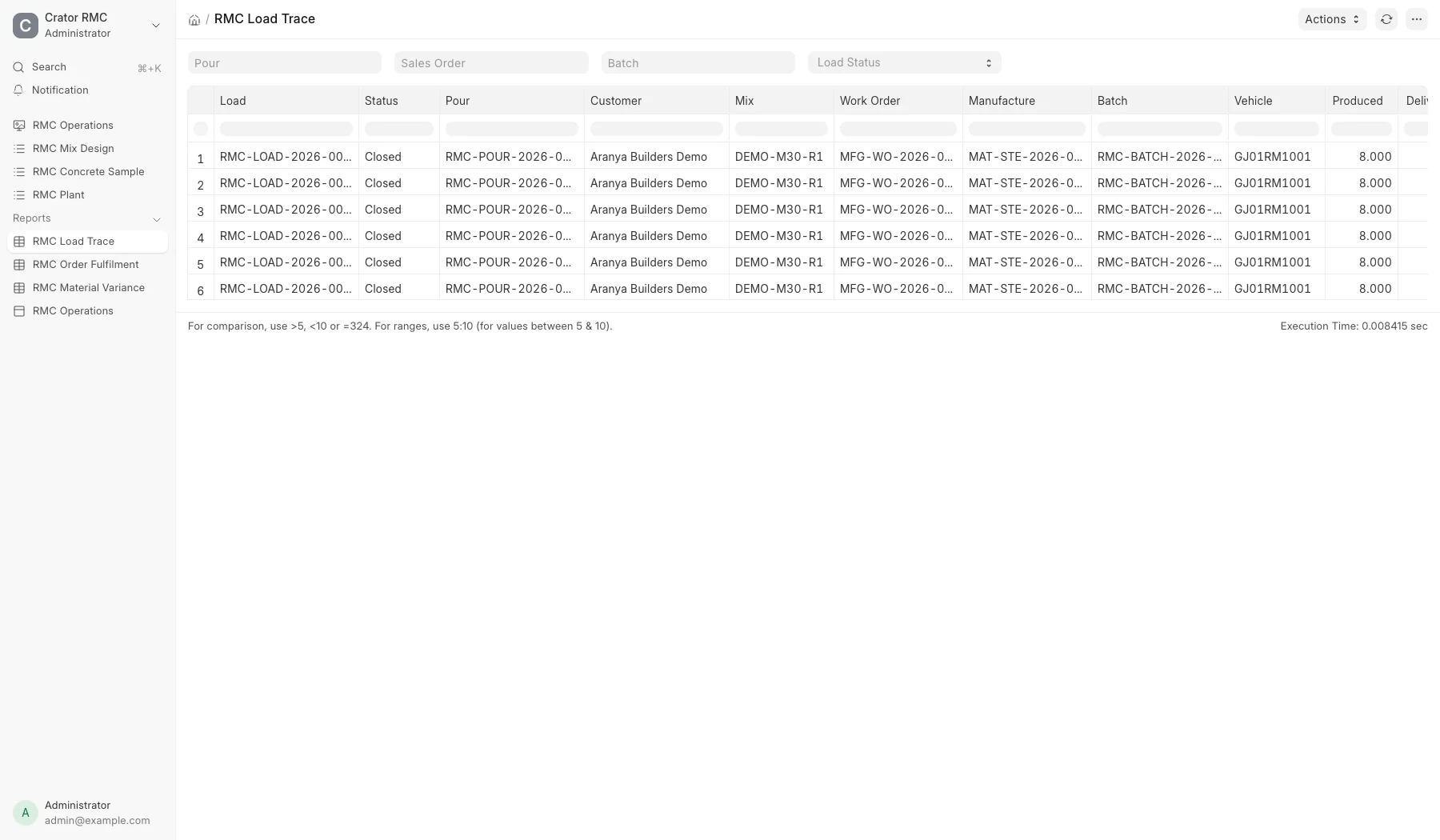
The 40 m³ order becomes one pour plan and five loads of 8 m³. One ERPNext Work Order covers the pour, while each load has its own manufacturing Stock Entry, finished concrete batch, assigned vehicle and trip timeline. This is the level where dispatch and traceability meet.
The report can answer a practical question without joining spreadsheets: which concrete batch, work order and mixer served each part of the pour?

Quality control
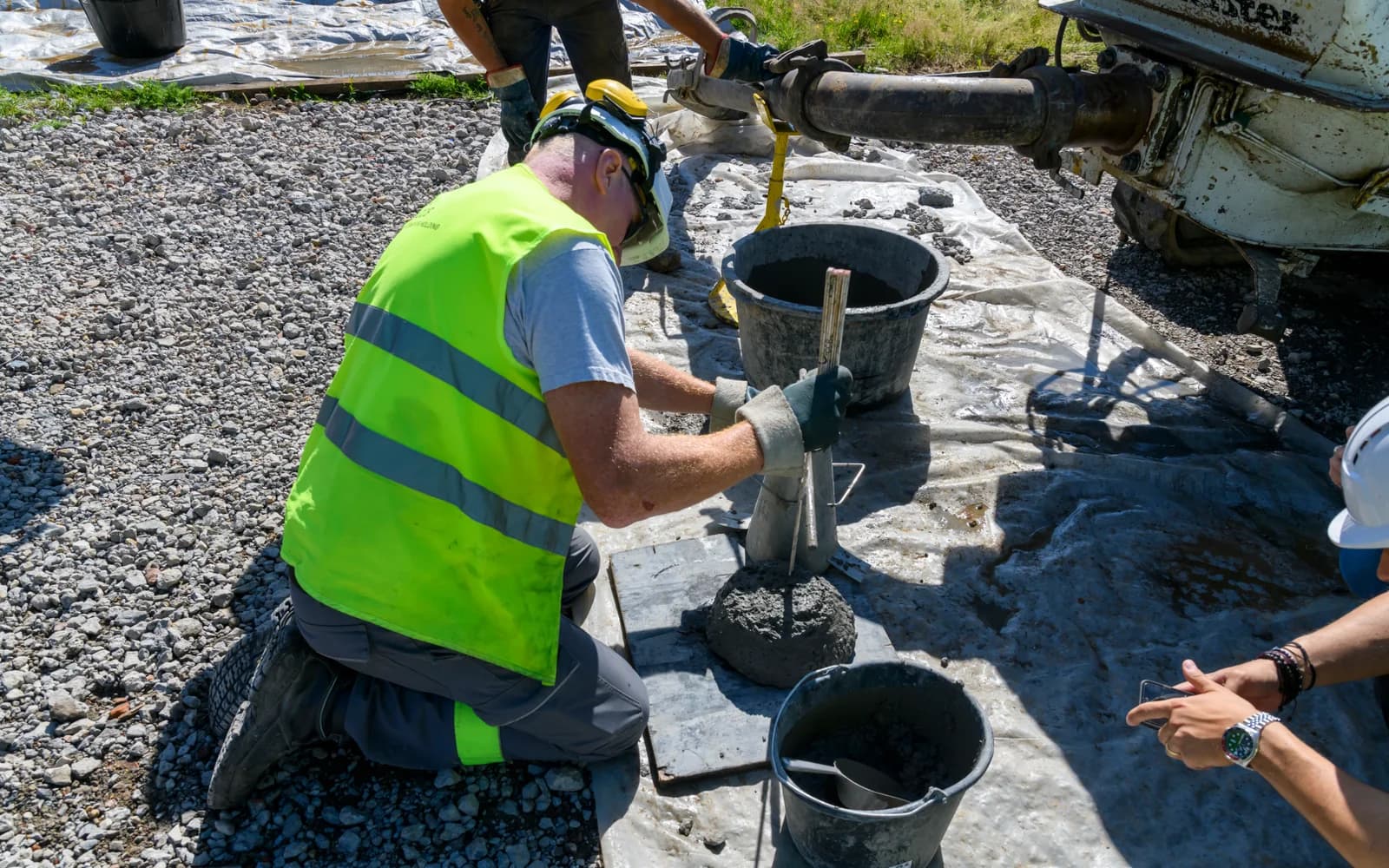
Quality stays attached to the load
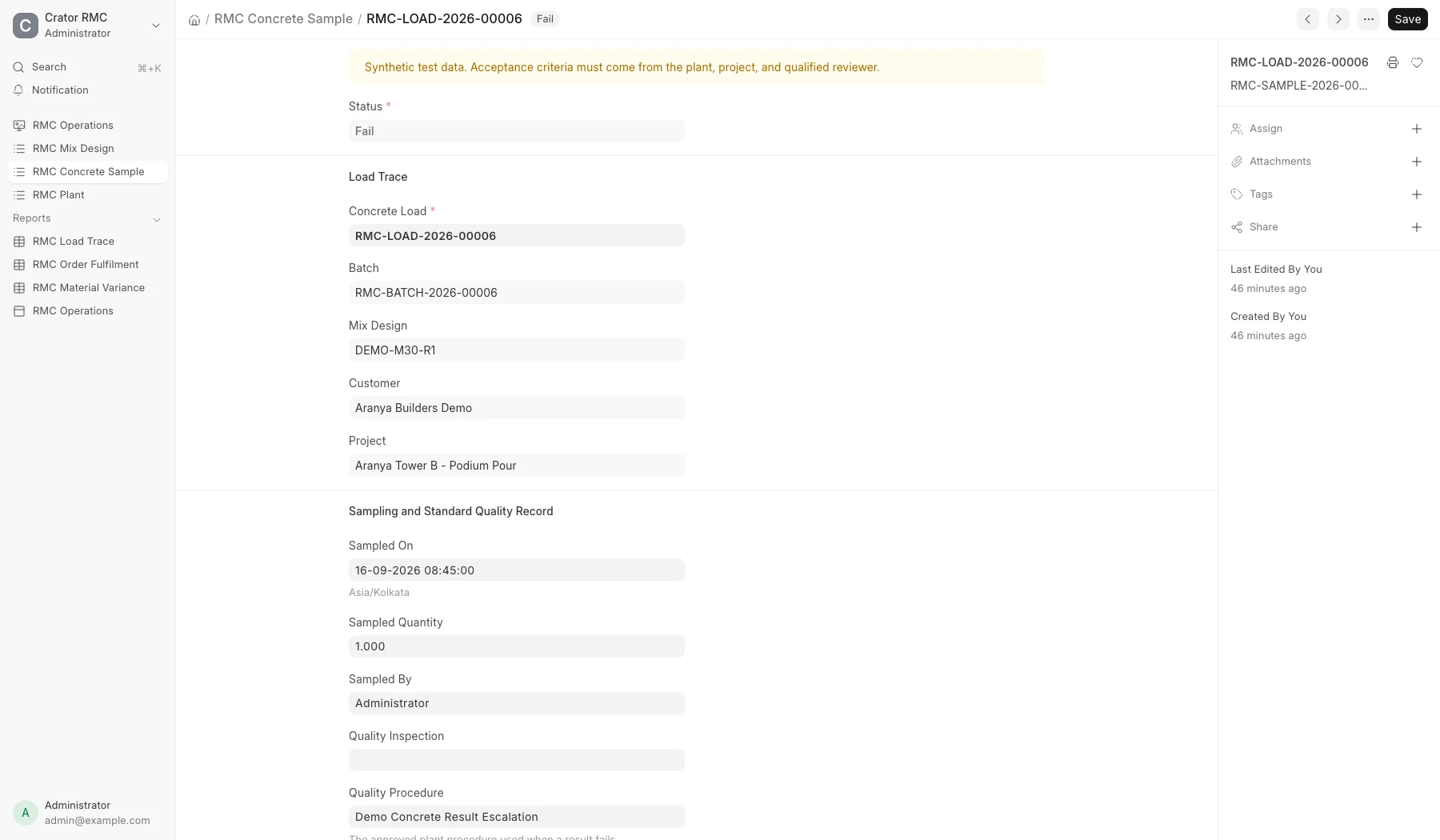
A concrete sample points back to the load, batch, mix revision, customer and project. The reference app supports scheduled test results and creates linked ERPNext Non Conformance and Quality Action records when a result fails.
The software records the event and holds the trace. It does not decide the mix, acceptance limit or engineering disposition. Those rules must come from qualified people and the plant's approved procedure.
Exception control
Returned concrete cannot disappear from the transaction
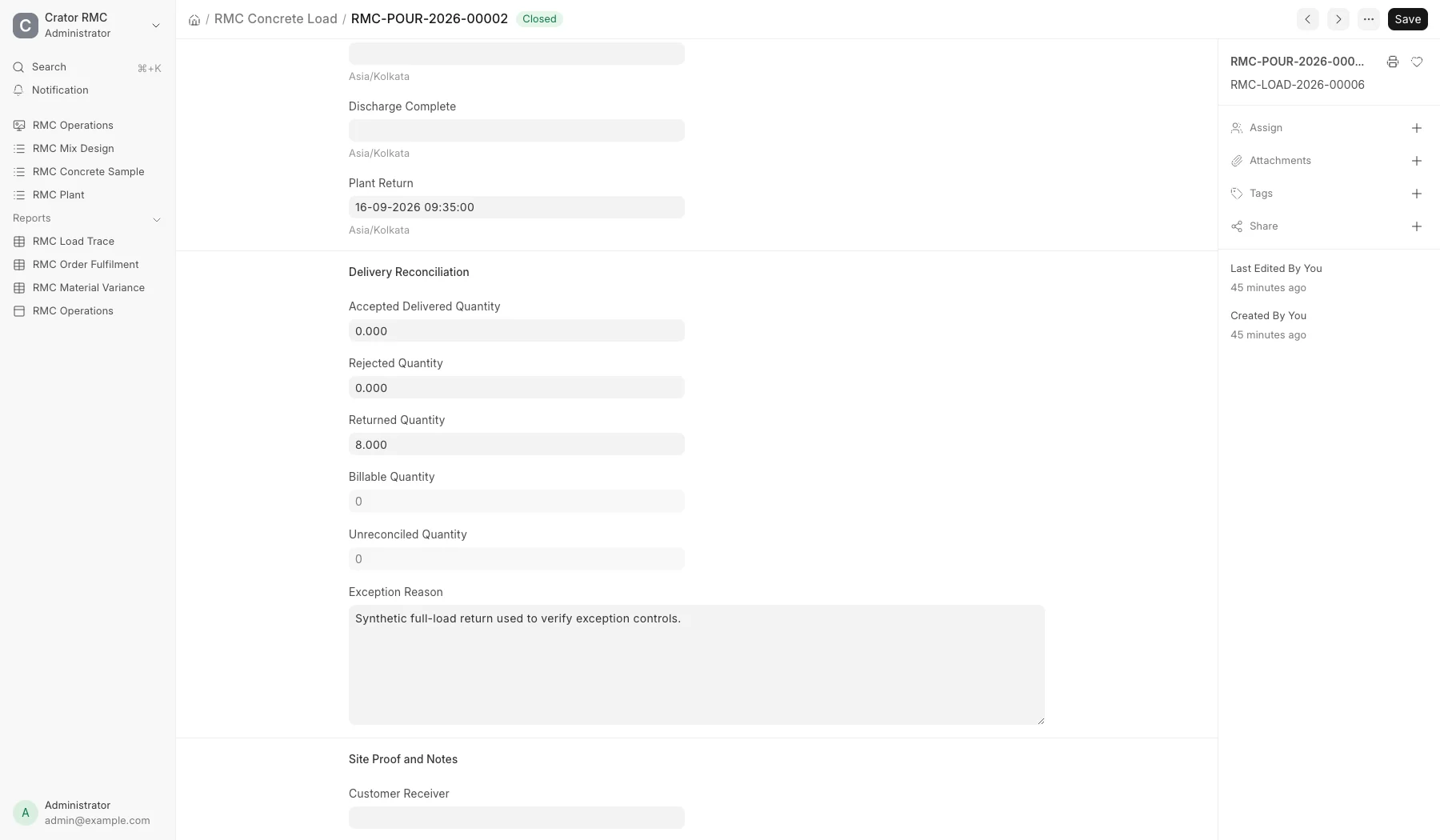
We ran a second transaction through a full return. The load produced 8 m³, returned 8 m³ to the plant, recorded zero accepted and zero billable quantity, and created no Delivery Note or Sales Invoice. A separate material variance was also flagged for review.
This proves the accounting guardrail without pretending the demo knows whether the concrete should be reused, reprocessed, disposed of or credited. That treatment is a plant policy decision.
Implementation
What Crator added to ERPNext
ERPNext supplies the commercial, manufacturing, inventory, fleet, delivery, accounting and quality foundation. Crator added an RMC Mix Design, RMC Pour, RMC Concrete Load, RMC Concrete Sample and plant records, plus reports for load trace, order fulfilment and material variance.
One RMC system
ERPNext foundation
- Sales Order and Project
- BOM, Work Order and Stock Entry
- Batch, Vehicle and Driver
- Delivery Note and Sales Invoice
- Non Conformance and Quality Action
Crator RMC layer
- Pour plan and site window
- Approved mix revision and per-load production
- Mixer trip timeline and controller readings
- Accepted, rejected and returned quantity control
- Load-linked samples and scheduled results
For the broader software decision, read our guide to the best ERP options for manufacturing in India.
Production boundary
What still needs a real plant decision
The app is a working starting point, not a claim of plant readiness. A production implementation still needs approved mix rules, controller and weighbridge interfaces, GPS and proof-of-delivery mapping, laboratory procedures, returned concrete policy, GST configuration, print formats and acceptance testing with plant staff. We would also confirm pump allocation and billing, mobile plant or hired-asset workflows, dump-and-divert permissions and multi-plant costing wherever they apply.
The record model was informed by the NRMCA quality management guidance, the Indian ready-mixed concrete standard context published by the Bureau of Indian Standards, and standard ERPNext records for manufacturing and quality management. These references do not certify the synthetic build for a real plant.
Frequently asked questions
It connects the customer order, approved mix revision, pour plan, plant production, transit mixer, delivery, quality sample, returned quantity and invoice. The useful unit of traceability is the individual mixer load.
Yes. ERPNext already provides sales, manufacturing, stock, batch, fleet, delivery, accounting and quality records. Crator adds the RMC-specific operating model for pours, mix revisions, mixer loads, material readings, trip events and quantity reconciliation.
Yes, after the plant systems and their interfaces are confirmed. This reference build records controller IDs, material readings and trip timestamps, but its integration data is deliberately marked as synthetic. A production adapter needs plant-specific mapping, retries and failure handling.
A load cannot close until produced quantity is reconciled as accepted, rejected or returned. The reference exception records eight cubic metres returned, zero billable quantity and no delivery or invoice. The operational treatment of returned concrete still requires an approved plant policy.
It is a working reference implementation built with Crator on ERPNext. We can hand over the app and adapt it, but mix engineering, controller integration, laboratory rules, tax configuration and production acceptance still need decisions from the actual plant team.