ERP for electronics manufacturing in India
We used Crator to build a working electronics manufacturing ERP reference on ERPNext. One synthetic industrial gateway order connects an approved BOM revision, component lots and date codes, an approved alternate, 12 finished serials, functional testing, rework, delivery and invoicing. The screens below come from the installed ERP, not a design mockup.
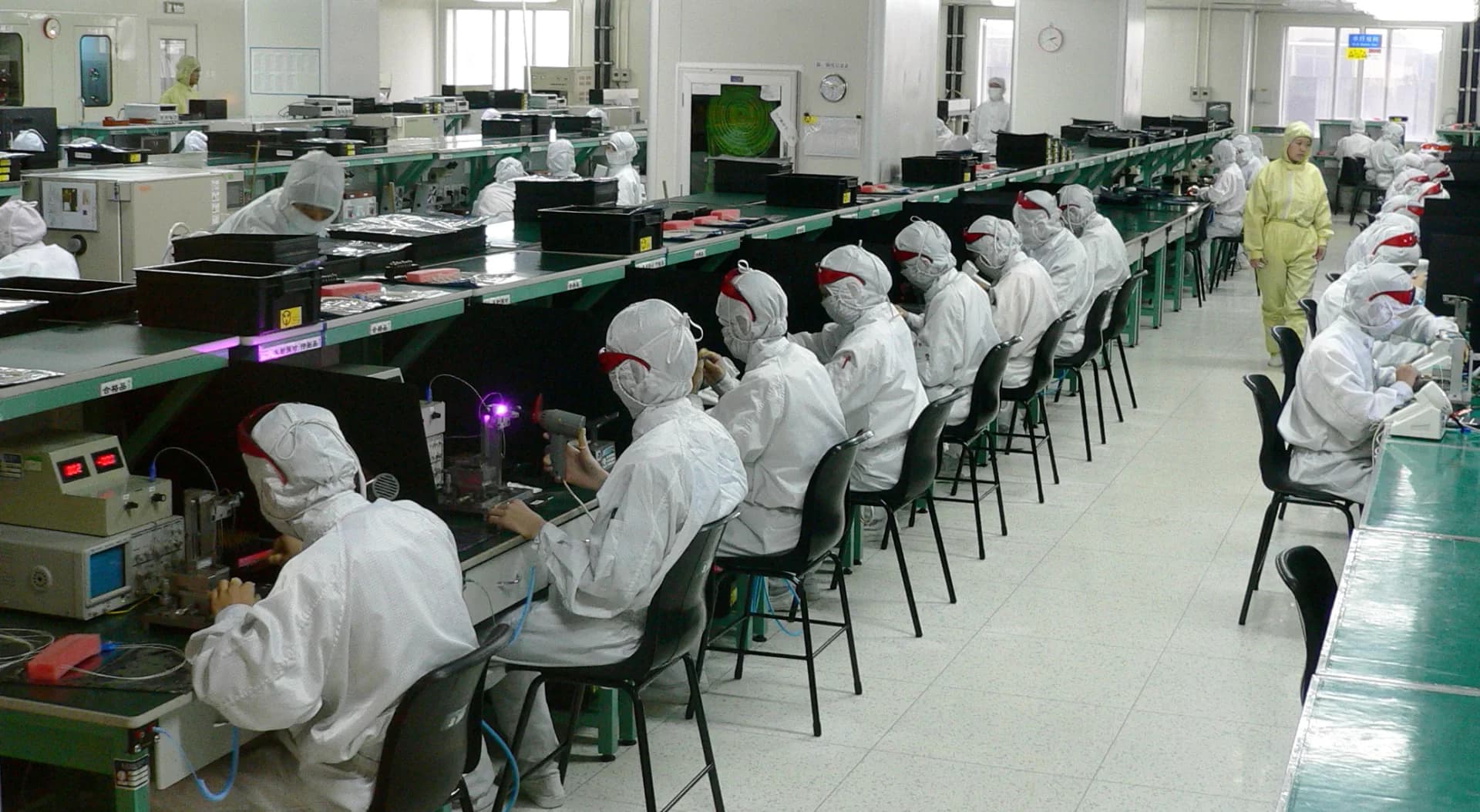
Why electronics manufacturing software has to follow the exact build
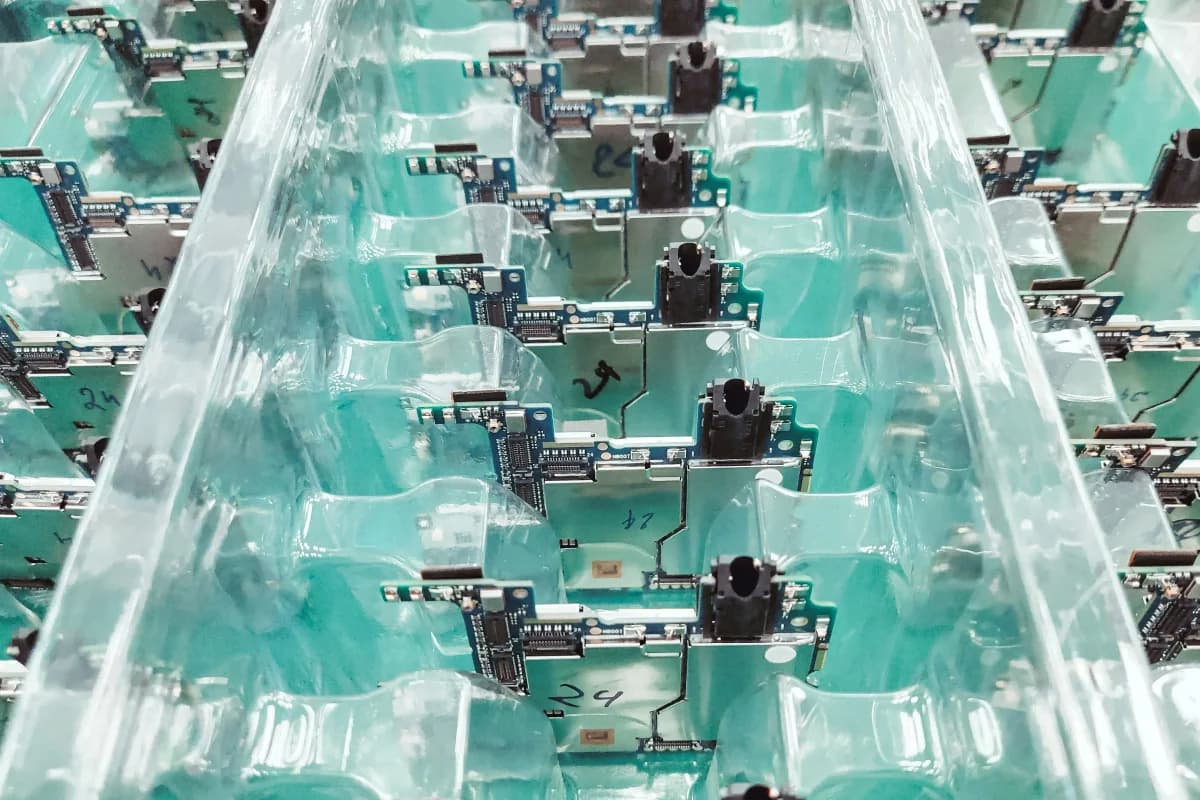
A finished gateway is one saleable item, but its manufacturing record is a chain of engineering, material and test decisions. When a field failure appears, the useful question is not only which work order made it. The team needs to know which revision, substitute, component lots, date codes, tests and rework belong to that individual serial number.
The production revision must be explicit
A released unit should resolve to the approved BOM revision that governed its build.
A substitute is a controlled engineering decision
An available part is not automatically valid for every product revision and effective date.
Component identity continues into each serial
Lot and date-code history makes a material question answerable after shipment.
A failed test is part of the product history
Failure, authorised rework and passing retest must remain in sequence instead of being overwritten.
Revision and substitute control
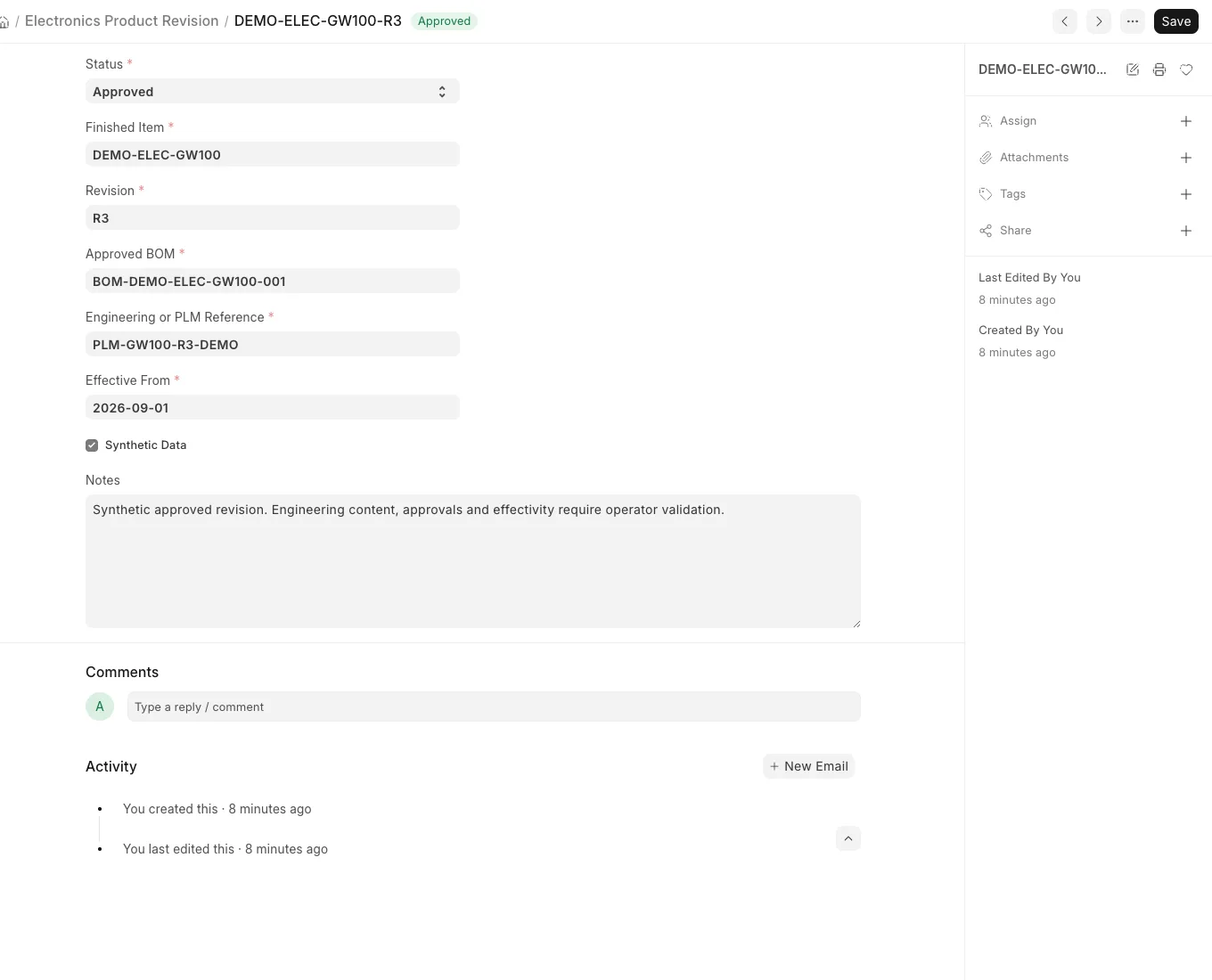
The gateway is built against approved revision R3
The Electronics Product Revision locks product DEMO-ELEC-GW100 to its submitted ERPNext BOM, drawing reference and effective date. Approval makes that revision immutable in the reference app.
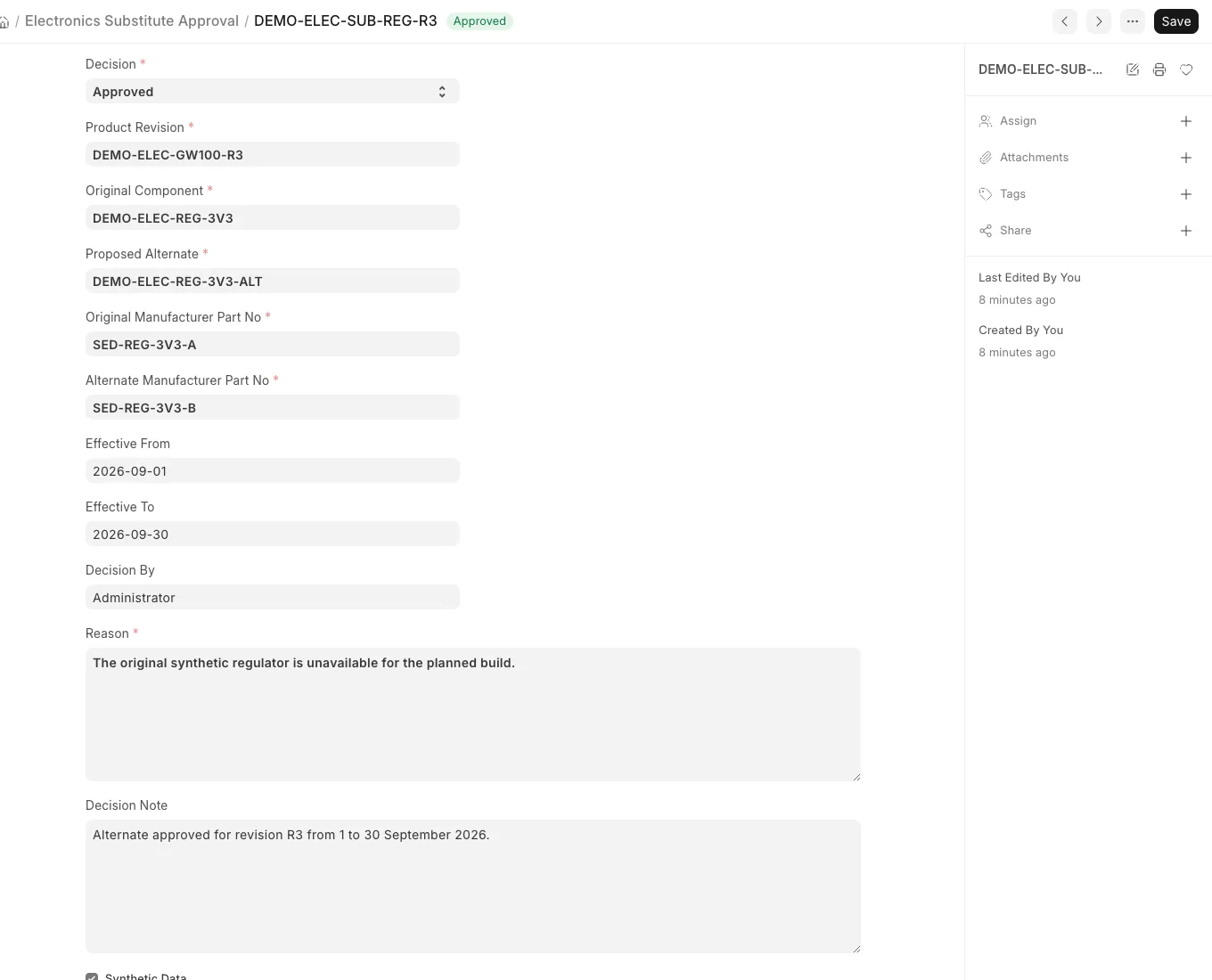
A separate approval authorises one synthetic 3.3 V regulator alternate for R3. It records the original component, alternate component, reason, approver and effective window before production starts.
Standard manufacturing documents
The assembly order connects engineering to ERPNext execution
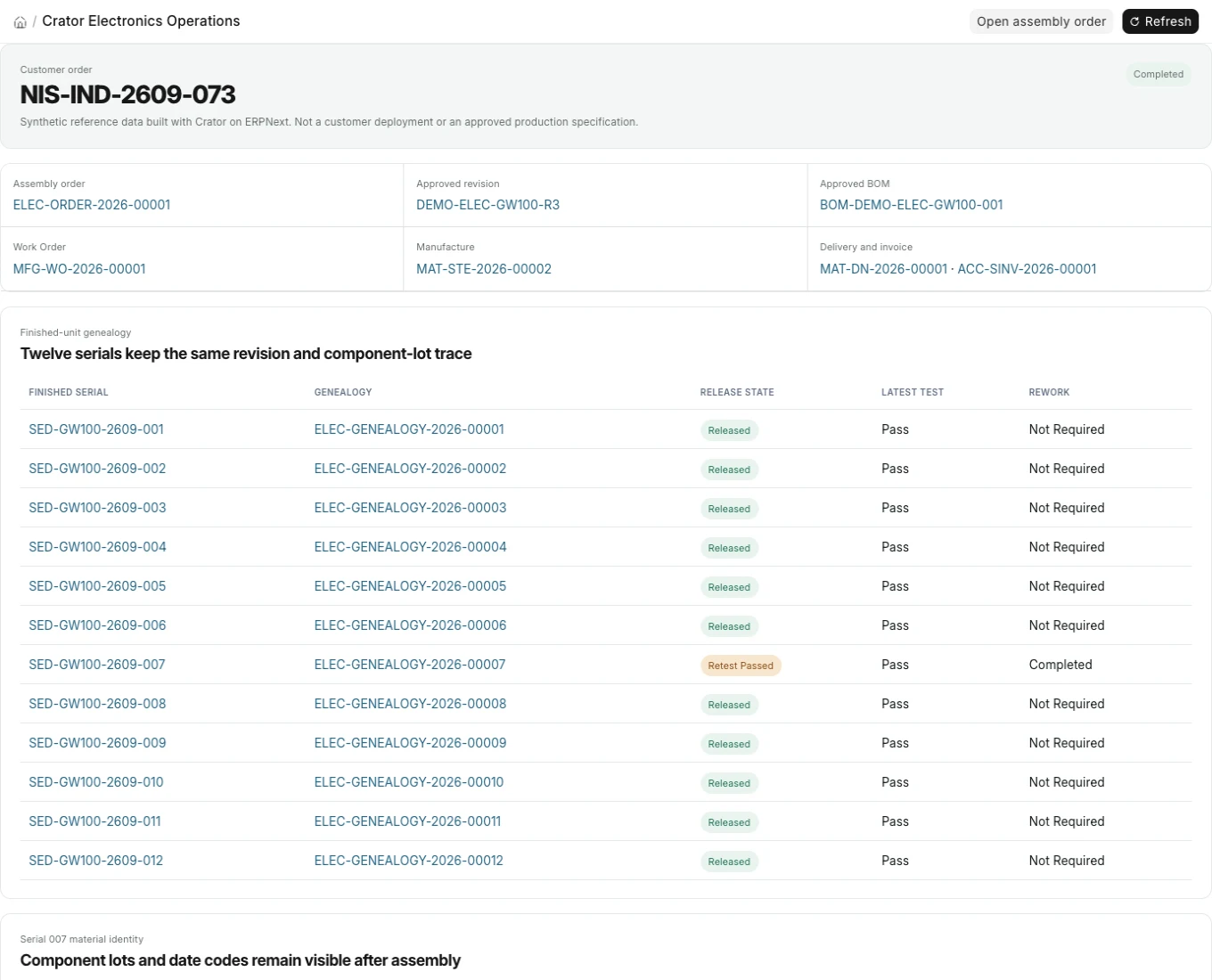
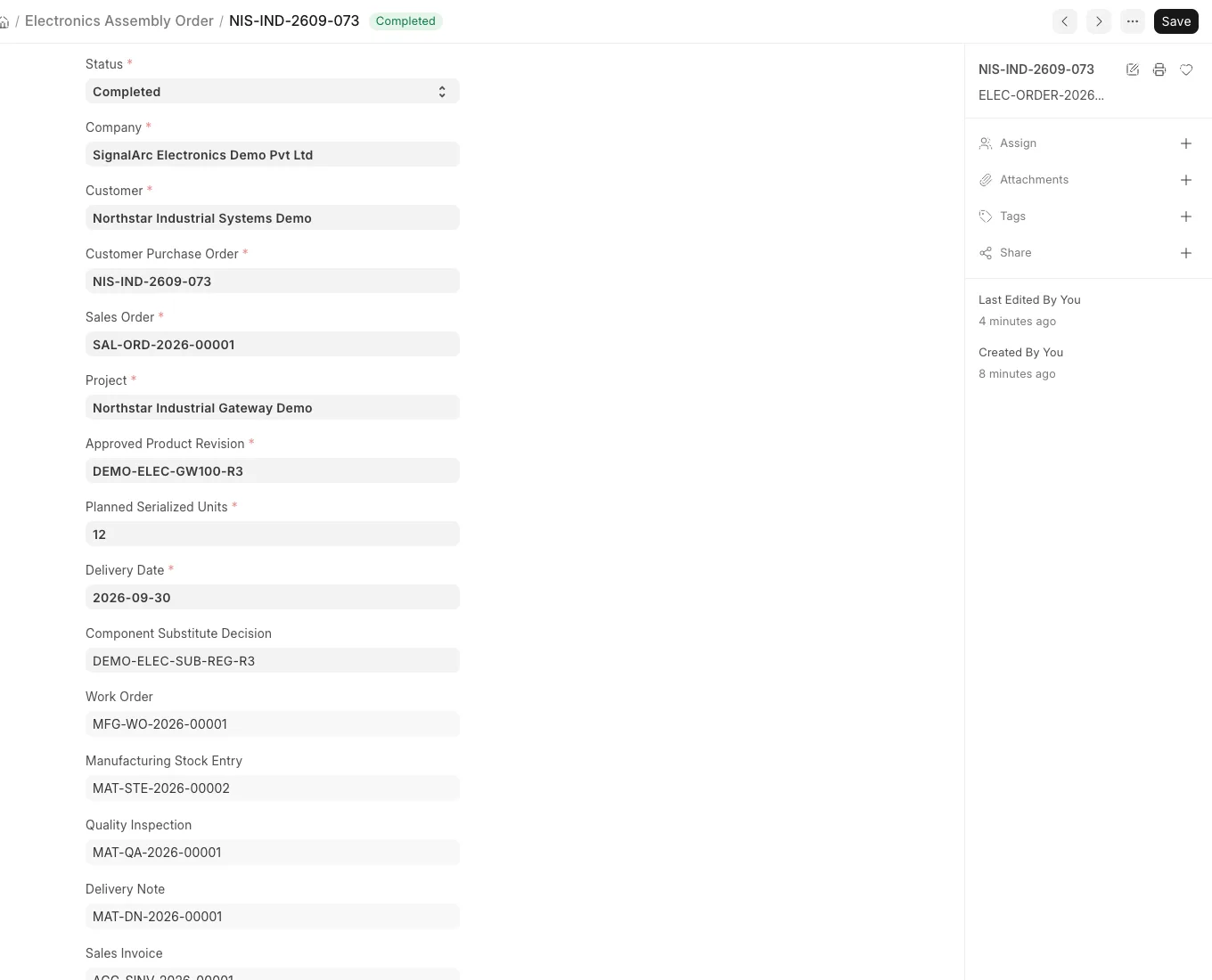
The synthetic customer order plans 12 serialized gateways. Its Crator assembly order links the approved revision and substitute approval to a submitted ERPNext Sales Order, Work Order, manufacture Stock Entry, Quality Inspection, Delivery Note and Sales Invoice.
Those standard documents remain the stock and commercial system of record. Crator adds the electronics-specific context and validates that the released chain agrees from manufacture to delivery.
Per-serial genealogy and test
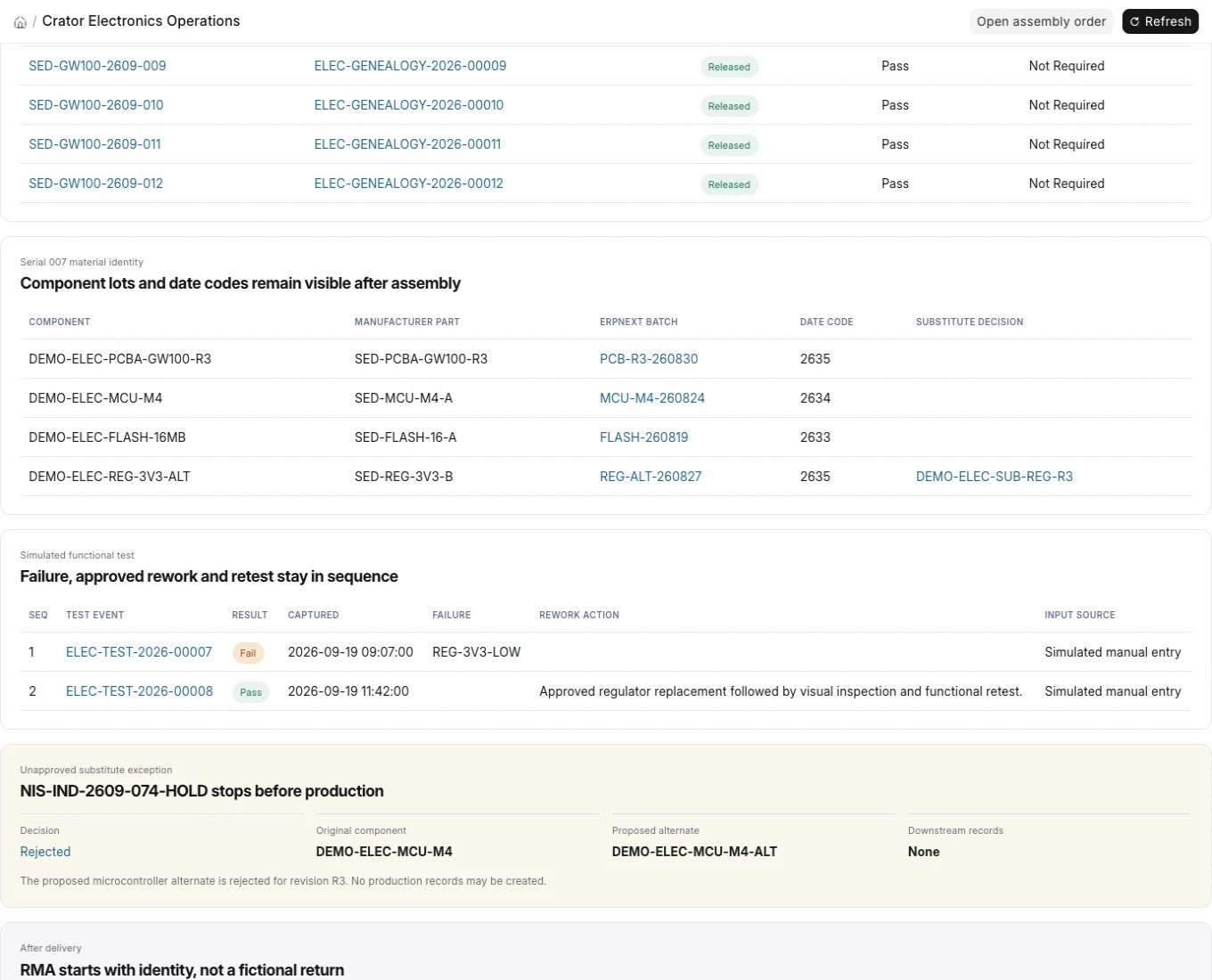
All 12 serials keep the same four component lots
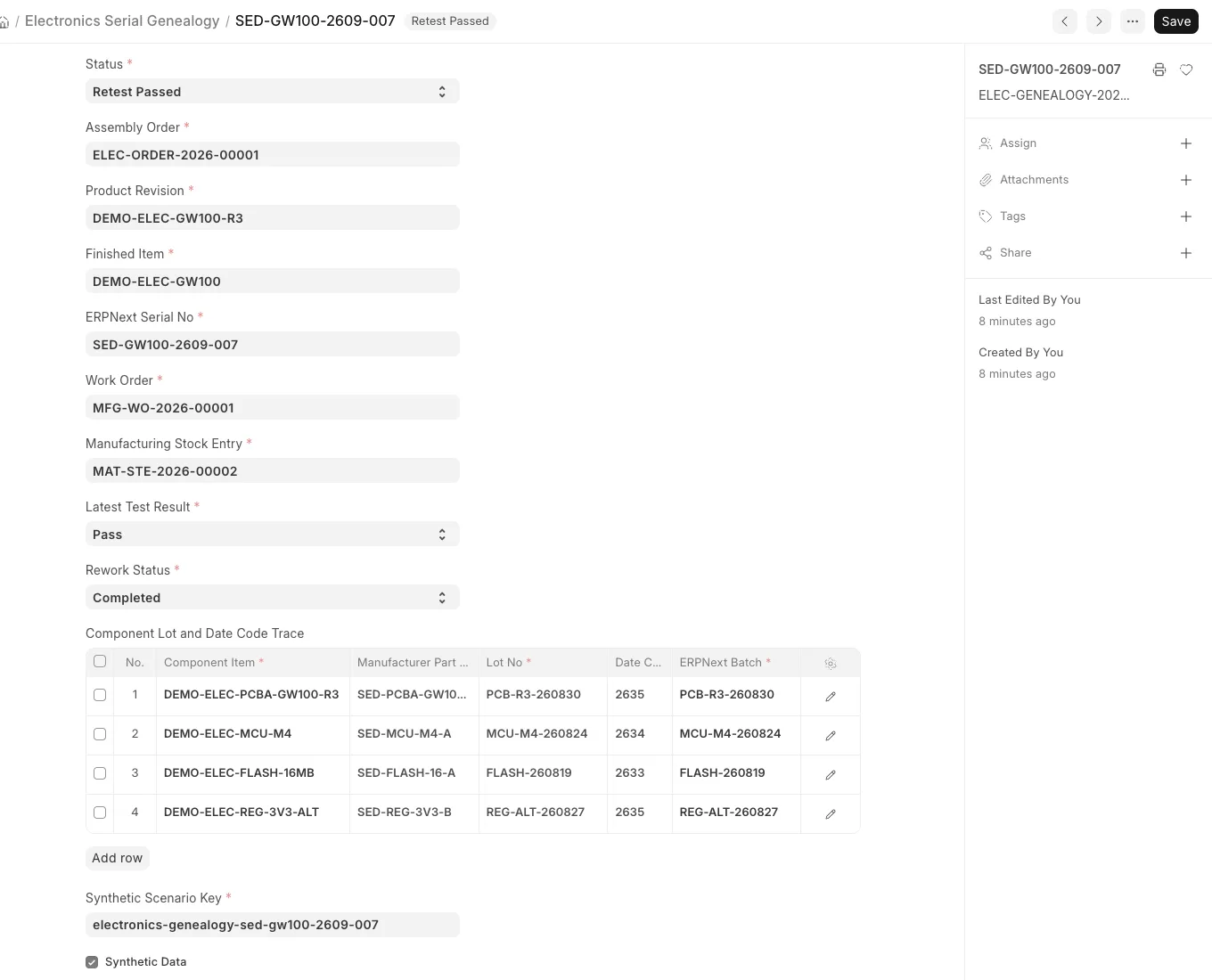
Each finished Serial No has a genealogy record for revision R3, PCBA lot PCB-R3-260830, microcontroller lot MCU-M4-260824, flash lot FLASH-260819 and regulator lot REG-ALT-260827. The lot rows also retain synthetic date codes 2633 through 2635.
Serial SED-GW100-2609-007 first fails functional test with code REG-3V3-LOW. Its history then records approved regulator rework and a later passing retest. The original failure remains visible.
Blocked exception
An unapproved microcontroller substitute stops before production
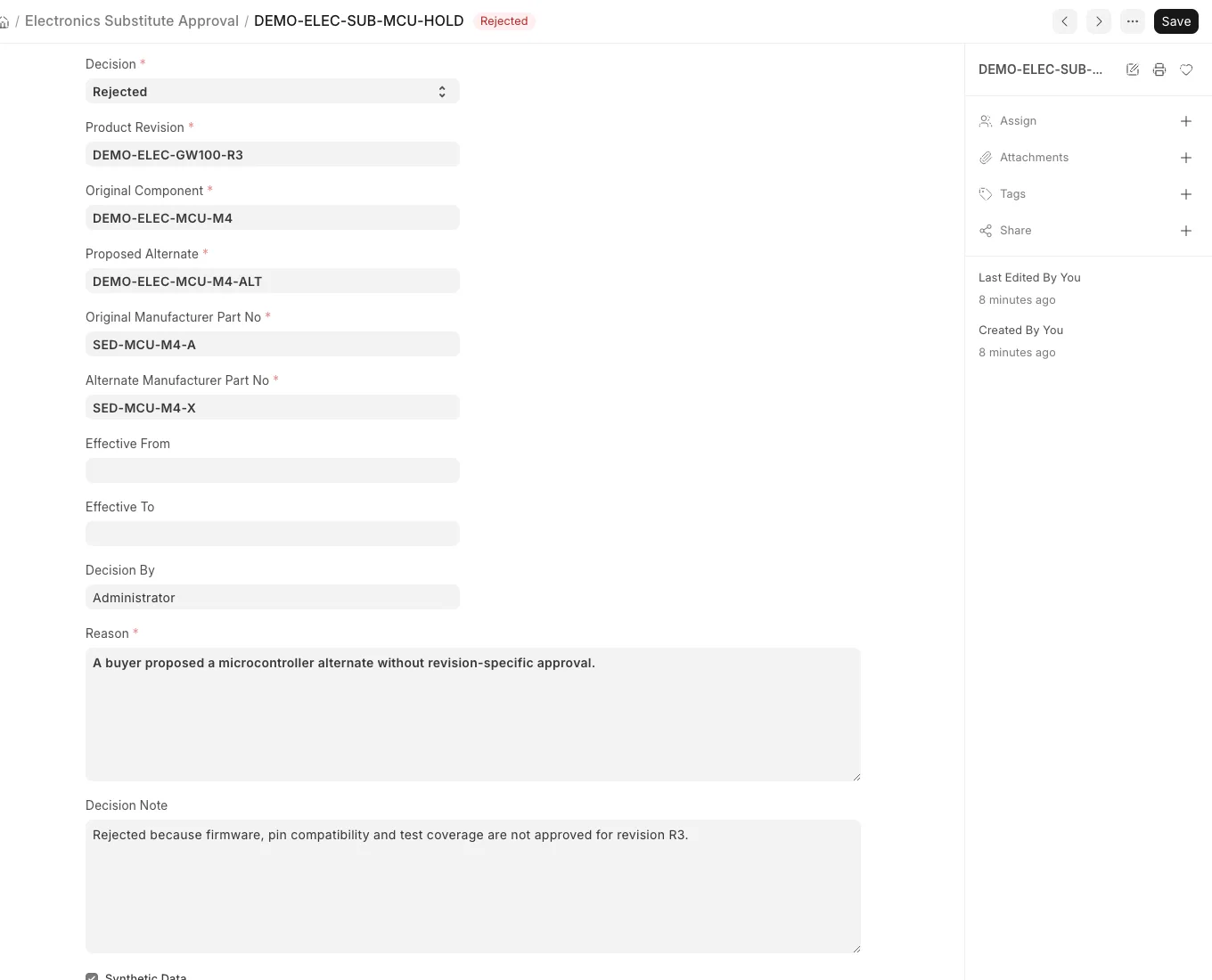
A second synthetic four-unit order proposes a microcontroller alternate that is not approved for revision R3. The Electronics Substitute Approval records the rejected decision and the assembly order stays on Component Hold.
Tests confirm that the held order has no Work Order, manufacture Stock Entry, finished serial, Quality Inspection, Delivery Note, Sales Invoice or genealogy. The system shows a real stop, not a warning beside transactions that already happened.
After shipment
The RMA record begins at the return boundary
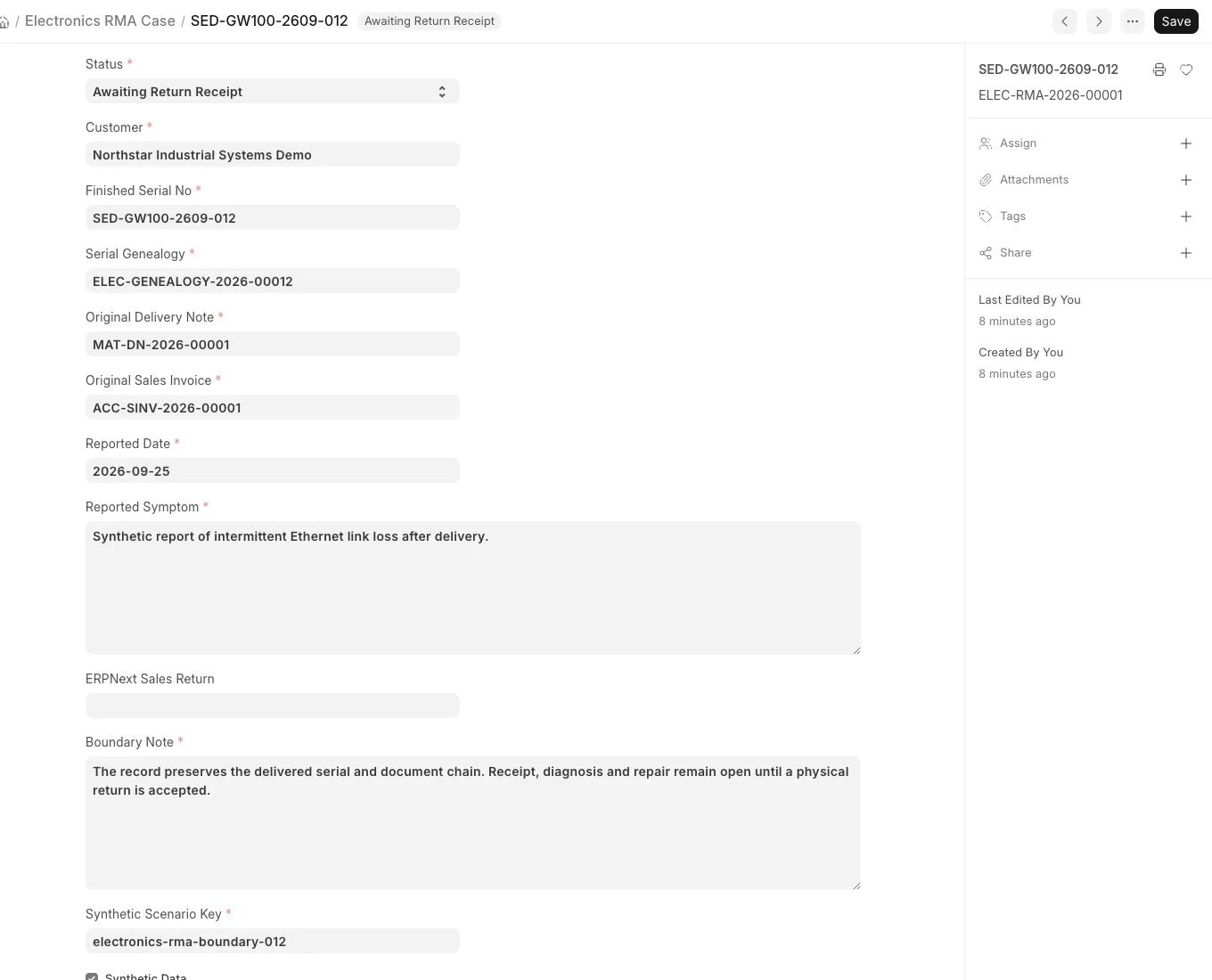
One synthetic reported symptom links back to the delivered serial, its genealogy, Delivery Note and Sales Invoice. The case stays at Awaiting Return Receipt. It does not claim that stock was returned, diagnosed, repaired or replaced.
A real return would begin only after accepted physical receipt and a standard ERPNext Sales Return. Authorisation, quarantine, diagnosis, repair, replacement and warranty decisions still need a production process owned by the manufacturer.
Implementation
What Crator added to ERPNext
ERPNext remains the order, production, stock, quality, delivery and accounting foundation. Crator adds the controlled electronics revision, substitution decision, per-serial material and test history, blocked-release logic and RMA boundary as a separate Frappe app.
One electronics manufacturing system
ERPNext foundation
- Items, BOMs and Item Alternatives
- Sales Orders and Work Orders
- Batches, Serial Numbers and Stock Entries
- Quality Inspections, Delivery Notes and Sales Invoices
Crator electronics layer
- approved product revision with BOM lock
- substitute approval scoped to the revision
- component lot and date-code genealogy per serial
- test, rework and retest event history
- component hold and return-receipt boundary
For the broader software decision, read our guide to the best ERP options for manufacturing in India.
Production boundary
What a real electronics manufacturer still has to decide
This reference proves the configured records and controls, not production readiness. A rollout still needs engineering BOM ownership, PLM integration, approved-vendor and substitute governance, receiving and moisture controls, reel and tray labelling, scan points, SMT and inspection interfaces, test protocols, failure and rework authority, genealogy depth, permissions, security, tax and accounting configuration, retention, migration, validation, user acceptance, cutover and support.
It also needs a documented compliance position for the actual product and markets. IPC describes risk-based traceability rather than one universal record set. An ERP record alone does not prove RoHS, REACH, BIS, WEEE, safety, EMC, customer or IPC compliance.
Reference basis: ERPNext documentation for BOMs, Work Orders, Quality Inspections and Delivery Notes; electronics traceability boundary informed by IPC-1782B.
Frequently asked questions
It should connect the customer order to the approved product and BOM revision, component lots and date codes, authorised substitutes, work order, finished serials, test history, rework, quality release, delivery and invoice. PLM, SMT line control, AOI, test equipment and compliance systems remain separate unless they are deliberately integrated.
Yes. ERPNext provides Items, BOMs, Item Alternatives, Work Orders, Batches, Serial Numbers, Stock Entries, Quality Inspections, Delivery Notes and Sales Invoices. Crator adds the controlled product revision, substitute approval, per-serial genealogy, test-event sequence and RMA boundary shown here without changing ERPNext core.
Each released finished serial has a genealogy record tied to the approved revision and the exact synthetic component lots used in its build. The reference records the PCBA, microcontroller, flash memory and regulator lot plus date code for all 12 units. A live design must decide its required trace depth, scan points and retention rules.
Only when the alternate is approved for the named BOM revision and effective window. The reference accepts one regulator alternate and separately rejects a proposed microcontroller substitute. The rejected request leaves its assembly order on Component Hold with no work order, manufacture, serial, quality, delivery or invoice documents.
No. The reference proves an internal document trail. It does not establish RoHS, REACH, BIS, WEEE, safety, EMC, customer or IPC compliance. A production rollout must define the applicable product, market and customer requirements, approve the evidence source and validate the resulting controls.
It is a working reference app built with Crator on ERPNext, not a fictional customer case study. The app can be handed over and adapted, but production still needs approved masters, integrations, permissions, security, accounting and tax configuration, migration, validation, user acceptance and support.