ERP for footwear manufacturing in India
We used Crator to build a working footwear manufacturing reference on ERPNext. One synthetic 120-pair Derby order connects three size SKUs, upper-and-sole BOMs, a leather batch, cutting yield, left-right pair matching, assembly, quality, delivery, invoicing and costing. The screens below come from the installed ERP, not a design mockup.
Why footwear software has to follow every size and every pair
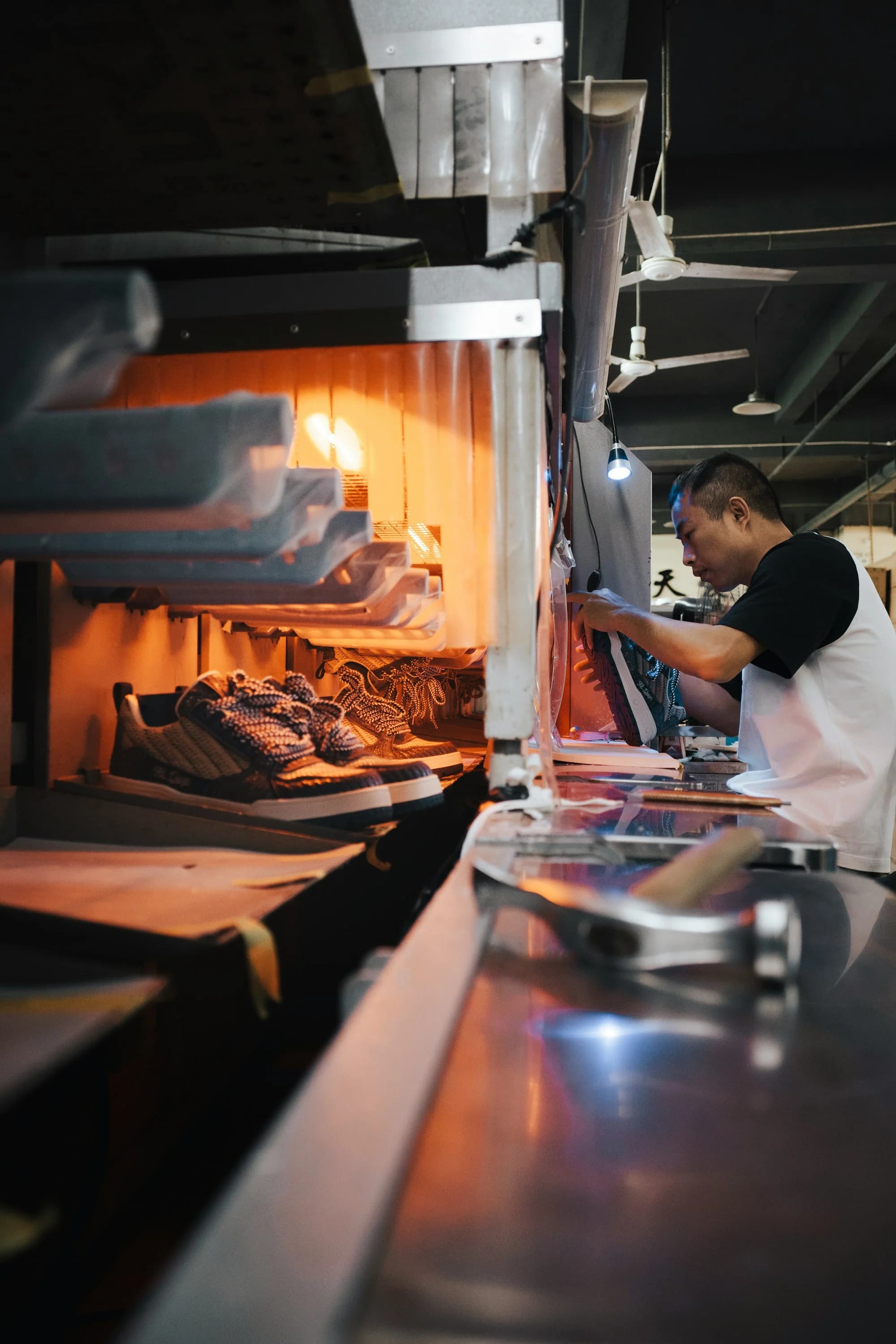
A footwear order may share one style and colour, but the factory still buys and cuts area-based material, produces separate sizes, forms left and right components, and releases matched pairs. The useful record connects that physical work to standard inventory, manufacturing and accounts.
The size run remains distinct
Sizes 7, 8 and 9 are separate finished SKUs with their own BOM, Work Order and accepted quantity.
The BOM joins upper and sole materials
Leather, outsole, insole, laces, adhesive and packaging stay connected to the finished-size route.
Left and right must become one matched pair
Equal upper counts, matched pairs, assembly and accepted quality are checked before completion.
Cutting yield includes reusable remnant
Allocated area resolves into accepted uppers, scrap and remnant instead of disappearing into one usage figure.
Size-run planning
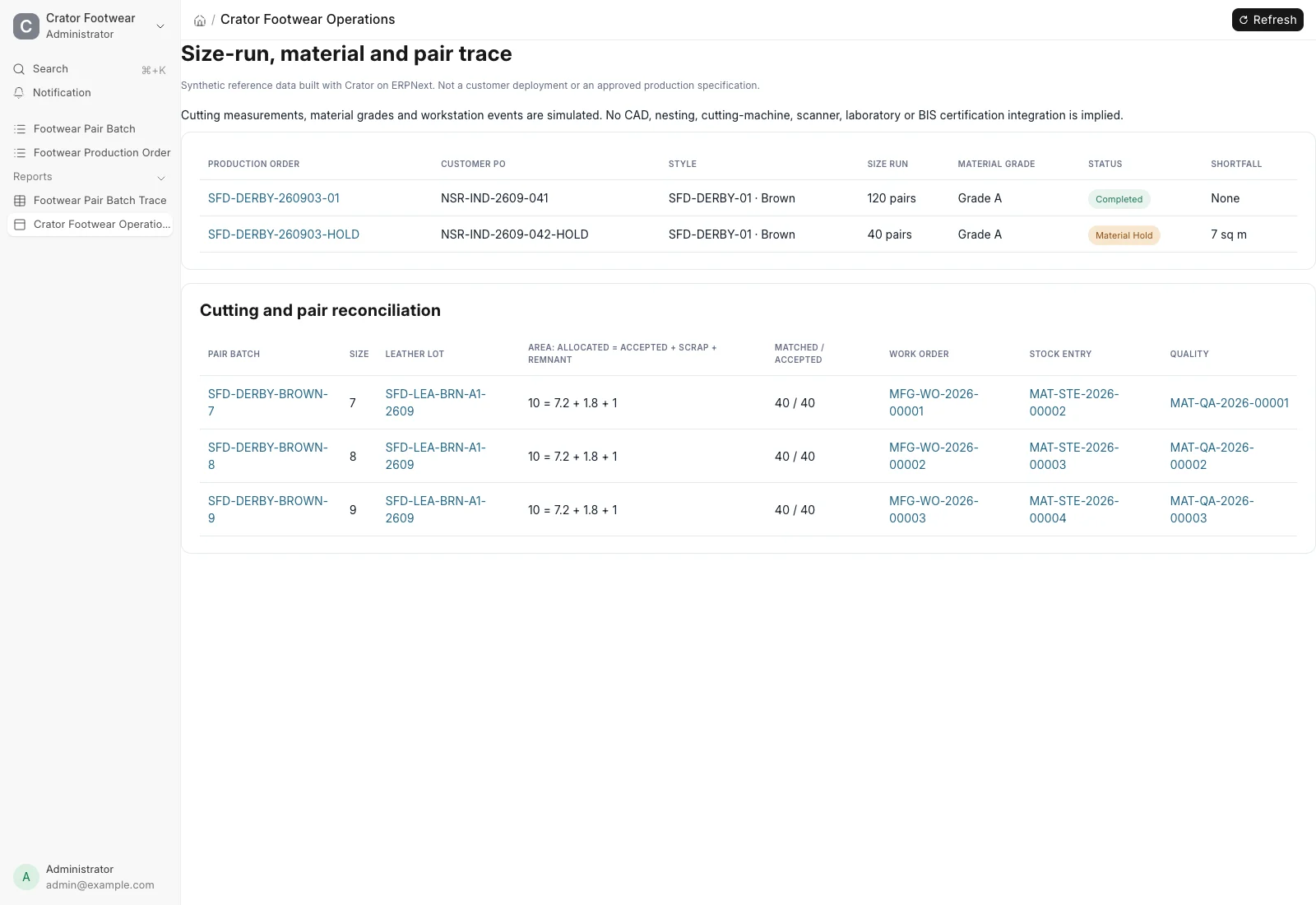
One customer order becomes three controlled manufacturing routes
The synthetic order holds 40 pairs each in sizes 7, 8 and 9. Each size is an ERPNext Item variant with an upper-and-sole BOM and a Work Order routed through cutting, closing, lasting, sole attachment and finishing.
Last and colour references remain production master data. The reference does not design the last, grade a pattern or operate a cutting machine.
Cutting and pair execution
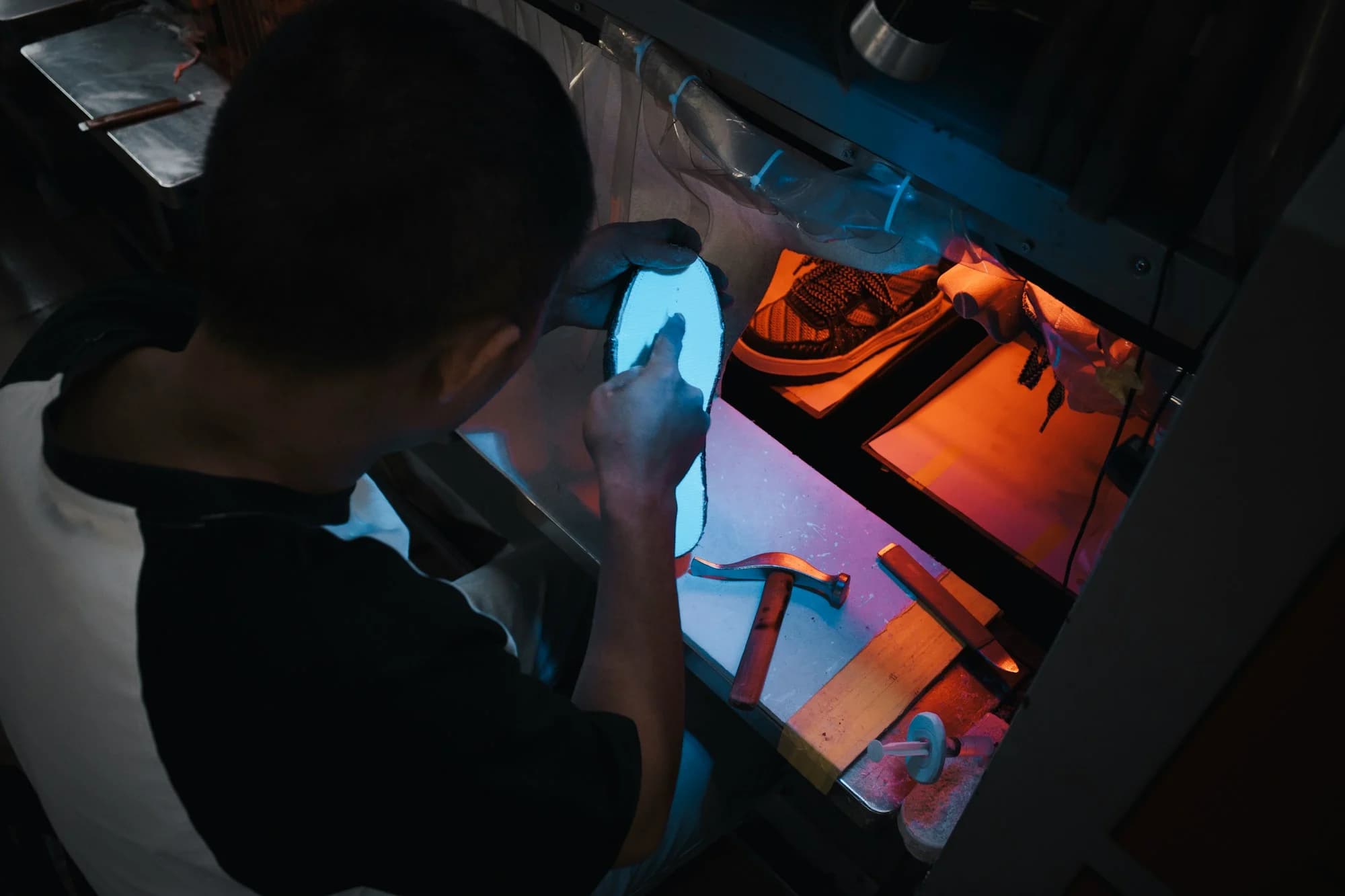
Area yield and pair counts reconcile at each size
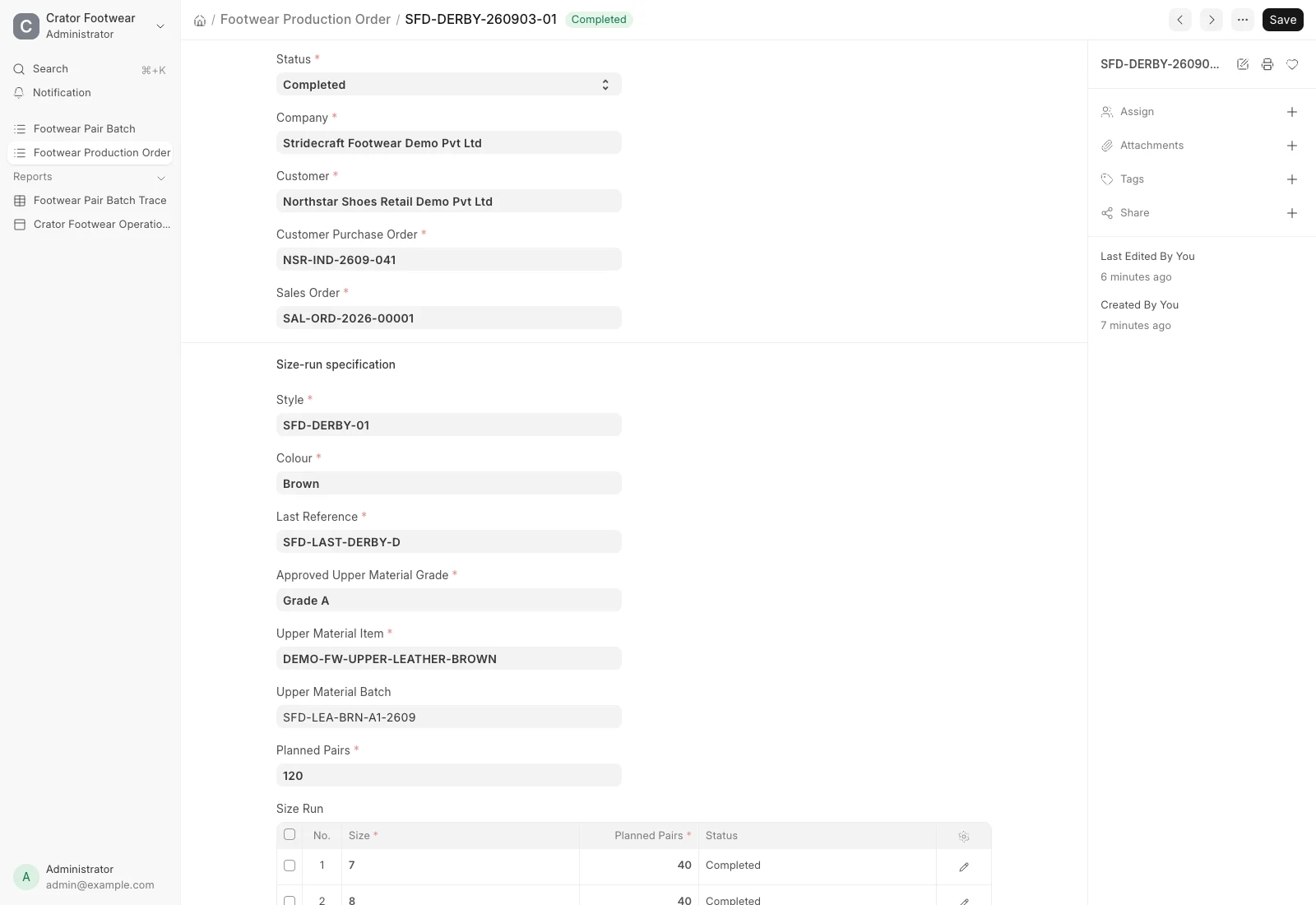
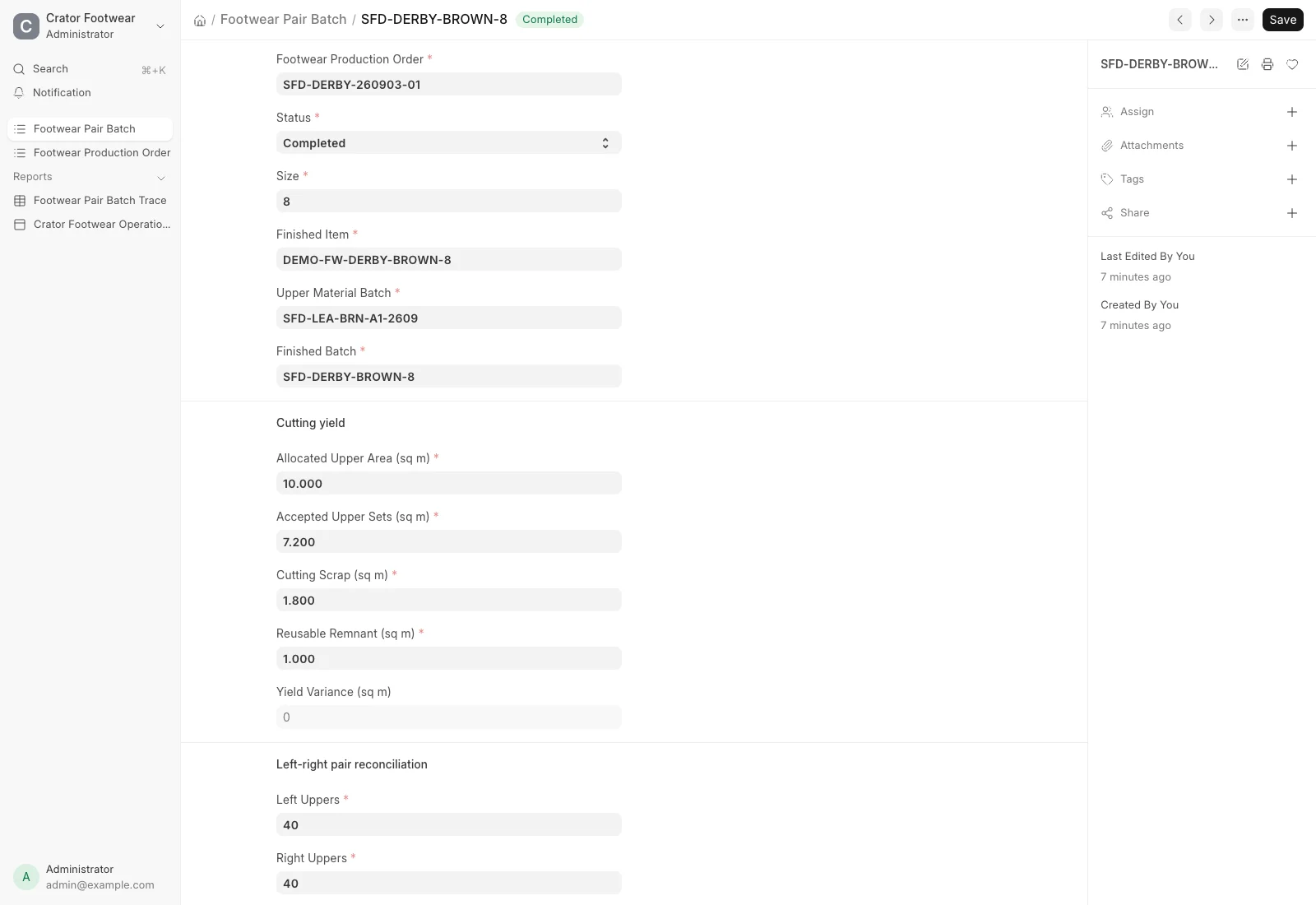
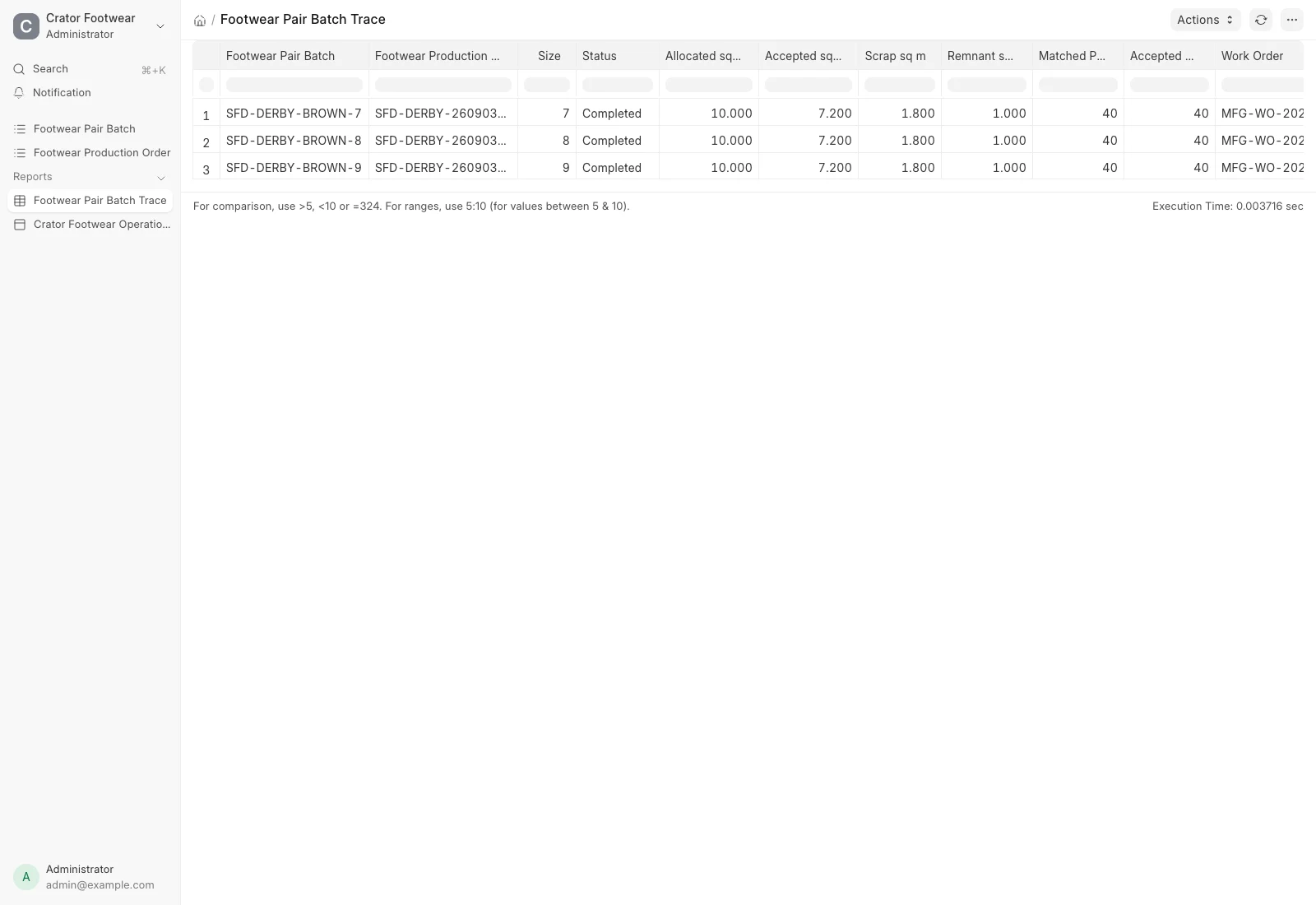
Each size receives 10.000 square metres of the synthetic Grade A leather batch. The pair batch records 7.200 square metres in accepted upper sets, 1.800 as cutting scrap and 1.000 as reusable remnant, leaving zero cutting-area variance.
It then records 40 left uppers, 40 right uppers, 40 matched pairs, 40 assembled pairs and 40 accepted pairs. The app rejects a record if those equations do not agree.
ERPNext manufacturing and quality
The footwear trace resolves to submitted standard documents
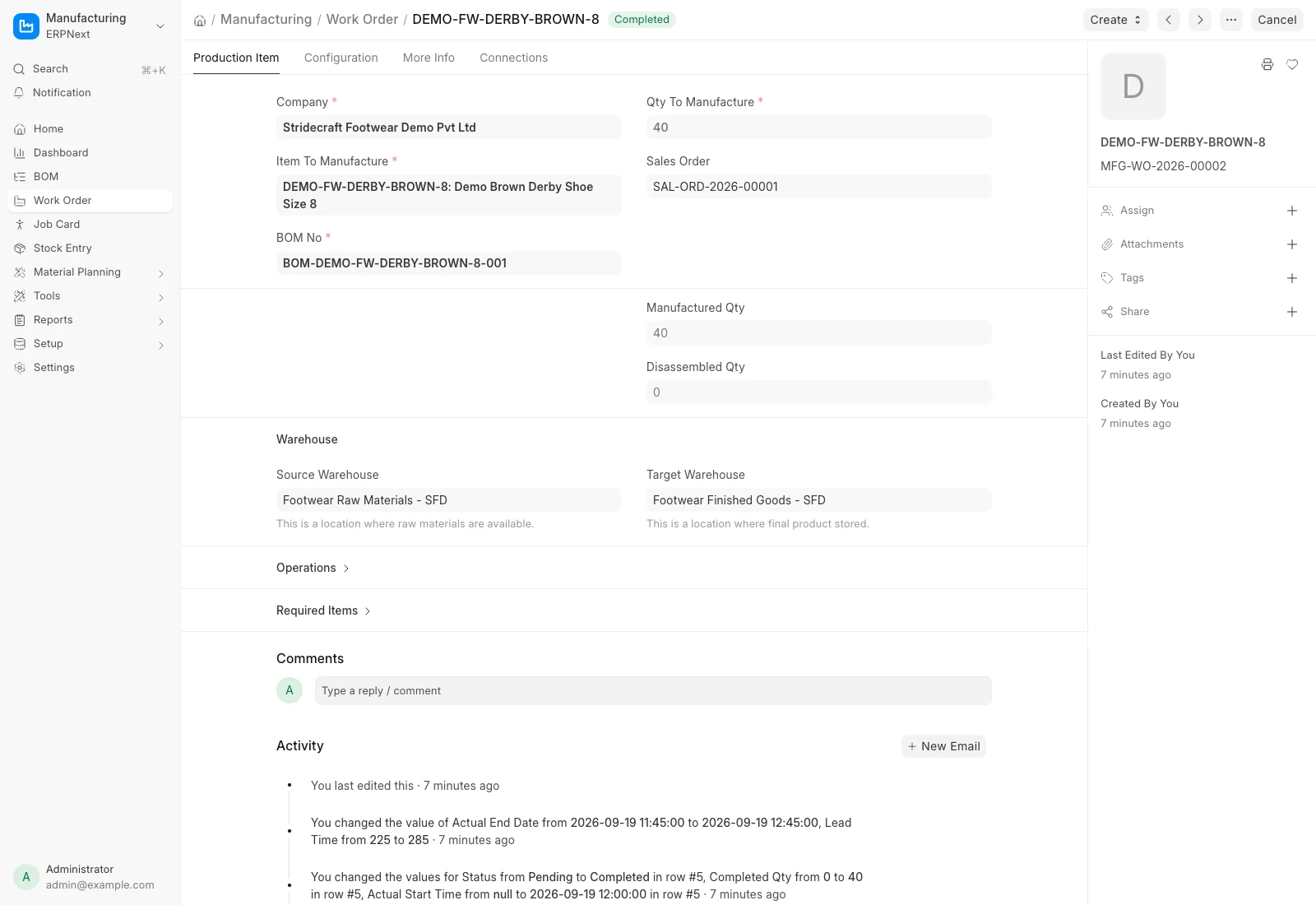
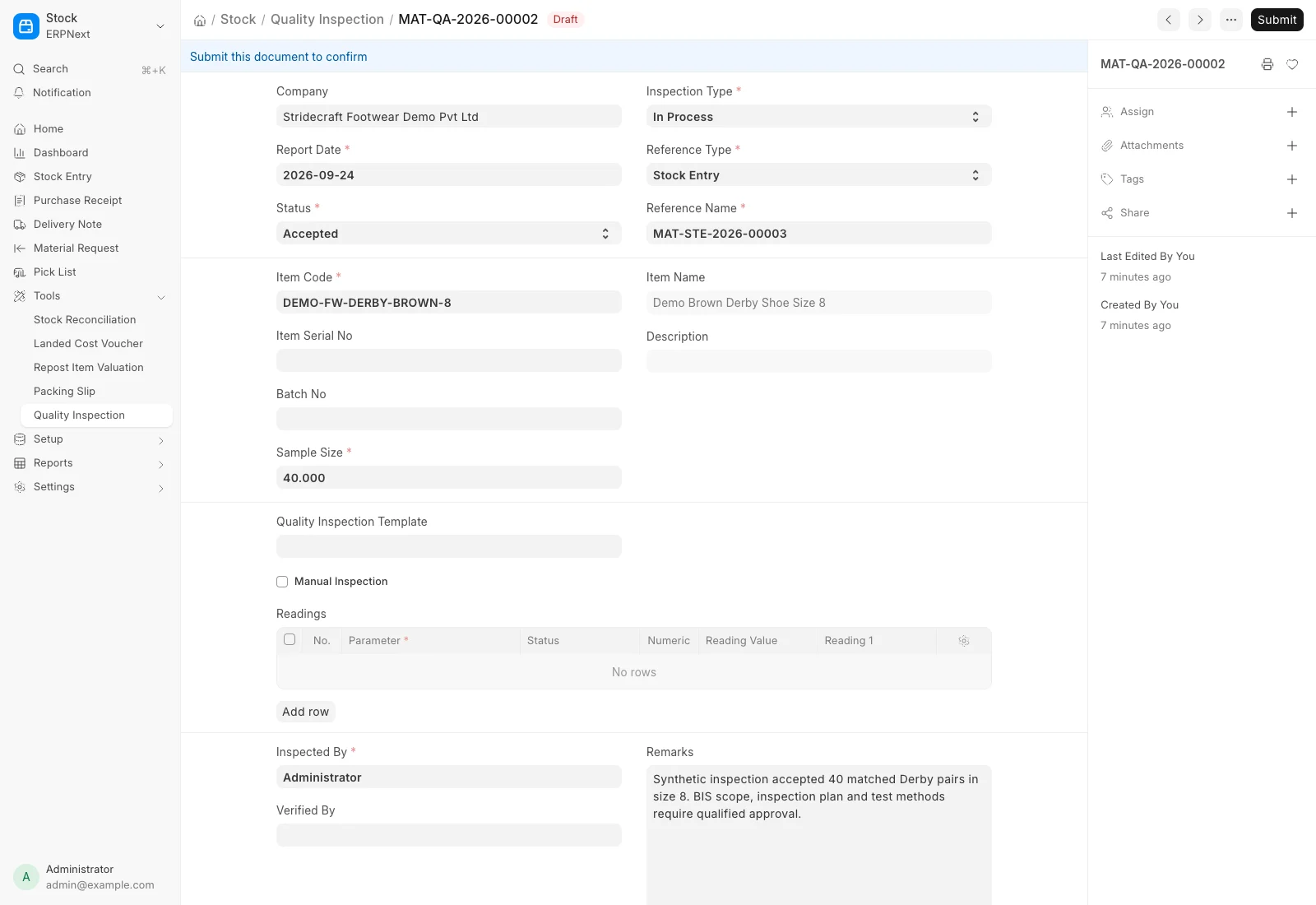
Three ERPNext Work Orders generate five operation Job Cards per size. Submitted manufacture Stock Entries receive the finished quantity, and accepted Quality Inspections record the release before a Delivery Note and Sales Invoice close the 120-pair customer order.
Material exception
A seven-square-metre Grade A shortfall blocks production release
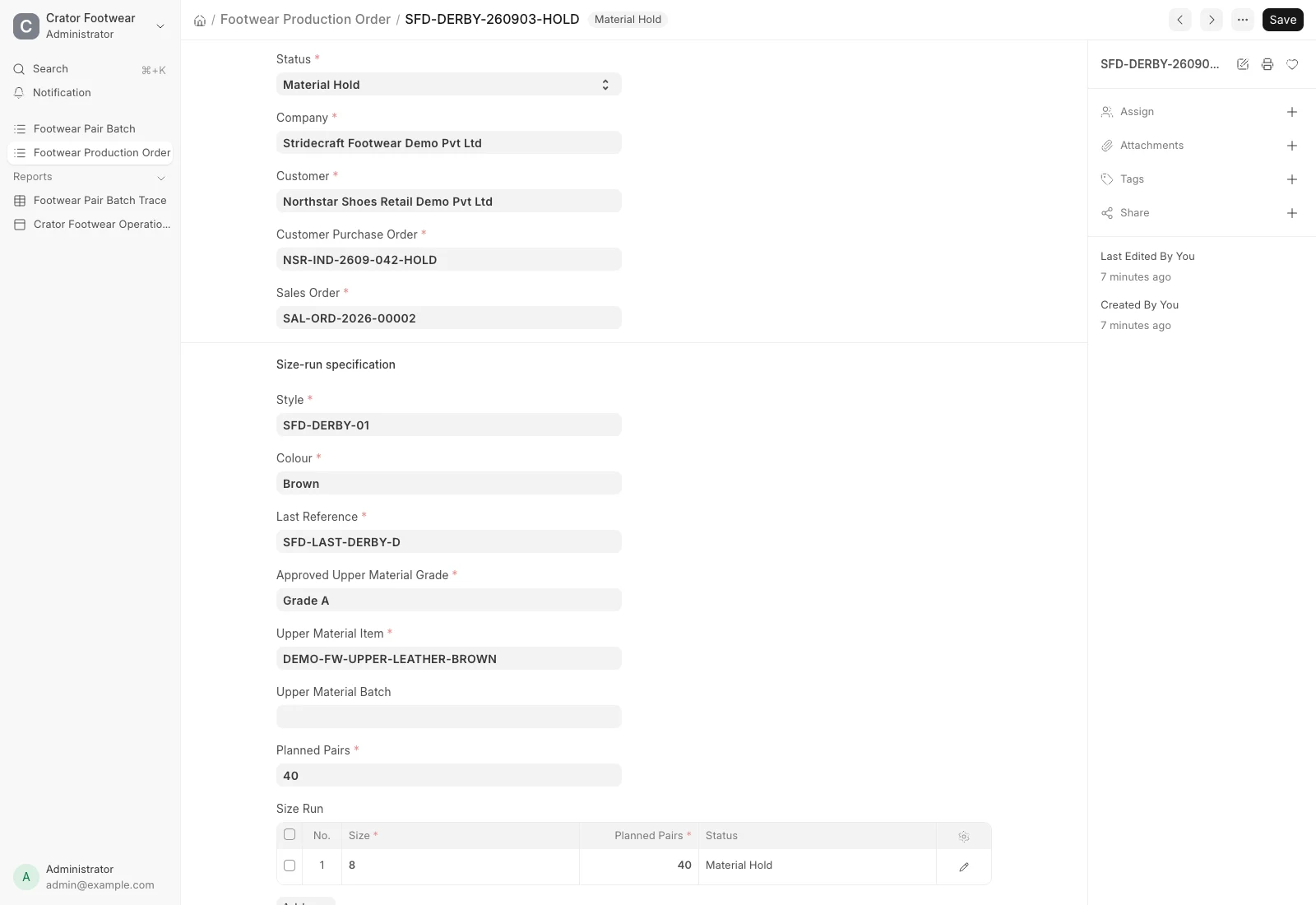
A second synthetic size 8 order requires 10.000 square metres of approved Grade A leather, but only 3.000 square metres of compatible remnant is available. A Grade B batch has enough area, but the substitution has not been approved.
The order stays on Material Hold. It cannot link a Work Order, pair batch, Quality Inspection, Delivery Note or Sales Invoice until an authorised production manager resolves the material rule.
Reconciliation and costing
The report reads the same records used to run production
The pair trace reports size-level cutting yield, matched quantity, accepted quantity, Work Order, Stock Entry, Quality Inspection and planned versus actual cost. The page does not present a separate analytics dashboard or duplicate operational truth in marketing-only tiles.
Implementation
What Crator added to ERPNext
ERPNext remains the inventory, manufacturing, quality, delivery and accounting foundation. Crator adds the footwear-specific size-run, cutting-yield, pair-matching and material-release controls as a separate Frappe app without editing ERPNext core.
One footwear manufacturing system
ERPNext foundation
- Customers, Sales Orders and Item variants
- BOMs, Work Orders and Job Cards
- Batches, Stock Entries and warehouses
- Quality Inspections, Delivery Notes and Sales Invoices
Crator footwear layer
- production order with style, last and size run
- upper-and-sole route in one footwear trace
- cutting area, scrap and reusable-remnant equation
- left-right pair matching and accepted quantities
- material-grade hold before downstream release
Production boundary
What a real footwear manufacturer still has to decide
The reference proves the configured records and controls, not production readiness. A rollout still needs approved styles, patterns, lasts, yield standards, material-grading rules, inspection plans, machine interfaces, barcode or RFID decisions, accounting and tax treatment, roles, migration, user acceptance, cutover and support. Applicable BIS requirements and certification must be confirmed by the manufacturer’s qualified compliance owner.
For the broader selection context, read our guide to the best ERP options for manufacturing in India.
Frequently asked questions
For a manufacturer, it should connect the customer order to the style, size run, material lots, BOMs, work orders, cutting yield, left-right pair matching, assembly, quality, finished stock, delivery, invoice and cost. Product design, machine control and statutory certification remain separate responsibilities.
Yes. ERPNext supplies Item variants, Batches, BOMs, Work Orders, Job Cards, Stock Entries, Quality Inspections, Delivery Notes and Sales Invoices. Crator adds the footwear production order, size-run trace, cutting-area reconciliation, pair-batch controls and material-grade hold shown here without changing ERPNext core.
Each size remains a separate finished Item variant with its own BOM and Work Order. The pair batch records left uppers, right uppers, matched pairs, assembled pairs, accepted pairs and rejected pairs. Validation prevents mismatched counts from being treated as completed stock.
The reference reconciles allocated cutting area against accepted upper sets, cutting scrap and reusable remnant. A second order is held because its approved Grade A remnant is short by seven square metres and the available Grade B batch has no substitution approval.
No. The reference does not control patterns, nesting, dies, cutting machines or line settings. It does not submit to BIS, determine which Quality Control Order applies, create a certification claim, or prove GST, e-invoice and e-way bill configuration. Those decisions need the manufacturer’s approved designs, equipment interfaces and qualified compliance owners.
It is a working reference app built with Crator on ERPNext, not a fictional customer case study. The app can be handed over and adapted, but production still needs the company’s product masters, material rules, inspection plans, roles, devices, accounting policy, migration and user acceptance testing.