ERP for furniture manufacturing in India
We used Crator to build working furniture ERP software around a configured wardrobe order. It follows approved room dimensions through labelled panels, cutting, edge banding, drilling, hardware, room packing, delivery and invoice. The screens below come from the installed ERP, not a design mockup.
Why furniture manufacturing ERP has to preserve the configuration and every panel
A made-to-order wardrobe is not finished when one item quantity reaches stock. Approved room dimensions, finish, panel identity, hardware and packing destination have to survive the route while ERPNext carries normal manufacturing, stock, delivery and accounts.
Site dimensions decide what may enter production
The room, measurement reference and approved configuration revision have to stay attached to the order. A later measurement must not silently alter a released design.
Panel identity continues after cutting
A side, shelf, shutter and drawer part can share a board but need different dimensions, finishes and edges. Their labels carry that identity into later operations.
Cut output needs a visible reconciliation
A replacement part can make cut quantity exceed plan. The difference needs a recorded rejection or recut rather than an unexplained production variance.
Room packing is part of production traceability
Every accepted panel and hardware kit must reach the correct room-labelled cartons before the finished wardrobe can move to delivery.
Crator added those controls in a separate Frappe app. ERPNext remains the source of truth for the order, BOM, Work Order, Job Cards, manufacture, quality, delivery and invoice.
Approved configuration
The order starts with the measured room, not a generic wardrobe code
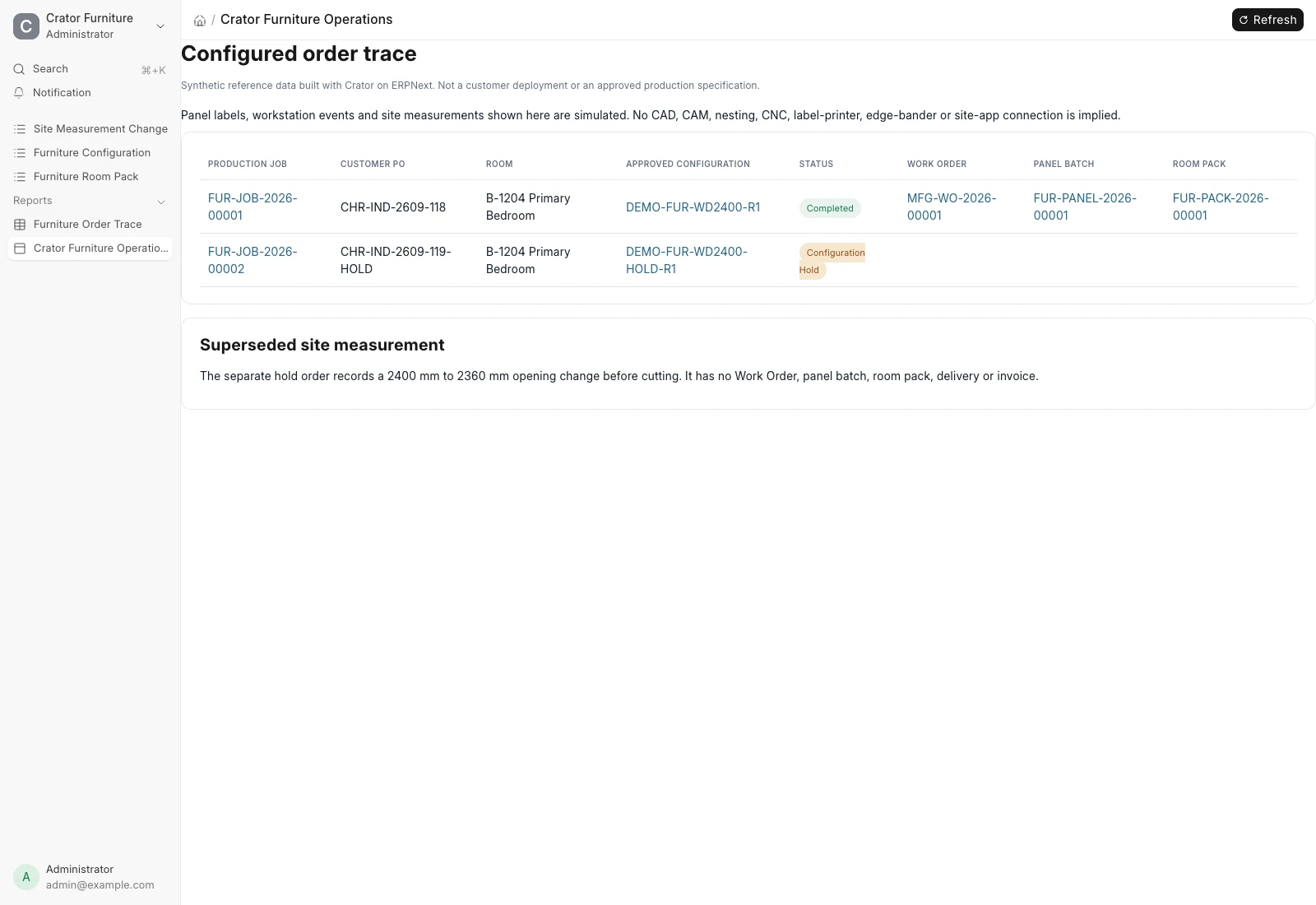
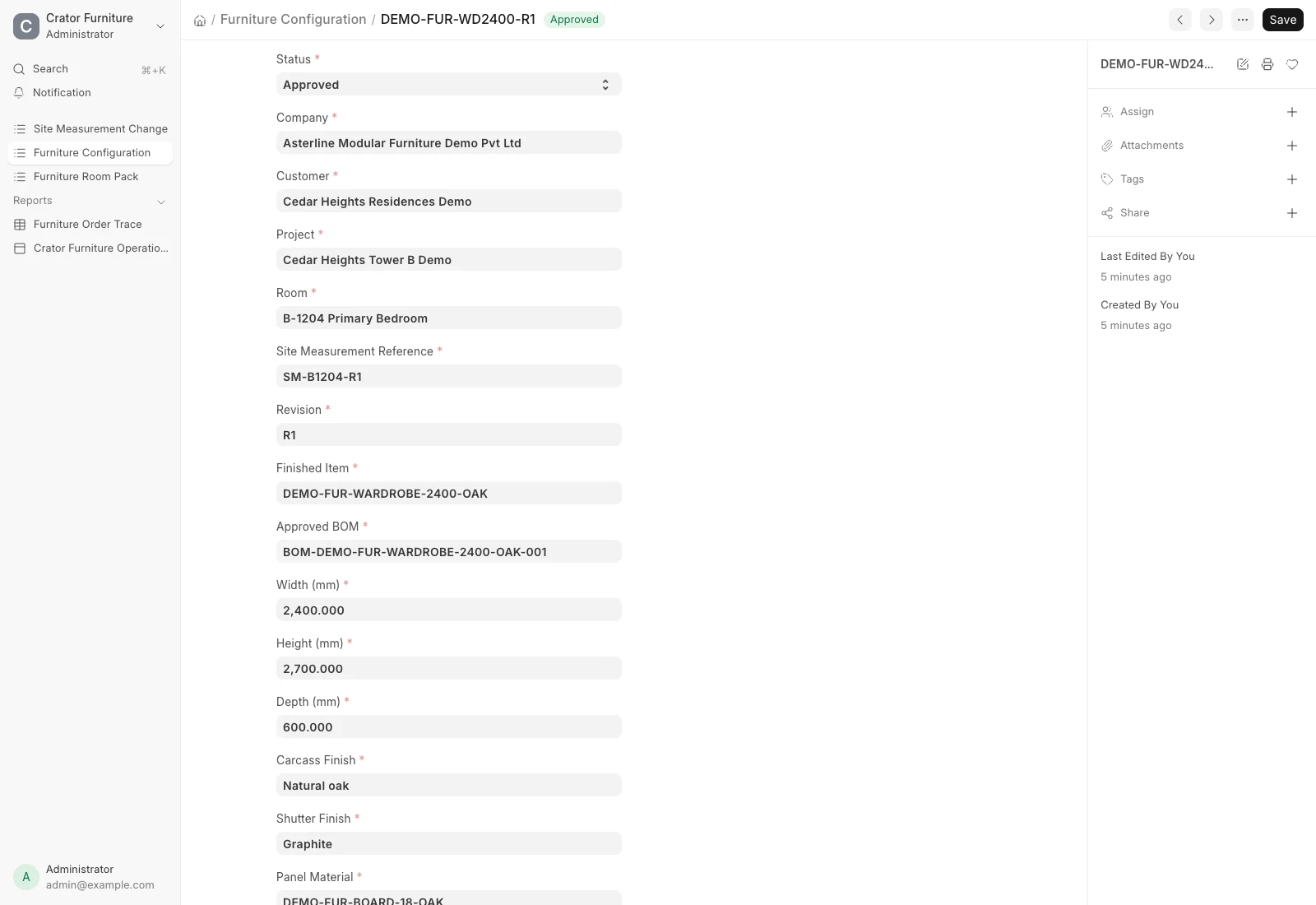
Configuration R1 records a 2400 mm width, 2700 mm height and 600 mm depth for the B-1204 primary bedroom. It links the finished Item and approved BOM to natural oak carcass panels, graphite shutters, edge band and the hardware set.
Those dimensions and materials are synthetic demonstration values. The app proves that an approved revision can be preserved. It does not approve structural design, tolerances or material suitability for a real wardrobe.
Panel production
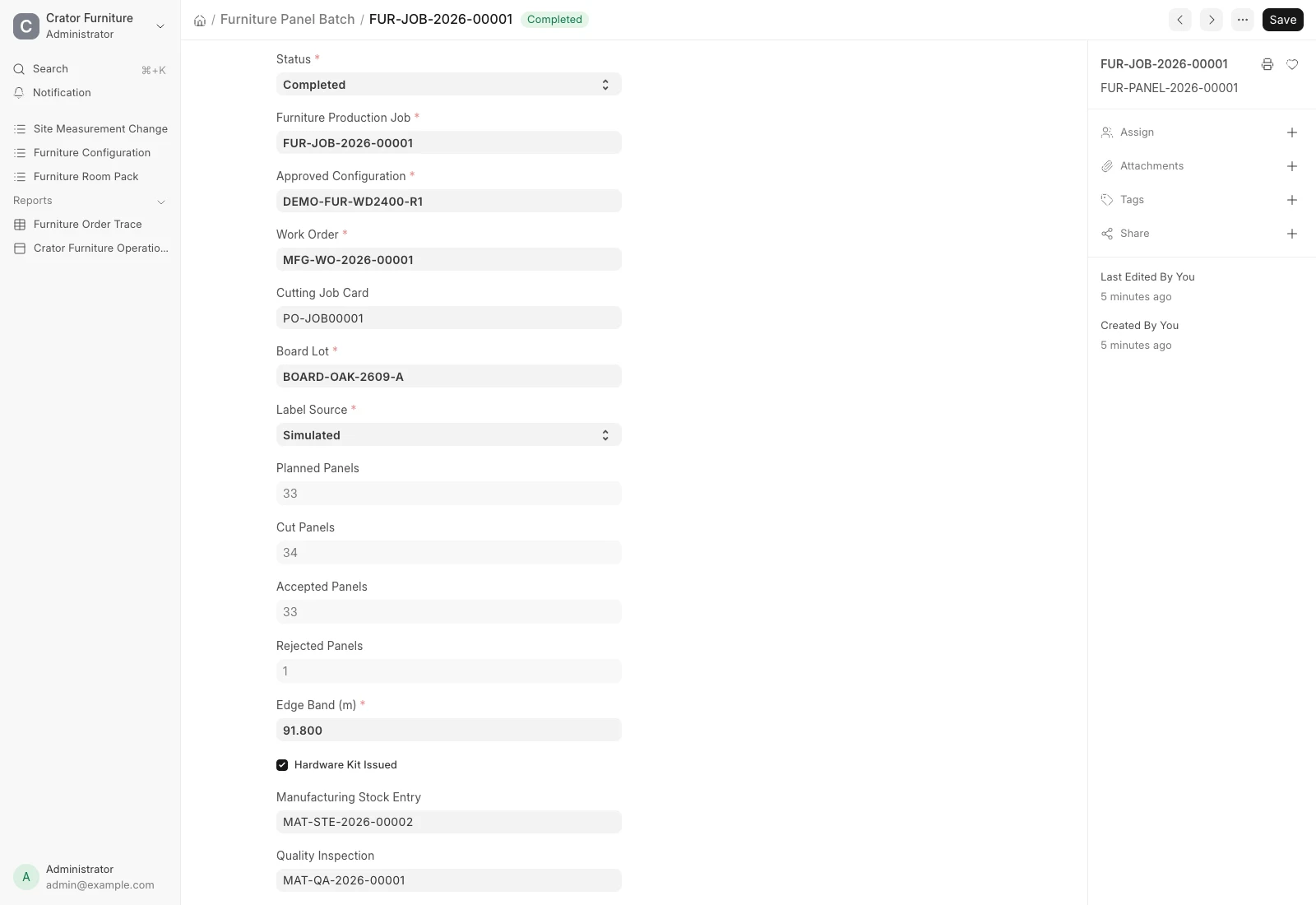
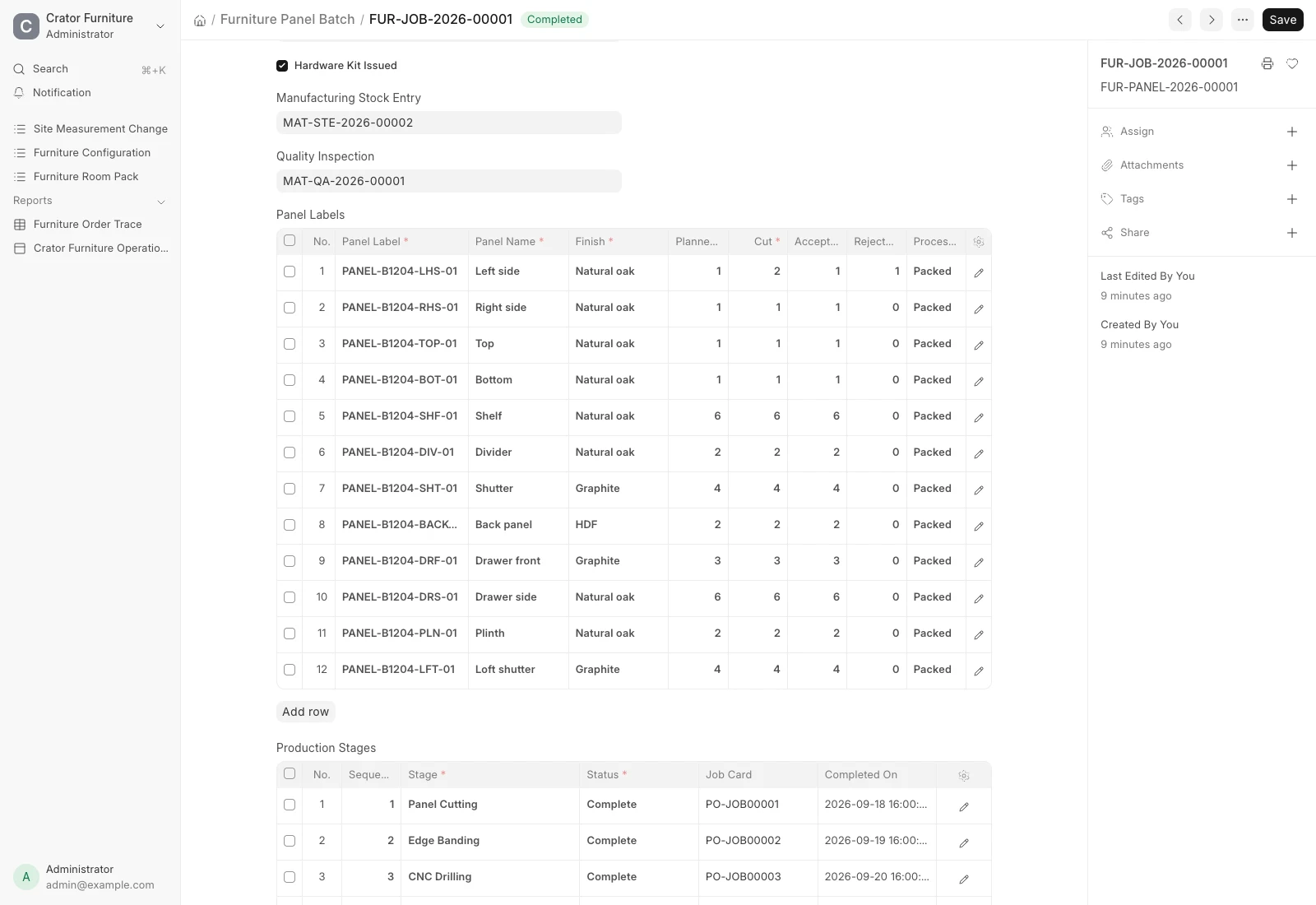
Thirty-three accepted pieces keep their identity through six stages
The reference panel batch holds 12 labelled part rows covering 33 planned pieces. One left side is rejected for synthetic edge damage and replaced, so 34 cut pieces reconcile into 33 accepted and one rejected piece.
Cutting, edge banding, drilling, hardware issue, assembly and room packing are recorded in sequence. Four of those stages link to submitted ERPNext Job Cards. The label source and workstation inputs are explicitly marked simulated.
Room pack
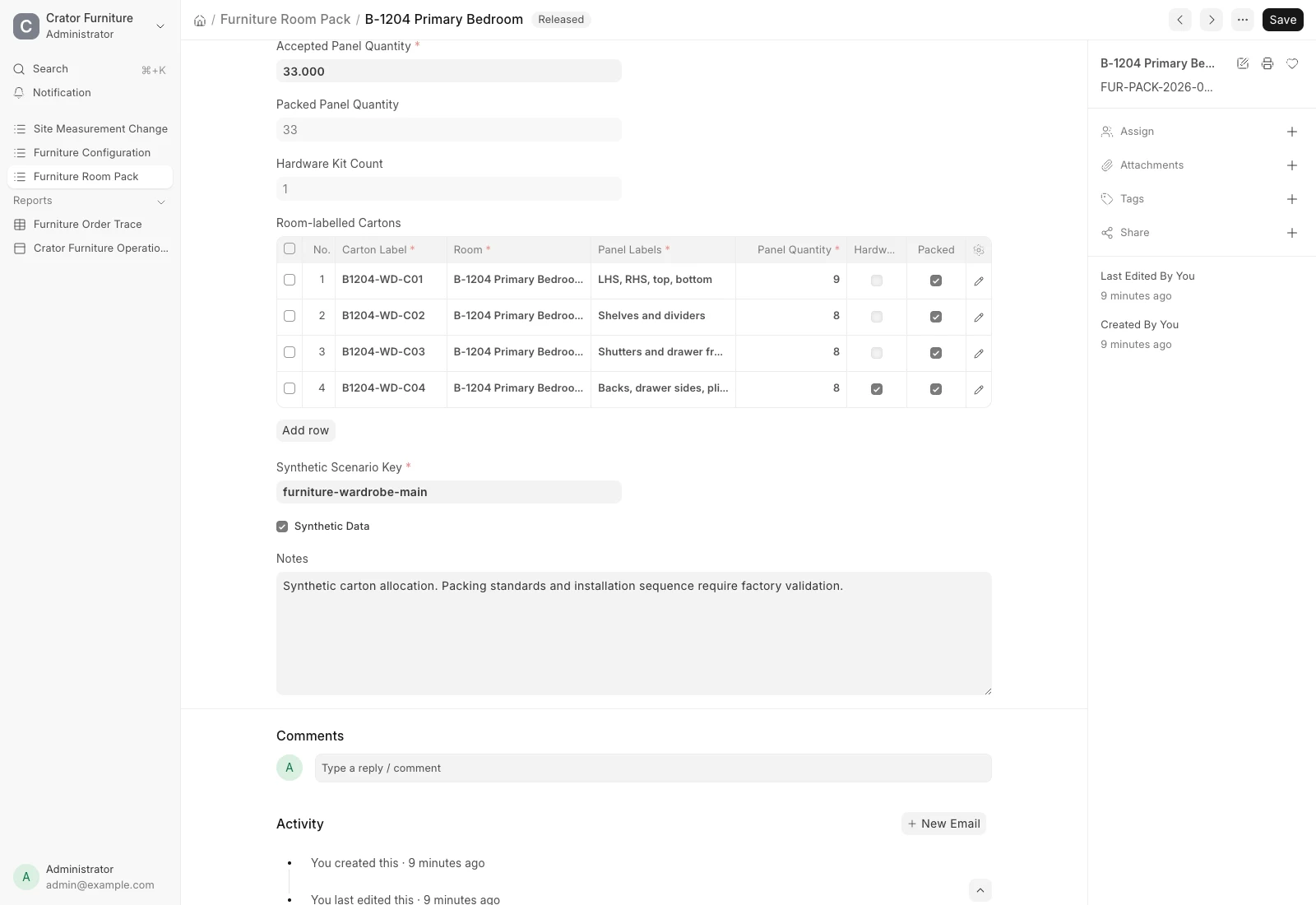
The finished quantity is released only after the room pack closes
Four carton labels account for all 33 accepted panel pieces and one hardware kit for the B-1204 primary bedroom. The room pack links back to the same panel batch and production job. ERPNext then records the finished stock, accepted inspection, delivery and invoice.
Revision hold
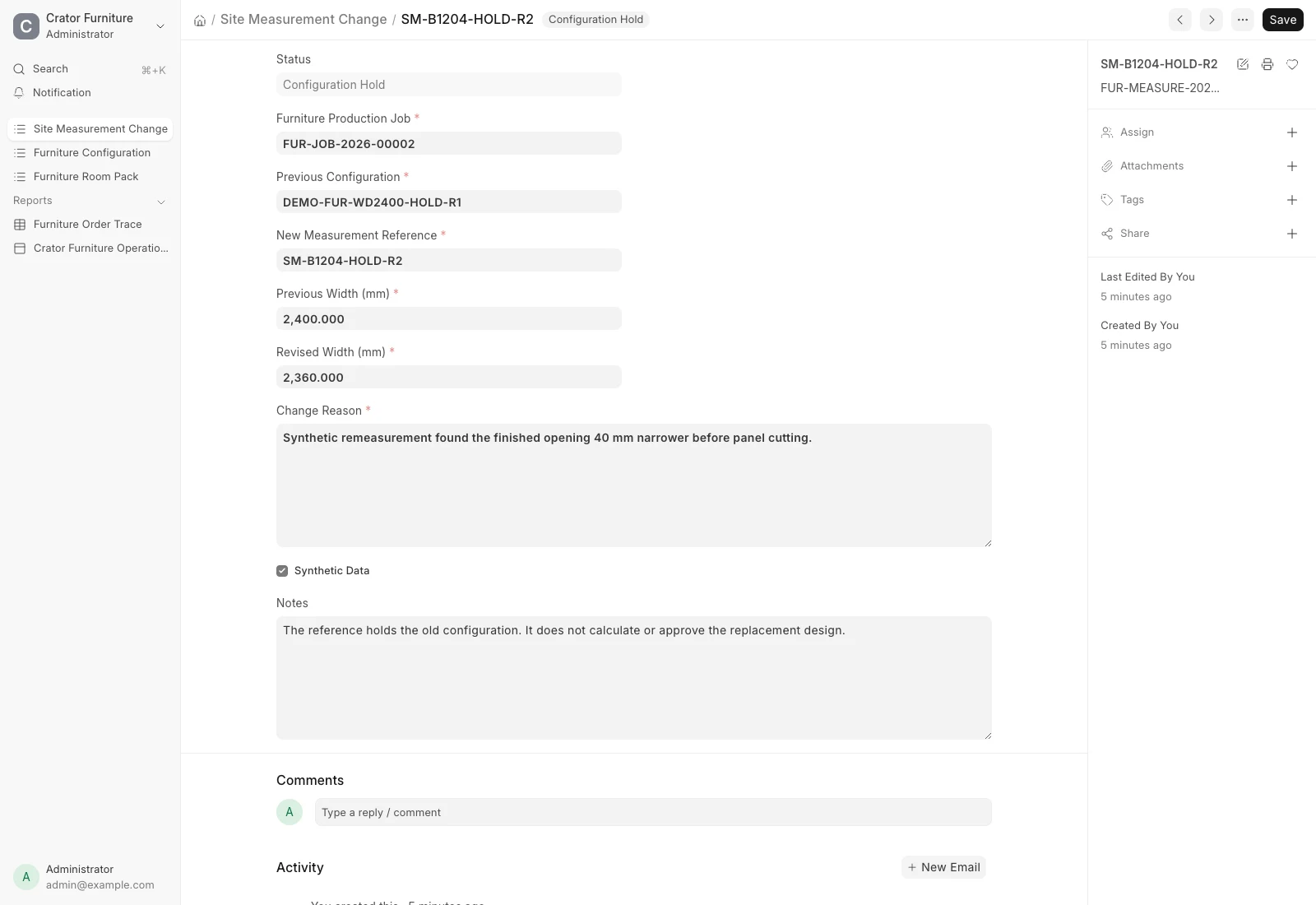
A 40 mm site change stops the separate order before cutting
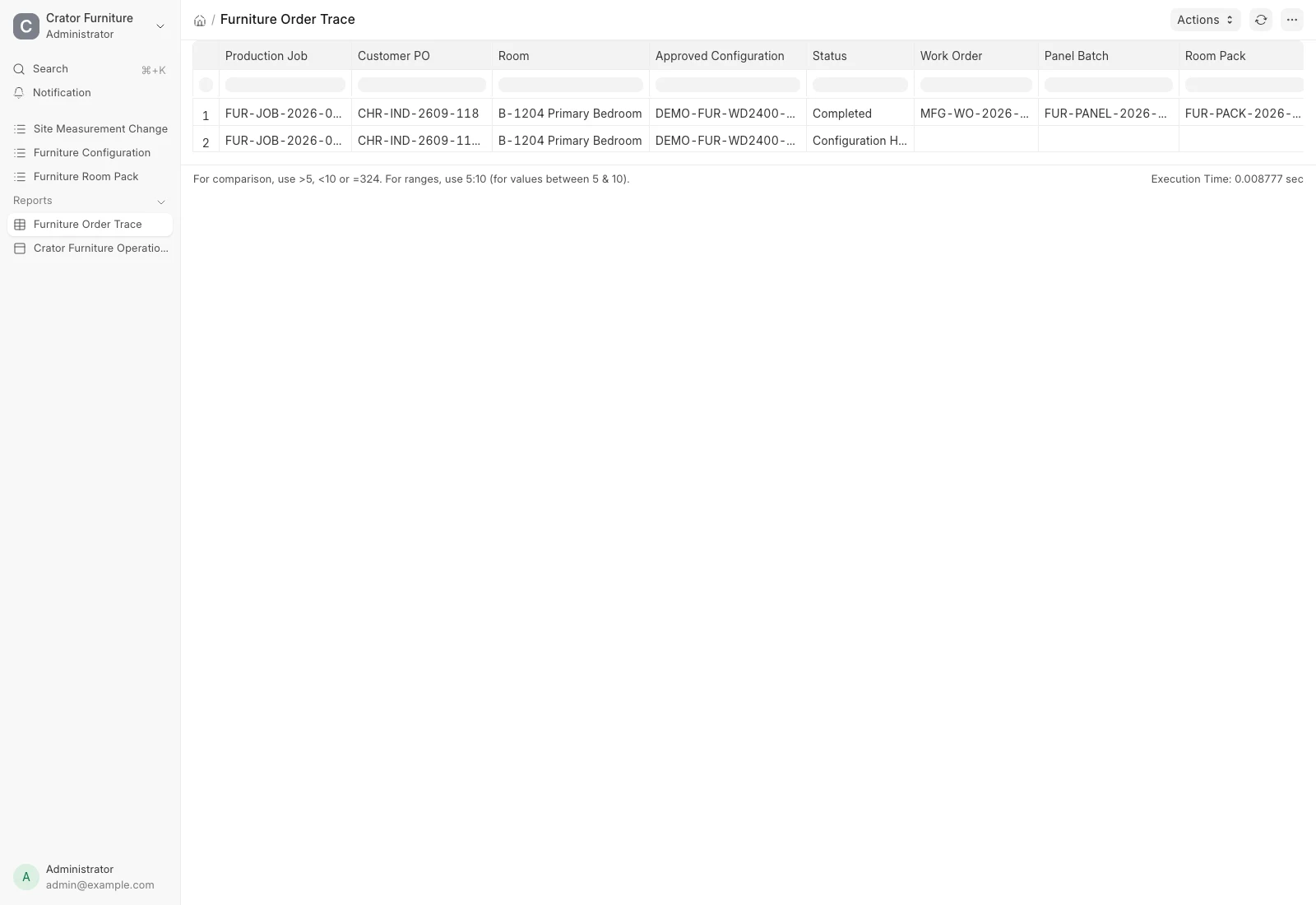
The exception order begins on a different configuration R1. A synthetic remeasurement reduces the finished opening from 2400 mm to 2360 mm before production. The old configuration becomes Superseded and its job moves to Configuration Hold.
The held job has no Work Order, panel batch, manufacturing Stock Entry, room pack, Delivery Note or Sales Invoice. The software enforces the stop. It does not calculate or approve the replacement design.
Implementation
What Crator added to ERPNext
ERPNext supplies the commercial, manufacturing, stock, quality, delivery and accounting foundation. Crator adds the configured-furniture operating layer and its reconciliation and revision controls without changing ERPNext core.
One furniture manufacturing system
ERPNext foundation
- Customer, Project and Sales Order
- Item, BOM and Work Order
- Operation Job Cards and Stock Entry
- Quality Inspection
- Delivery Note and Sales Invoice
Crator furniture layer
- Approved room dimensions and configuration revision
- Labelled panel-batch reconciliation
- Cutting, edge, drilling and hardware stage trace
- Room-labelled carton and hardware reconciliation
- Superseded-measurement production hold
For the broader software decision, read our guide to the best ERP options for manufacturing in India.
Production boundary
What still needs a real furniture company decision
This is working furniture manufacturing software, but it is not a claim of production readiness. A rollout still needs approved design rules, tolerances, board and hardware substitutions, label identity, reprint control, recut policy, finish and quality standards, packing method, installation sequence, GST setup, permissions and user acceptance tests.
CAD geometry, automatic nesting, offcut optimisation, CAM programs, panel saw control, label printing, edge-bander programs, CNC drilling and site-capture integrations are outside this reference. Every machine, barcode and site value shown in the ERP is simulated. Real interfaces need customer-specific mapping, retries, reconciliation and release ownership.
The tested reference uses standard ERPNext records for bills of material, Work Orders, Job Cards and Quality Inspections. Furniture-production context comes from HOMAG documentation on part labels in panel dividing and its batch-size-one factory case study. These sources support the workflow boundary. They do not certify the synthetic values or the app for a real factory.
Frequently asked questions
For a configured furniture manufacturer, it can connect the customer order and approved dimensions to the BOM, panel labels, cutting, edge banding, drilling, hardware, assembly, room packing, stock, quality, delivery and invoice. The useful trace preserves both the finished item and the individual parts that must arrive together at the correct room.
Yes. ERPNext already provides Items, BOMs, Sales Orders, Work Orders, Job Cards, Stock Entries, Quality Inspections, Delivery Notes and accounting. Crator adds the furniture-specific configuration, panel identity, stage, room-pack and revision-hold records that connect those standard documents.
Yes. This reference gives each panel type a label, reconciles planned, cut, accepted and rejected quantities, then packs every accepted panel and one hardware kit into four cartons for a named room. A real rollout still needs the factory to approve its barcode format, reprint controls, packing method and installation sequence.
No. The reference preserves an approved configuration and its panel output, but it does not draw the wardrobe, optimise sheet nesting, generate CAM programs or control a panel saw, label printer, edge bander or CNC. Those systems can be connected only after their interfaces, revision rules, retries and ownership are confirmed.
The separate exception records a new site measurement that reduces the opening width from 2400 mm to 2360 mm. It marks the old configuration Superseded and puts the production job on Configuration Hold before a Work Order, panel batch, room pack, Delivery Note or Sales Invoice can exist.
It is a working reference implementation built with Crator on ERPNext, not a fictional customer case study. We can hand over and adapt the app, but the real manufacturer still has to approve its design rules, materials, tolerances, machine connections, quality gates, GST setup, roles and acceptance tests.