Frappeverse Mumbai 2026 keynote: ERPNext focuses on polish and scale
· Yajat Gulati · 12 min read · Updated

This article is part of our Frappeverse Mumbai 2026 recap, which covers all nine keynotes.
Frappe used its Framework and ERPNext keynote in Mumbai to show two sides of the same product effort. On the surface, the team is making ERPNext easier to navigate, configure and use every day. Underneath, it is rebuilding the parts that determine how the system performs, stays secure and handles years of business data.
The session covered more than 90 minutes of work across Frappe Framework and ERPNext. The common idea was quality. Frappe is making existing workflows more coherent while giving the product a stronger foundation for what comes next.
An AI awakening built on Framework
Frappe founder Rushabh Mehta began with what he called the company's “AI awakening.” His point was broader than adding an assistant to ERPNext. As coding agents take on more software development, the quality of the platform they build on becomes more important.
Frappe already has a useful foundation for that shift. DocTypes provide a structured vocabulary for business software, while Frappe UI and the new Desk components give developers and agents reusable interface primitives. The approach is consistent with how Frappe usually builds: put the capability in Framework so it can improve more than one product or workflow.
Rushabh described this as a “great reshuffling” and encouraged the community to think of itself as a builder of technology, not only a consumer of it. That set up the rest of the keynote well. The next set of announcements focused on making the product underneath those future applications easier to use and safer to extend.
Designing an ERP without a design benchmark
Nikhil Kothari, Frappe's director of products, opened with the problem the team has set itself. ERPNext runs on roughly 22,000 active Frappe Cloud sites, across companies ranging from small retailers to billion-dollar businesses. Its capability is well established. Its user experience still reflects years of features accumulating across the product.
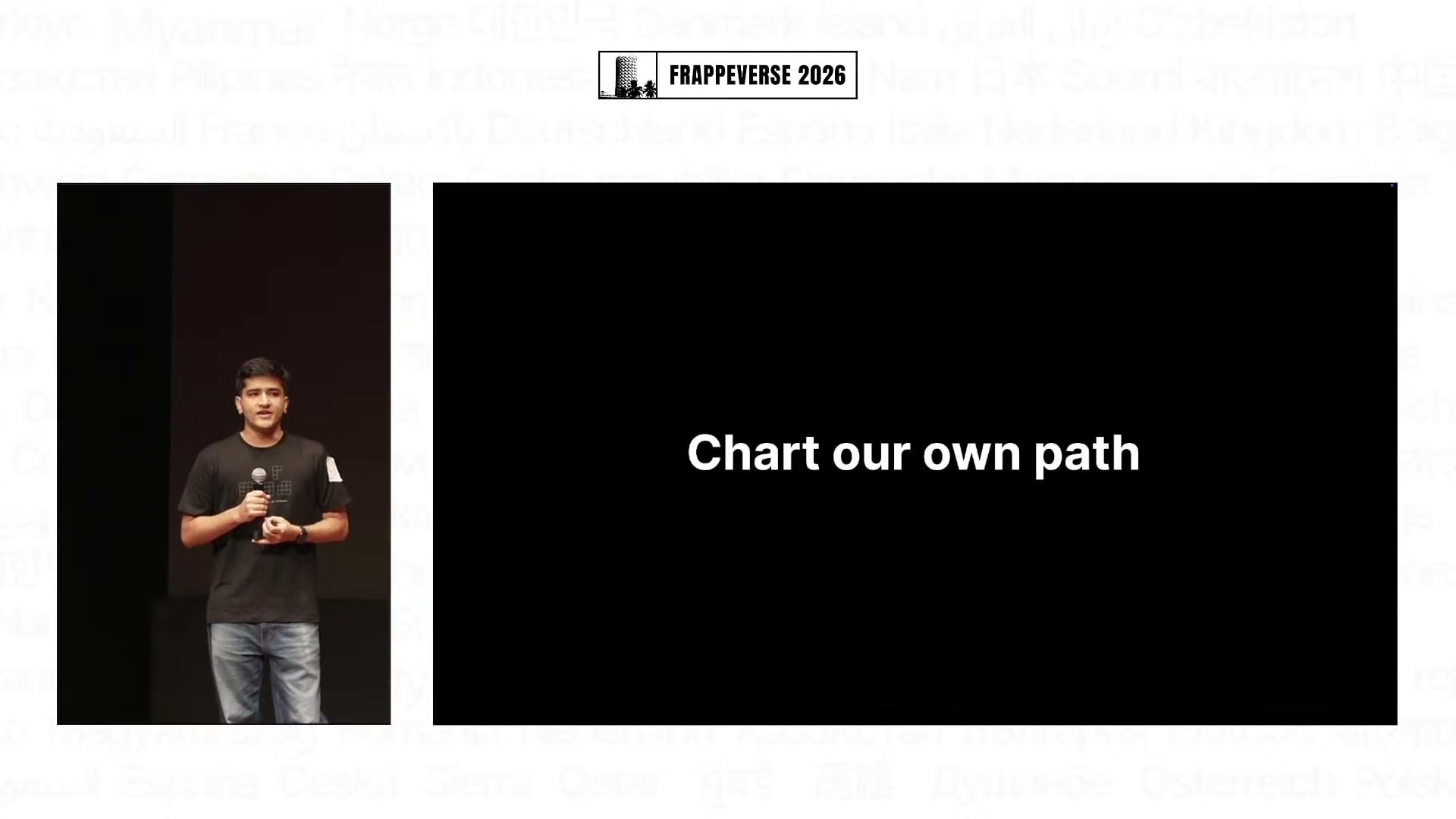
Consumer software has familiar design benchmarks such as Apple and Figma. Nikhil argued that ERP software has no equivalent, so Frappe will have to chart its own path. He framed the work around four ideas: information hierarchy, feature discoverability, ease of use and interfaces crafted for a specific job.
That work begins in Framework. The develop branch now has a component explorer with more than 20 Desk-native components, including context menus, hover cards and popovers. These are the primitives Frappe teams, custom-app developers and coding agents can reuse instead of rebuilding common interactions each time.
A clearer navigation hierarchy
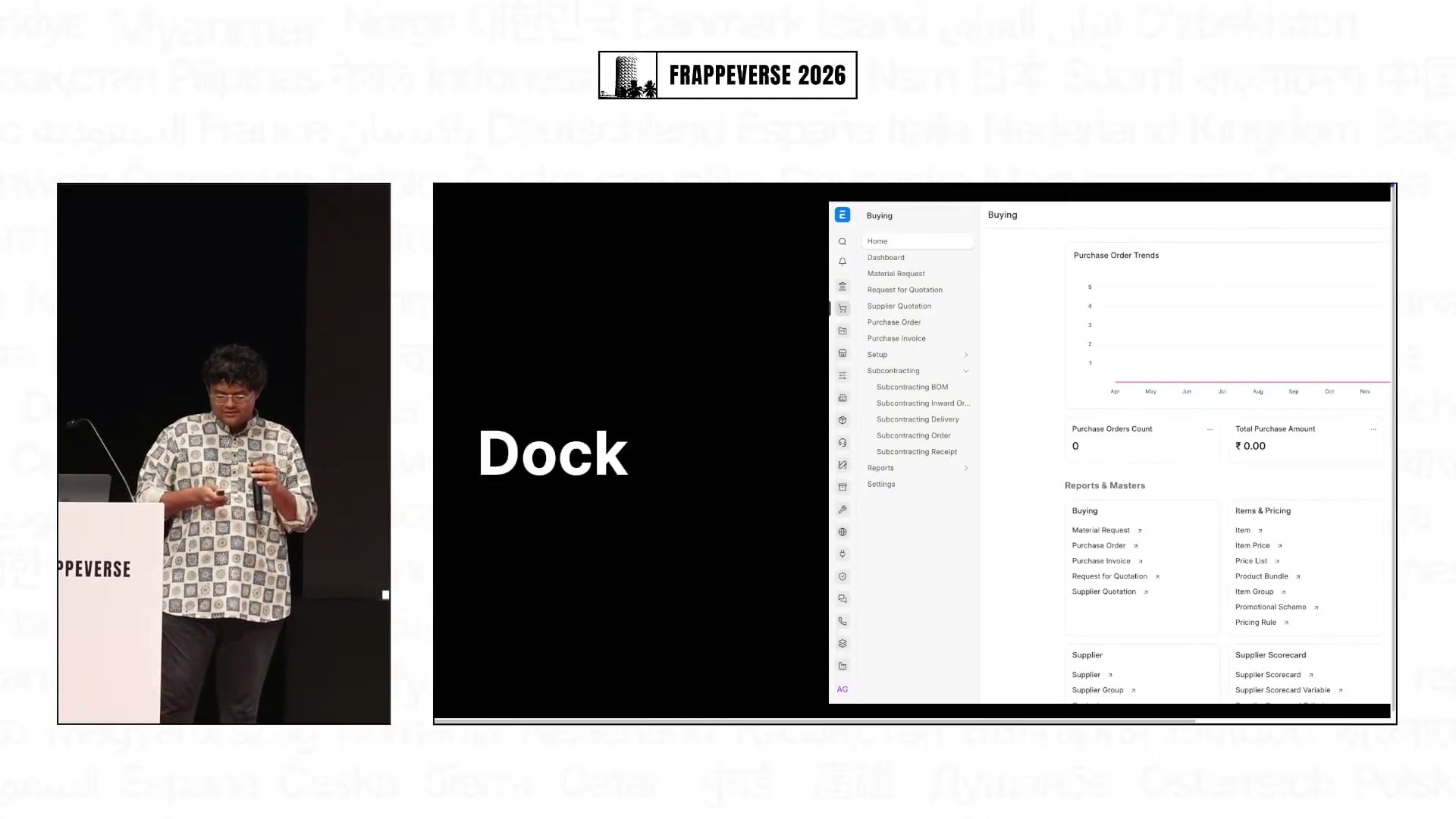
Soham Kulkarni, an engineer on Frappe's Framework team, addressed a navigation model that had become difficult to predict. Version 15 centered workspaces. Version 16 introduced a persistent app-level sidebar, but moving between modules could still take more clicks than it should, while apps, modules, workspaces and sidebars competed to organize the same system.
Frappe is making modules the primary unit of navigation again. A new Dock moves users between modules, while the sidebar contains links and workspaces for the current module. Companies can customize that structure and turn off the modules they do not use. Soham called it “double-sidebar season at Frappe,” but the division of responsibility is straightforward: the Dock chooses the module; the sidebar helps users work inside it.
The revised navigation is intended for version 16, rather than a later version 17 change.
Configuration without losing context
Nishka Gosalia, a Frappe engineer working on ERPNext, showed how the team is bringing scattered configuration closer to the document being configured.
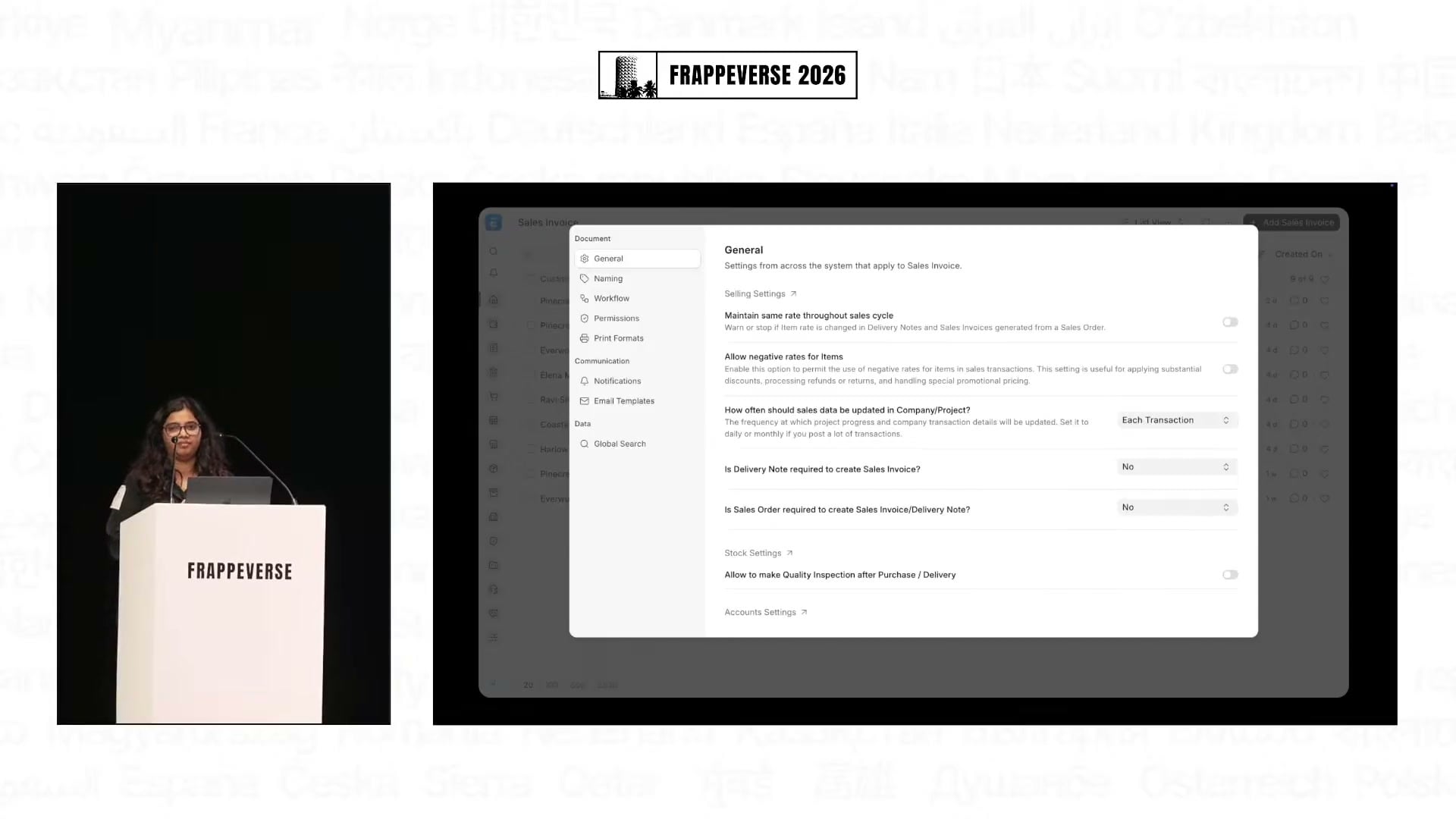
Setting up a Sales Invoice can involve Naming Series, Workflow, Role Permission Manager, Notifications, Email Templates, Print Formats and settings spread across several modules. The new DocType Settings panel gathers those controls in one place. From a Sales Invoice, an administrator can review its naming series, workflows, permissions, print layouts and relevant module settings without reconstructing the path to each tool.
User preferences are getting the same treatment. Email, list-view, form-view, appearance and theme settings will be available from one panel in the sidebar.
Inline previews reduce a different kind of context switching. Attachments can open beside the document instead of downloading immediately. A voucher can open beside the report row that led to it, preserving the report, its filters and the thread of the investigation. Global Search is also being redesigned, with searchable categories and direct control over which fields can be found.
Everyday screens get more consistent
Khushi Rawat, an engineer on Frappe's ERPNext team, presented a broader pass over the screens people use every day.
Supplier lists now distinguish active, frozen, on-hold and disabled records. Item lists describe an item's type and purpose instead of exposing an implementation-oriented checkbox. Field labels are being standardized, unclear fields are getting descriptions, and large settings pages are being divided into smaller tabs and sections.
Related information is also moving closer to the object it belongs to. Item prices can be viewed and added from the Item form. Address and Contact cards support actions such as editing, setting a primary record and unlinking. The Role form now shows its users and document permissions, with controls to update them in place.
None of these changes is dramatic alone. Together, they reduce the product-specific trivia that users previously had to learn or remember.
A data importer built for imperfect sheets
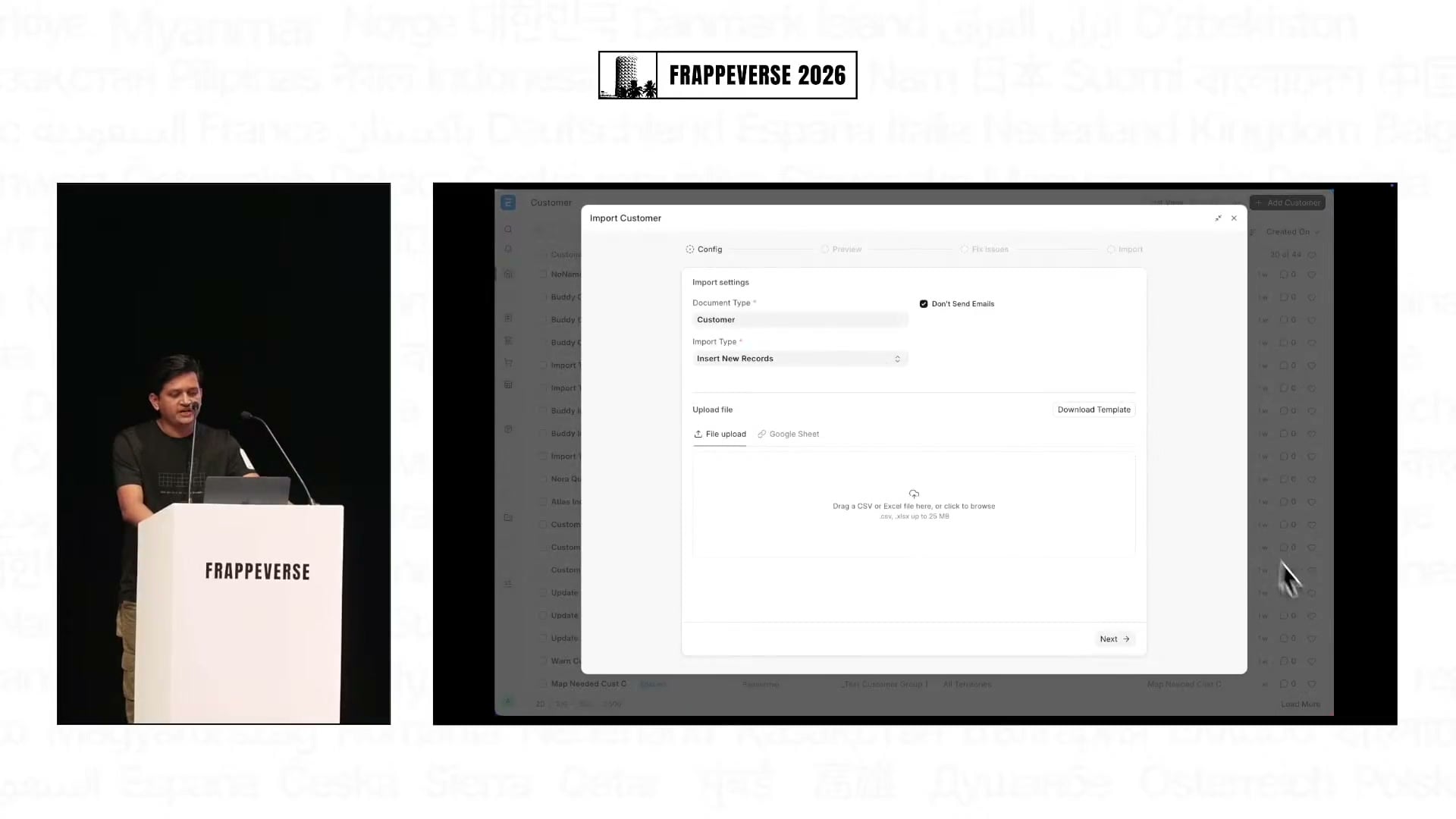
Frappe engineer Sumit Jain showed a rebuilt data importer with four stages: upload, preview, fix issues and import.
The importer scans the full sheet before starting and collects invalid values in one table. Users can map those values to valid records, skip bad rows without stopping the rest of the import, and review how columns will be interpreted. In the Customer example, the importer also created and linked related Contacts and Addresses.
The important implementation detail is that this behavior is extensible rather than hard-coded for one DocType. A custom app can provide its own column mapping, post-validation and row-import logic. That gives implementers a supported way to adapt imports to the relationships and validation rules inside a real business.
Better tables, layouts and print formats
Ejaaz Khan, an engineer working on Frappe Framework, continued with a set of changes to tables and forms.
Child-table and list-view columns can be resized by dragging, with widths represented in pixels instead of abstract values. Child-table rows support bulk editing, and report columns can be frozen while the rest of the report scrolls. A saved list layout can retain filters, sorting and selected columns together.
DocType Layouts make it possible to create a smaller form for a particular workflow. An employee-onboarding flow, for example, can show the five or six fields needed at that stage instead of the full Employee form with more than 60 fields.
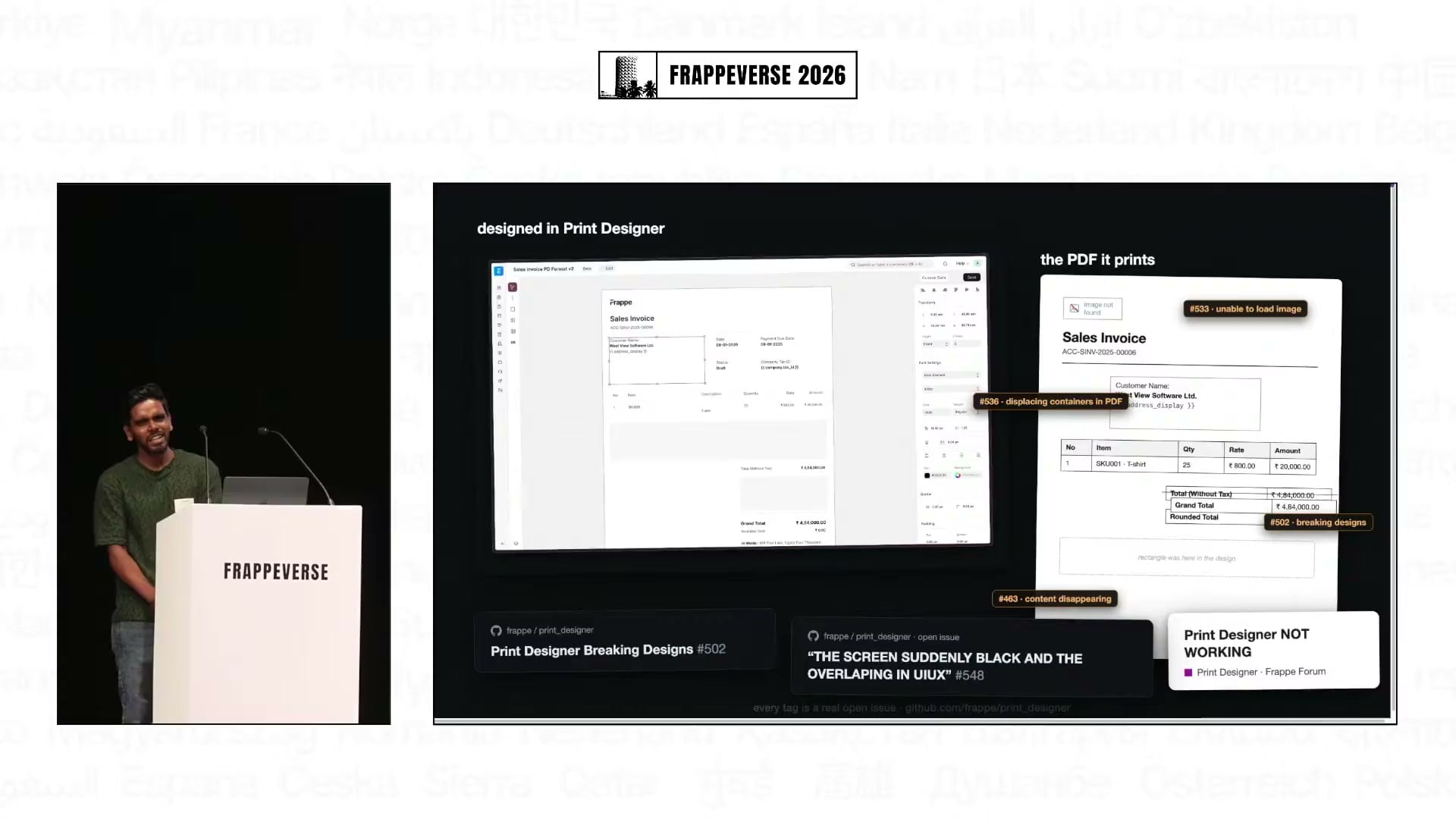
Frappe also showed a new visual print-format builder for composing document fields, text and images with drag and drop. ERPNext has accumulated two Framework builders and a separate Print Designer app over the years. The new builder is aimed at the common case where an end user needs to create a workable business document without writing the format by hand.
Insights dashboards become native to Desk
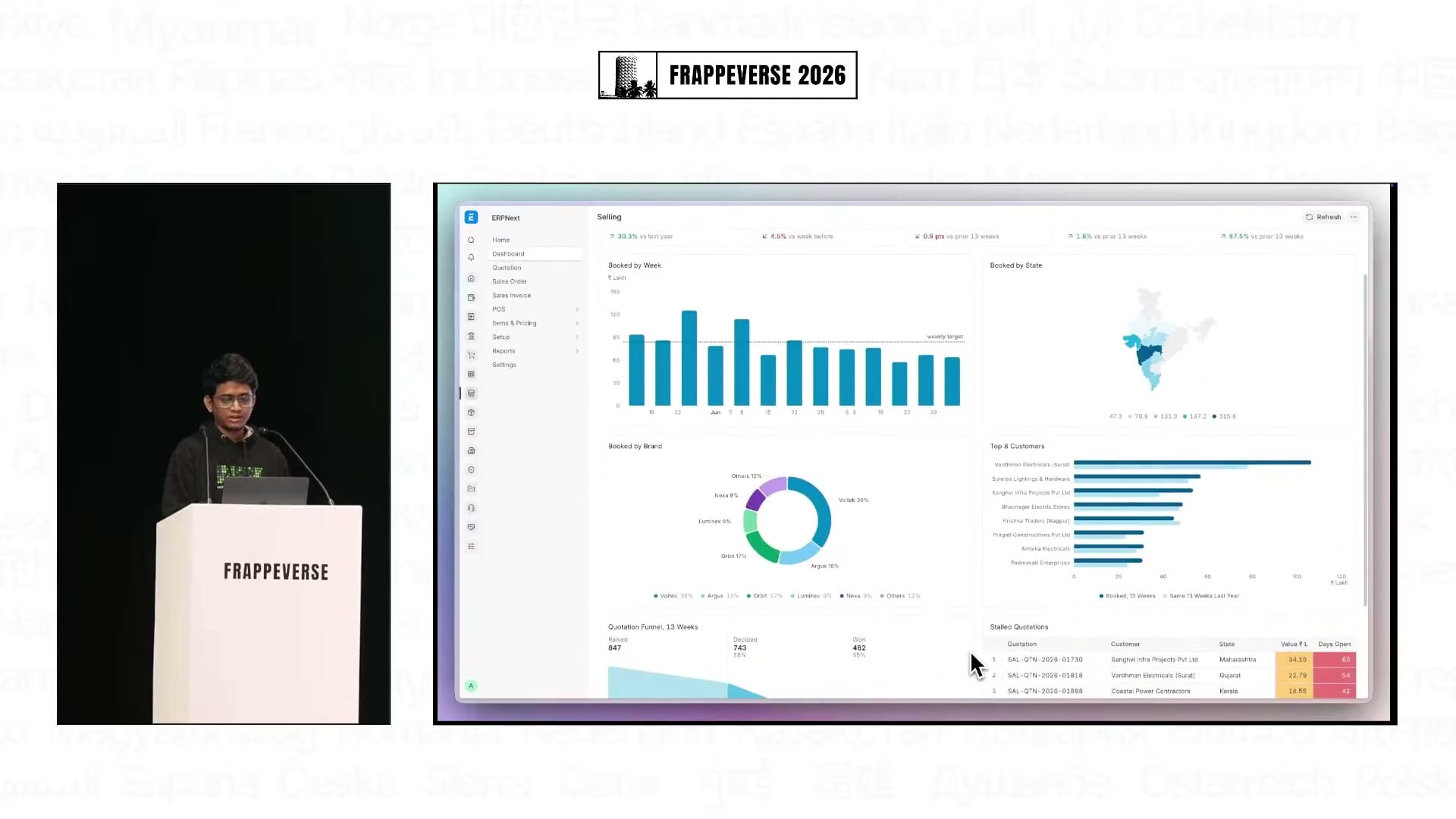
Saqib Ansari, a Frappe product engineer working on Insights, brought Insights dashboards into ERPNext Desk as native components rather than iframes.
The dashboards support targets, comparisons, global filters and several chart types. A user can select a data point, break it down by another dimension, backtrack through that analysis and open the Sales Order or other record behind the number. The path from a business signal to its underlying transaction now stays inside one interface.
Frappe has started with six dashboards covering selling, overall business health, receivables, purchasing and payables, stock, and HR. An agentic feature is still under development; it is intended to answer questions from the dashboard's context while respecting the current user's permissions.
A redesigned banking module for v16
Nikhil returned to demonstrate the redesigned banking module coming in ERPNext v16. It brings bank accounts, reports, matching and reconciliation into one interface, then removes several small sources of repetitive work.
Date ranges accept natural-language inputs such as “last two weeks” without requiring AI. Account selection uses fuzzy search. Transfers between two bank accounts can be recognized as matching mirror transactions and reconciled together. Reconciliation actions also have an undo history, so a user can reverse an incorrect match without manually reconstructing it.
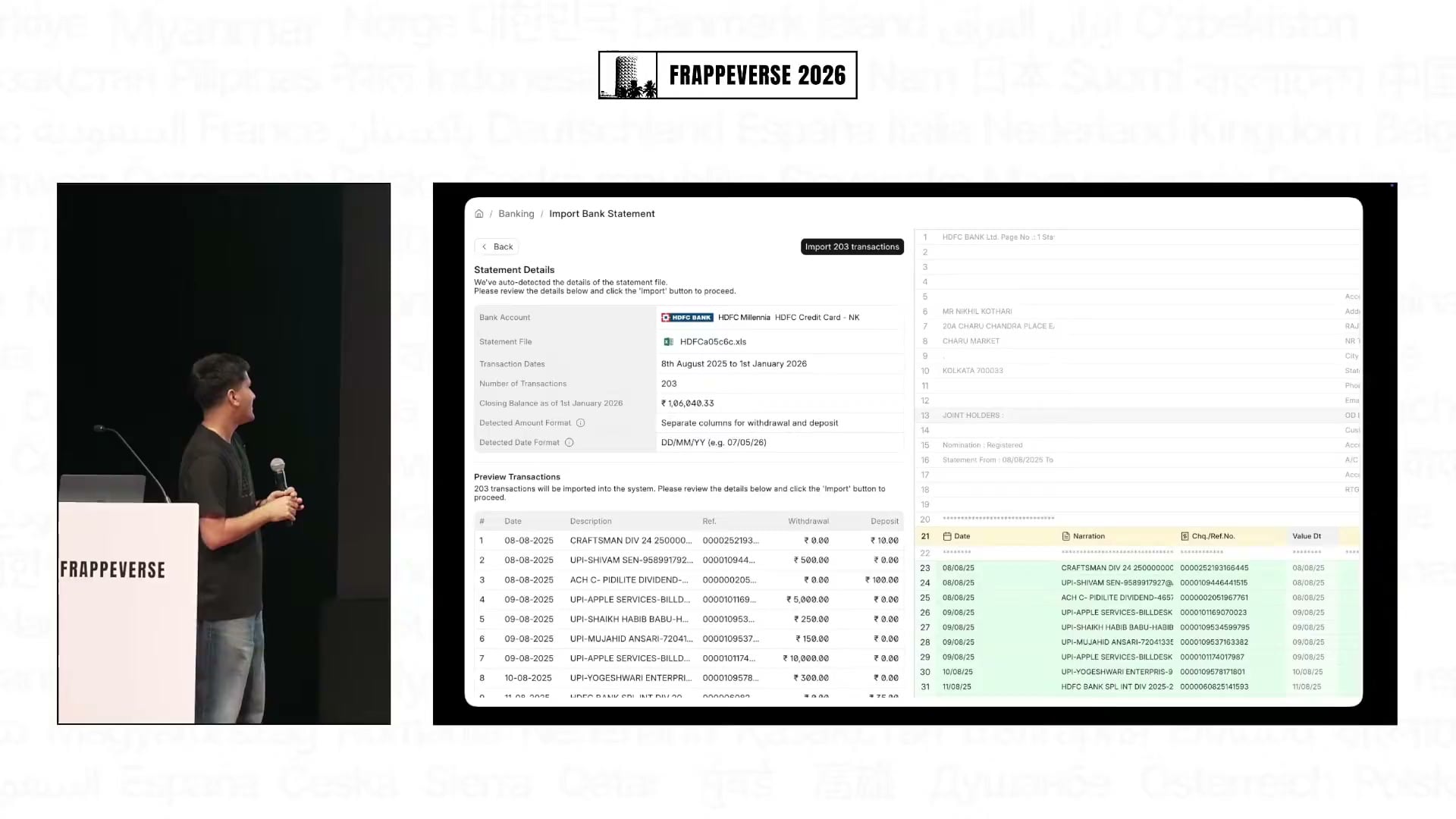
The statement importer addresses a messier problem. Bank exports put headers on different rows, represent debits and credits differently, insert separators and sometimes arrive as password-protected PDFs. ERPNext identifies the header and transaction rows, extracts the values and closing balance, then presents a preview before import.
Frappe also prepared light- and dark-mode treatments for more than 70 bank logos. It does not change the accounting, but it is a useful signal of the standard the team wants to apply to routine business software.
Performance at larger scale
Ruthra Kumar, an engineering lead at Frappe, presented performance improvements across accounting, stock and reporting.
The Chart of Accounts previously calculated each visible balance with a separate query. Frappe rewrote that logic as one query, making the calculation roughly ten times faster.
Backdated stock entries posed a larger problem. ERPNext would repeatedly repost future entries warehouse by warehouse, even when an item moved through several warehouses and returned to its starting point. The rewritten process builds a tree of the item's path and reposts only the relevant nodes. For one customer making an entry almost a year in the past, a job that had taken nearly a full day completed in about 20 minutes.
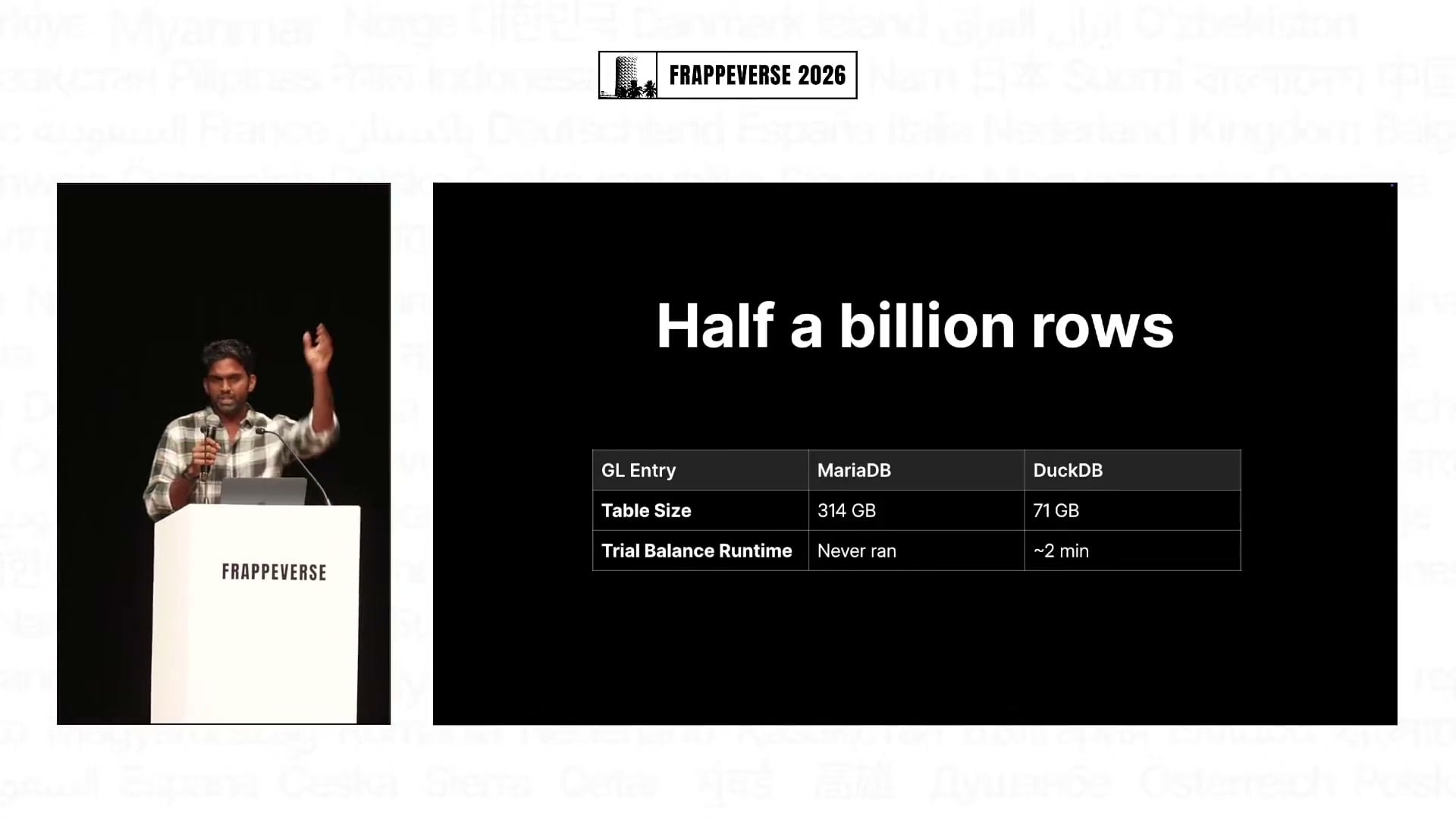
Frappe Framework is also getting first-class DuckDB support. MariaDB remains the transactional database, while Frappe synchronizes data into DuckDB for analytical workloads.
One customer was adding close to a million ledger entries per day and had accumulated roughly 600 million entries. With supported financial reports moved to DuckDB, its Trial Balance could run in about two minutes.
This is not a zero-cost switch for every report. Custom reports still need to be rewritten to query DuckDB, while Frappe has already made most standard Accounts reports DuckDB-aware. Framework handles the difficult part: keeping the analytical database synchronized with MariaDB.
Security changes in Framework and Frappe Cloud
Sabu Siyad, a security engineer at Frappe, described changes across the application layer, Frappe Cloud infrastructure and the development process.
Almost 10 percent of the security reports Frappe received over the previous two years involved SQL injection. The team has removed a risky raw-SQL interface and moved the relevant work to Query Builder, which requires parameterized inputs. It has also reduced the globals available to server-side templates and continues to fix template-injection issues.
At the infrastructure layer, Frappe Cloud is placing servers behind a private network rather than exposing them directly to the internet. Firewall controls can block specific routes, parameters and IP addresses. Core products receive quarterly security audits.
The longer-term change is procedural. Pull requests are reviewed regardless of whether their code was written by a person or an LLM, baseline quality rules are enforced before merging, and dedicated engineers now cover security work across Framework and ERPNext. The goal is to remove common routes to vulnerabilities, not only patch each report after it arrives.
ERPNext adds depth to accounting, stock and quality
Dipen Gala, ERPNext's product manager, presented a dense set of business features alongside the UX and platform work.
Budgets can span multiple financial years, be revised without cancelling the original, and be maintained for individual accounts. Distribution can be quarterly, half-yearly or yearly. Profit and Loss and Balance Sheet reports can also be shown in columns by an accounting dimension, allowing branches to be compared side by side.
Sales Orders can generate partial pro forma invoices for the quantity or value being delivered next. Companies can block new transactions for customers with overdue invoices while setting a tolerance for negligible amounts.
ERPNext is also adding provisional accounting for stock delivered but not billed. When a Delivery Note falls in one period and its Sales Invoice in another, the intermediate account keeps cost and income recognition aligned. Standard-cost valuation becomes a fourth inventory valuation method for make-to-stock manufacturing, and one manufacturing flow can produce multiple finished goods, co-products, by-products and scrap with percentage-based cost allocation.
The redesigned quality workflow supports two operating models. Companies that need to book a purchase immediately can receive goods into a quarantine warehouse and inspect them before moving them to storage. Companies that inspect first can use a Goods Inward Note, which records the arrival without creating a stock or accounting impact. The planned flow also covers unit-level checks, scheduled reinspection and quality inspection on more stock documents.
A stronger foundation for deeper changes
Nabin Hait, a Frappe co-founder and the company's vice president of products, closed with the work behind the release and the parts ERPNext still needs to rebuild.
Over the previous year, contributors closed almost 2,500 GitHub issues across ERPNext and Framework. The projects received more than 10,000 pull requests and roughly 14,000 commits from about 425 contributors. One month-long sprint paused feature work so the teams could focus entirely on bugs.
The next phase begins with code structure. Files longer than 3,000 lines and functions stretching into hundreds of lines are being split into smaller services. These changes are intended to be structural, with tests added before the refactoring to preserve behavior.
Pricing Rules are being redesigned as an opt-in Pricing Scheme. It can identify conflicting rules during setup, run scenarios before a transaction and explain which rule applied and why. Existing customers will keep the current system until they opt in, and a migration tool will help with data that cannot be converted safely without user decisions.
The most ambitious work is a prototype of a new stock engine written in Python. The proposed design separates the engine from the database, makes Stock Ledger Entries immutable, removes running balances from those entries and avoids reposting future records. A backdated transaction would produce adjustment entries instead of rewriting what came after it. Nabin was clear that this work is at the beginning, not a finished release.
That refactoring depends on stronger tests. ERPNext has reached roughly 87 percent test coverage and Frappe Framework about 77 percent. ERPNext's coverage rose by around eight percentage points, with more than 1,000 tests added in recent months.
The keynote made a credible case for optimism because it connected visible improvements with the less visible work required to sustain them. ERPNext is getting easier to navigate and configure, but Frappe is also addressing the query patterns, security boundaries, tests and data structures that determine how well those interfaces hold up in production.
Watch the Day 1 Track 1 livestream from the start of the Framework and ERPNext keynote